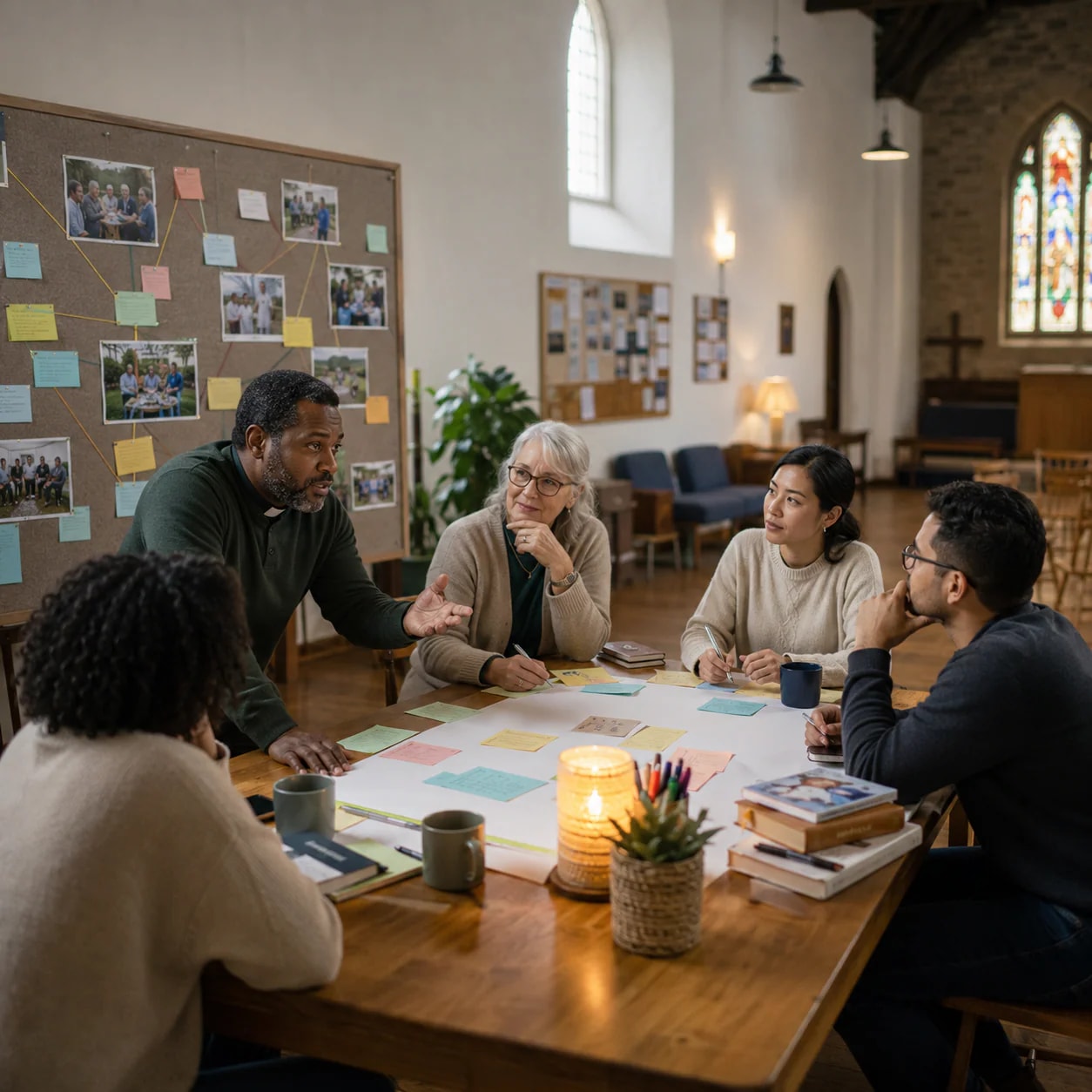
A participatory framework for involving affected communities, discerning shared priorities, navigating power differences, and turning a common direction into an accountable action plan.
What a Collective Vision Is—and What It Should Accomplish
A collective vision is a shared description of the future a group wants to work toward. Creating one is not simply a writing exercise or a vote on a slogan. It is a participatory process in which affected people, partners, beneficiaries, decision-makers, and other stakeholders help define the issue, identify priorities, and decide how progress should be understood.
Participatory approaches invite these groups to shape both the questions being asked and the measures used to assess results. Applied to visioning, that principle means participants are not merely consulted after leaders have chosen a direction. They take part in defining the direction itself.
A useful collective vision should connect three elements:
– The different perspectives of people affected by the issue. – A set of shared priorities that can guide decisions. – A path from long-term aspirations to coordinated, near-term action.
Community Planning Collaborative describes its own work as bringing stakeholders together through vision discussions, working groups, and shared strategy development, with immediate actions connected to longer-term priorities. This is a service provider’s description of its method, not independent proof that one format works in every setting. Groups should select and adapt a process according to their participants, resources, and context.
The finished statement matters, but the process matters too. A vision developed without relevant stakeholders, honest analysis, or a route to action may represent only the people who already hold influence. The objective is a documented direction that participants can use to make plans, assign responsibility, and review whether their actions remain aligned with their stated priorities.
Before the Meeting: Identify Who Must Be Included
Begin with a stakeholder map rather than an invitation list. Participatory evaluation involves project providers, partners, beneficiaries, and other stakeholders in choosing questions and deciding how results and impact will be measured. A collective visioning process can use the same broad categories to examine who needs a meaningful role.
List the groups that provide services or organize the work, those that formally authorize decisions, and those expected to carry out the plan. Then identify the people who experience the issue or will live with the consequences of the group’s decisions. Include partner organizations and other parties whose knowledge, resources, or responsibilities affect what can be done.
For each group, ask:
– How is this group affected by the issue or a possible response? – What knowledge, responsibilities, or resources does it bring? – Does it have decision-making power, and should that power be shared or clarified? – Is it being invited to shape the vision, or only to react to a proposal developed elsewhere? – Who may be missing because the organizers’ existing relationships do not reach them?
The central challenge is not merely producing a long list. Participatory processes must determine whether the relevant groups are actually represented. Revisit the map before the meeting and again after initial conversations reveal additional stakeholders.
Document what is still unknown. If organizers cannot yet determine who speaks for an affected group, they should not quietly treat the gap as resolved. Record the missing perspective and decide how the process will seek it. If complete participation is not possible, disclose that limitation when documenting the vision.
Participation also requires time and commitment from everyone involved and can consume significant resources. Build the process around what people can realistically sustain. The aim is not maximum attendance at one event; it is meaningful involvement in defining the issue, establishing priorities, and reviewing results.
Set Conditions for Fair and Meaningful Participation
Inviting people into the same room does not remove differences in authority. Participatory processes can be distorted when facilitators or evaluation teams hold more power than community members. Conflicting values, objectives, and interests can also make agreement difficult. These conditions should be named as part of the process rather than treated as unexpected disruptions.
Before substantive discussion begins, explain what participants can decide, what has already been decided, and who retains formal authority. Agree on how proposals will be recorded and how the group will respond when it cannot reach agreement. A clear decision rule helps participants understand whether the aim is consensus, a documented range of positions, or another defined outcome.
Facilitators can examine influence by tracking whose perspectives shape the discussion and whose do not. Ask whether affected participants have an opportunity to frame the problem in their own terms, whether organizational representatives are dominating the agenda, and whether dissent is being documented accurately. When a power difference cannot be removed, acknowledge it and record how it may have shaped the result.
Meaningful participation also requires a process that people can actually use. Ask invited groups what arrangements or participation formats they need and provide more than one route for contributing when resources allow. Do not assume that one meeting format represents everyone equally.
Prepare for conflict by distinguishing disagreement from failure. Participants may share a general concern while disagreeing about priorities, acceptable tradeoffs, or who should act. Record areas of agreement, unresolved differences, and the interests behind competing proposals. Do not label a position as a shared vision if material disagreement remains hidden.
Community Planning Collaborative says its approach uses stakeholder vision discussions, working groups, and shared strategy development. Those formats may offer separate spaces for detailed work, but the description comes from a service provider and does not independently establish effectiveness. Whatever format is chosen, its fairness should be judged by who participates, how influence is distributed, how disagreement is handled, and how decisions are documented.
A Faith-Grounded Discernment and Visioning Process
Faith communities can connect collective visioning with discernment by moving through a recurring sequence: identify the issue, describe and analyze it, reflect and evaluate, decide and plan, and act. The Salvation Army’s faith-based facilitation material presents these stages as a cycle, with action leading into another round of evaluation rather than ending the process.
1. Identify the event or issue. State what has brought the group together. Separate the issue itself from a preferred response so participants can help define the question before a plan is selected.
2. Describe and analyze. Gather the perspectives represented in the group and examine what is happening, who is affected, and what participants understand about causes and consequences. Record disagreements and gaps rather than forcing a single account before the group has completed its analysis.
3. Reflect and evaluate. Consider the issue in relation to the community’s shared faith commitments and values. Ask which parts of the analysis challenge the group, where its present practices align with its commitments, and where tension remains. Reflection should inform evaluation of the available choices rather than function as a substitute for practical analysis.
4. Decide and plan. Translate the emerging direction into specific commitments. The faith-based facilitation material advises groups to identify available resources, responsible people, timing, training or other support, safety safeguards, communication responsibility, and a time to review progress. A plan is incomplete if these operational questions remain unanswered.
5. Act. Carry out the agreed steps through the people and structures named in the plan. Preserve a record of decisions so participants can compare implementation with what was actually authorized.
6. Return to evaluation. After action begins, review what happened and begin the cycle again. The process may reveal new facts, missing stakeholders, unmet support needs, or a need to revise the plan. Returning to evaluation allows the collective vision to guide ongoing learning instead of becoming a fixed statement detached from events.
This sequence can provide a common structure for congregations and faith-based groups without prescribing what their theological reflection must conclude. Participants remain responsible for articulating their own values, interpreting their context, and deciding what action follows.
Facilitation Formats for Building Shared Direction
Collective visioning can use several formats rather than relying on a single large meeting. The available sources describe stakeholder vision discussions, working groups, design workshops, online meetings, and digital collaboration tools. These descriptions come from organizations offering planning or facilitation services; they show how those providers structure their work but do not independently demonstrate that the formats will be effective in every community.
A vision discussion can establish the central issue, surface participants’ aspirations, and identify questions requiring deeper work. A working group can concentrate on a defined part of the plan, provided its mandate and relationship to the wider group are clear. The Community Planning Collaborative says its process combines vision discussions and working groups with shared strategy development, linking near-term actions to long-term priorities.
A design workshop can organize focused collaboration around project vision, needs, or sustainability goals. Re:Vision describes using design workshops for public and private stakeholders, alongside online meetings and digital collaboration tools intended to support consensus. Because this is the provider’s own account of its services, groups should treat it as a menu of possible formats rather than evidence that a particular workshop produces consensus.
Online meetings and digital tools can provide another channel for discussion and documentation. Their use should still be examined through the same participation questions as an in-person meeting: which stakeholders are included, who can shape the agenda, how competing views are recorded, and how decisions move into the shared plan.
Groups can combine formats. A broad discussion might identify priorities, smaller groups might develop options, and a later session might review the proposed strategy. At each handoff, document who participated, what the group was authorized to decide, what remains unresolved, and how the wider body can respond. The format serves the collective process; it should not quietly determine whose contribution carries the most weight.
Turn the Vision into an Accountable Action Plan
A collective vision becomes actionable when participants can see who will do what, with which resources, on what schedule, and under what safeguards. The faith-based facilitation material identifies several elements to address during action planning: available resources, responsible people, timing, training or support, safety, communication responsibility, and a date for reviewing progress.
Use one documented plan to answer these questions:
– Priority: Which part of the collective vision does this action advance? – Action: What specific step has the group approved? – Resources: What people, funds, materials, relationships, or other resources are available? – Responsibility: Who owns the action, and who else must participate? – Timing: When will work begin, and when should the step be completed or reconsidered? – Training and support: What preparation or continuing assistance will responsible participants need? – Safety: What safeguards must be in place before or during implementation? – Communication: Who will update participants and other stakeholders, and what information will be shared? – Review: When will the group examine progress and decide whether to continue, revise, or stop?
Connect short-term steps to the long-term priorities in the vision. Community Planning Collaborative describes this linkage as part of its community vision and shared-strategy work. That provider description does not establish one universal planning formula, but the distinction between immediate action and longer-term direction is useful: each action can be tagged to the priority it is meant to advance.
Assign responsibility to a named person or defined role rather than to “the group” in general. At the same time, distinguish ownership from unilateral authority. A responsible person can coordinate implementation while remaining accountable to the collective decisions recorded in the plan.
Schedule the first review before the meeting closes. Waiting until a problem appears can leave evaluation without an owner or a date. The review should return to the original vision, the approved action, the assigned responsibilities, and any recorded uncertainties. This creates a visible connection between what the group hoped to accomplish and what it actually did.
Keep Immediate Decisions Aligned with Long-Term Values
Mission-driven organizations often have to respond to immediate pressures while trying to preserve a longer-term direction. A practitioner perspective published through a LinkedIn aggregation argues for organizing around a shared idea, maintaining a coherent narrative, and avoiding reactive choices that pull an organization away from its enduring values. This is an individual practitioner’s view, not an independently verified research conclusion.
Groups can turn that perspective into a review prompt for urgent decisions:
– Which part of our documented vision does this response serve? – Does the response conflict with any value or priority the group has already adopted? – Is the message consistent with the group’s shared direction, or is it an isolated reaction? – What is temporary about this decision, and when will it be reviewed?
An urgent response does not need to resolve the entire long-term strategy. It should, however, be explicit about its relationship to that strategy. Recording that relationship helps later reviewers distinguish a deliberate short-term adjustment from an unexamined shift in direction.
When circumstances require a change, document the change openly. State which assumption, priority, or condition has changed and bring the decision back into the group’s review process. A collective vision should orient decisions without preventing participants from learning and revising their plans.
Review Results, Evidence, and Gaps Together
Evaluation can remain participatory after action begins. Participatory evaluation involves providers, partners, beneficiaries, and other stakeholders in defining evaluation questions and deciding how outcomes and impact will be measured. Applied to a collective action plan, this means the people who helped establish the vision should also have a role in deciding what progress looks like.
Start by defining the desired outcome connected to each action. Then agree on the question the review needs to answer and what information the group will examine. Separate what is known from what is assumed, and record where evidence is missing.
The Community Guide describes a systematic review process that defines interventions and outcomes, searches for and screens evidence, evaluates study quality, analyzes data, develops recommendations, and communicates both conclusions and evidence gaps. A community group does not need to claim that its own review is a formal systematic review. It can still borrow the discipline of clearly defining the action and outcome, examining available evidence, considering its quality, and disclosing gaps.
During a progress review, ask:
– Did the approved action occur as planned? – What information is available about the intended outcome? – Who helped define and interpret the measures? – Which affected perspectives are represented in the review? – What evidence is absent, uncertain, or of limited quality? – What should the group continue, revise, investigate, or stop?
The faith-based facilitation sequence reinforces the cyclical character of this work: action leads back to assessment, reflection, and further planning. Treat the review as a return to collective discernment rather than as a final verdict delivered by a small evaluation team.
Document conclusions and gaps together. A record that states only the favorable findings can conceal uncertainty, while a record of gaps alone may not guide action. The group needs both: what the available information supports and what it cannot yet establish.
Common Pitfalls and Practical Safeguards
Several recurring risks can weaken a collective visioning process. Each should be addressed in the design of the process and revisited during review.
Missing stakeholders. Organizers may fail to include all relevant or affected groups. Use a stakeholder map, revisit it as new perspectives emerge, and document participation gaps that remain unresolved.
Conflicting values or objectives. Participatory processes may bring incompatible goals and interests into the same discussion. Establish decision rules, record both agreement and disagreement, and avoid presenting unresolved conflict as consensus.
Unequal influence. Facilitators, evaluators, organizational leaders, and community members may not enter the process with equal power. Clarify formal authority, examine whose framing dominates, and disclose power differences that may have shaped the outcome.
Resource demands. Meaningful participation requires time and commitment and may consume substantial resources. Define the scope of each meeting or working group, be explicit about what participants are being asked to contribute, and keep the plan proportionate to the resources the group has identified.
A vision without implementation. Discussion can end with broad aspirations but no path to action. Before closing the planning phase, identify resources, responsible people, timing, training or support needs, safety safeguards, communication ownership, and a progress-review date.
Action without renewed assessment. A group can implement its first plan and never examine what followed. Use the faith-based facilitation cycle to return from action to evaluation, reflection, and another round of planning.
These safeguards do not guarantee consensus or eliminate structural differences. They make important limitations and responsibilities visible, giving participants a clearer basis for deciding whether the documented vision genuinely reflects their work together.
Collective Vision Planning Checklist
Use this checklist to move from initial convening to an accountable first review.
– [ ] State the event or issue without assuming a predetermined solution. – [ ] Map affected groups, beneficiaries, partners, providers, decision-makers, and others with relevant responsibilities or knowledge. – [ ] Check which relevant perspectives are still missing and document unresolved participation gaps. – [ ] Explain what participants can decide and where formal authority remains. – [ ] Agree on decision rules and how disagreement will be recorded. – [ ] Describe and analyze the issue before choosing an action. – [ ] Reflect on the analysis in relation to the group’s shared faith commitments or community values. – [ ] Document the collective vision and its long-term priorities. – [ ] Choose specific actions linked to those priorities. – [ ] Identify the resources available for each action. – [ ] Assign a responsible person or defined role. – [ ] Set an implementation timeline. – [ ] Record required training or continuing support. – [ ] Identify necessary safety safeguards. – [ ] Assign responsibility for communications and progress updates. – [ ] Define outcomes and decide with stakeholders how progress will be assessed. – [ ] Record evidence gaps, unresolved conflicts, and other uncertainties. – [ ] Schedule the first progress review before ending the planning process. – [ ] After action, return to evaluation, reflection, decision-making, and further planning.
The immediate next step is to convene the identified participants, document the shared direction, assign responsibility for the first actions, and put the first review date on the group’s calendar.
Disclosures and limitations
– This article was drafted with AI assistance from the supplied Content Plan and Research Package and should receive human editorial review before publication. – The factual material is synthesized from the supplied sources, including participatory-evaluation background, faith-based facilitation guidance, a public-health evidence-review framework, service providers’ descriptions of their methods, and a practitioner perspective. Provider and practitioner claims are identified as such and should not be treated as independent evidence of effectiveness. – Some supplied sources did not provide publication dates. The participatory-evaluation background came from a Wikipedia summary and should be traced to its original references before relying on it for consequential decisions. – No products are recommended, and no affiliate relationship was supplied. If commercial links or recommendations are added later, any affiliate or financial relationship should be disclosed clearly.
Sources
– MBA V OBLASTI GLOBÁLNÍCH PODNIKOVÝCH SLUŽEB – absl — absl – Strategic Visioning in Nonprofits — linkedin.com – Participatory evaluation – Wikipedia — en.wikipedia.org – Community Engagement, VisioningCharrette + Process Facilitation | Re:Vision — Re:Vision – The Community Guide Methodology — thecommunityguide.org – Faith-Based Facilitation | Salvation Army International Headquarters — salvationarmy.org – Services — Community Planning Collaborative — Community Planning Collaborative – Participatory Science — Extension – Clients — Lounge Lizard – GitHub – mhxion/awesome-discord-communities: A curated list of awesome Discord communities for programmers — GitHub