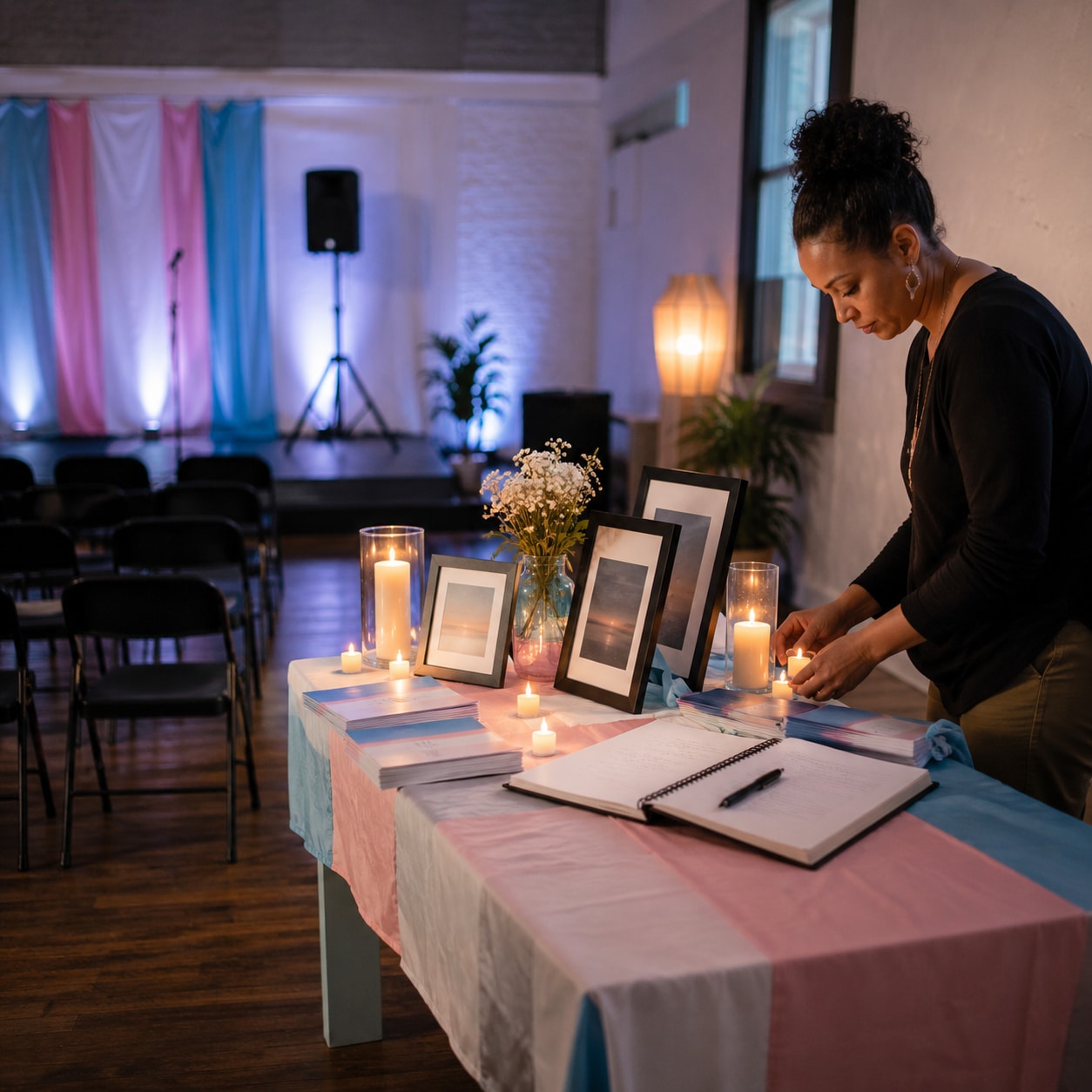
A practical guide to choosing a documented observance format, centering remembrance, supporting different participation modes, sharing educational materials, and clearly dating violence statistics.
What Transgender Day of Remembrance Commemorates
Transgender Day of Remembrance is observed annually on November 20 to remember transgender people killed in acts of anti-transgender violence. The observance began in 1999 following the murder of Rita Hester, with Gwendolyn Ann Smith helping to establish the first Transgender Day of Remembrance. The first observances took place in Boston and San Francisco in November of that year.
That history gives the day a specific memorial purpose. When planning an event, begin by making that purpose clear in the description, program, and choice of activities. The available sources document many forms of observance, but each is connected by remembrance rather than by a single required event structure.
Choose an Event Format That Fits the Memorial Purpose
Documented Transgender Day of Remembrance events take many forms. A gathering may include a reading of names, a candlelight vigil, a dedicated church service, a march, an art show, a food drive, a film screening, poetry, music, or a moment of silence. These formats can also be combined.
Choose among these documented options by considering the setting and the way each activity will serve the memorial purpose. A congregation might organize a dedicated service; an arts-centered community might incorporate poetry, music, or an exhibition; and another group might hold a vigil or march. A smaller gathering can still center remembrance through names, candles, or silence.
The supplied sources demonstrate this range but do not establish one format as universally preferable. They also do not provide a complete protocol for venue selection, safety, accessibility, facilitation, trauma-informed care, or worship planning. Organizers should therefore treat the examples as a menu of supported formats, not as comprehensive operational instructions, and seek current authoritative guidance for needs beyond the evidence presented here.
Build the Observance Around Remembrance
Reading the names of people who died during the preceding year is a common memorial practice. Candle lighting and moments of silence are also documented ways to mark loss. Together or separately, these elements can help keep the gathering focused on people rather than reducing their deaths to numerical totals.
When drafting the program, identify the part that will carry this memorial focus. It could be the reading of names, a period of silence, candle lighting, or a combination of those practices. Poetry, music, worship, art, or film may accompany the observance, but the program should still make its purpose unmistakable.
The sources support these memorial elements without prescribing an exact sequence, script, or duration. That leaves room for communities to select a structure appropriate to their setting while retaining the observance’s central commitment to remembrance.
Decide How People Can Participate
Participation does not have to be limited to one format. San Mateo County’s clearly dated 2025 observance combined an altar, a flag-raising, a reading of names, and a featured speaker. It also offered registration for a Zoom link, giving people a remote participation option alongside the physical event.
This example shows how a community institution can bring several memorial and public-program elements together while opening an additional path for attendance. It is an example rather than a universal template. Organizers can use it to frame planning questions: Will the gathering be in person, remote, or offer both options? Which memorial elements will be available through each mode? Which event details must be communicated so participants understand how to join?
The research package does not provide a complete technical or accessibility protocol for hybrid events. Any implementation details should be verified through current, authoritative resources before the event is announced.
Pair the Ceremony With Educational Resources
An observance can be accompanied by materials that support learning beyond the ceremony. For its 2025 event, San Mateo County published presentations, resource lists, allyship guides, and exercises intended for workplaces, schools, and communities.
That example suggests a useful distinction between the memorial gathering and the educational resources offered around it. The ceremony can remain centered on remembrance, while separate materials give participants opportunities to learn or continue discussion in other settings. Organizers might decide whether to share resources before the event, alongside the program, or as follow-up material.
San Mateo County’s approach is one documented institutional example, not a required model for every community. Organizers should review any materials they plan to distribute and confirm that the content, dates, and context remain appropriate and current.
Handle Violence Statistics With Care
Numerical claims about anti-transgender violence need explicit dates and attribution. NBC News reported that at least 22 transgender and gender-nonconforming people had been killed in the United States by November 20, 2019. The report said that most of the known victims were young Black women.
Those figures describe 2019. They should not be presented as a current count or used to characterize present conditions without newer evidence. If an event program, presentation, or resource includes statistics, label the period covered, name the source, and verify whether more recent authoritative information is available before publication.
A memorial practice such as reading names also should not be treated as interchangeable with an aggregate statistic. The supplied sources describe naming individuals, lighting candles, and observing silence as ways of keeping remembrance at the center.
Create a Source-Based Planning Checklist
Use this bounded checklist to draft the observance:
– State that Transgender Day of Remembrance is an annual November 20 memorial observance. – Keep remembrance central to the event’s description and program. – Select from documented formats such as a name reading, candlelight vigil, dedicated service, march, art program, food drive, film screening, poetry, music, or silence. – Decide whether a reading of names, candle lighting, a moment of silence, or a combination will provide the program’s principal memorial element. – Determine whether participation will be in person, remote, or available through both modes. – Decide whether presentations, resource lists, allyship guides, or exercises will accompany the ceremony. – Date and attribute every numerical claim about violence, and do not present the supplied 2019 figures as current. – Verify event details and any statistics with current authoritative sources before sharing them.
This checklist is intentionally limited to what the research package supports. The supplied sources do not provide a complete safety, facilitation, accessibility, trauma-informed-care, venue, technical, or worship-planning protocol. Those needs require additional authoritative guidance.
Disclosures and limitations
– This article was drafted with AI assistance from the supplied Research Package and approved Content Plan. – Factual claims are based only on the source records identified in each section and FAQ; no independent product testing, interviews, or firsthand experience are claimed. – No products or affiliate recommendations are included. Event details and time-sensitive statistics should be verified with current authoritative sources before publication.
Sources
– Transgender Day of Remembrance – Wikipedia — en.wikipedia.org – Transgender Day of Remembrance: At least 22 trans people killed in 2019 — NBC News – Trans Day of Remembrance — YouTube – EU Day for the Victims of the Global Climate Crisis – Building Resilience to Protect People and Communities — Climate Action – Transgender Day of Remembrance — County of San Mateo, CA – Transgender Day of Remembrance 2026 | Awareness Days — Awareness Days – Transgender Day of Remembrance: Honoring Lives, Fueling Change, and Holding Hope — Ryder Tombs – NASA Day of Remembrance – NASA — NASA – World Press Freedom Day 2025 — mzv.gov.cz – AtkinsRéalis submits Notice of Intent to U.S. Nuclear Regulatory Commission for CANDU® reactor licensing — AtkinsRéalis