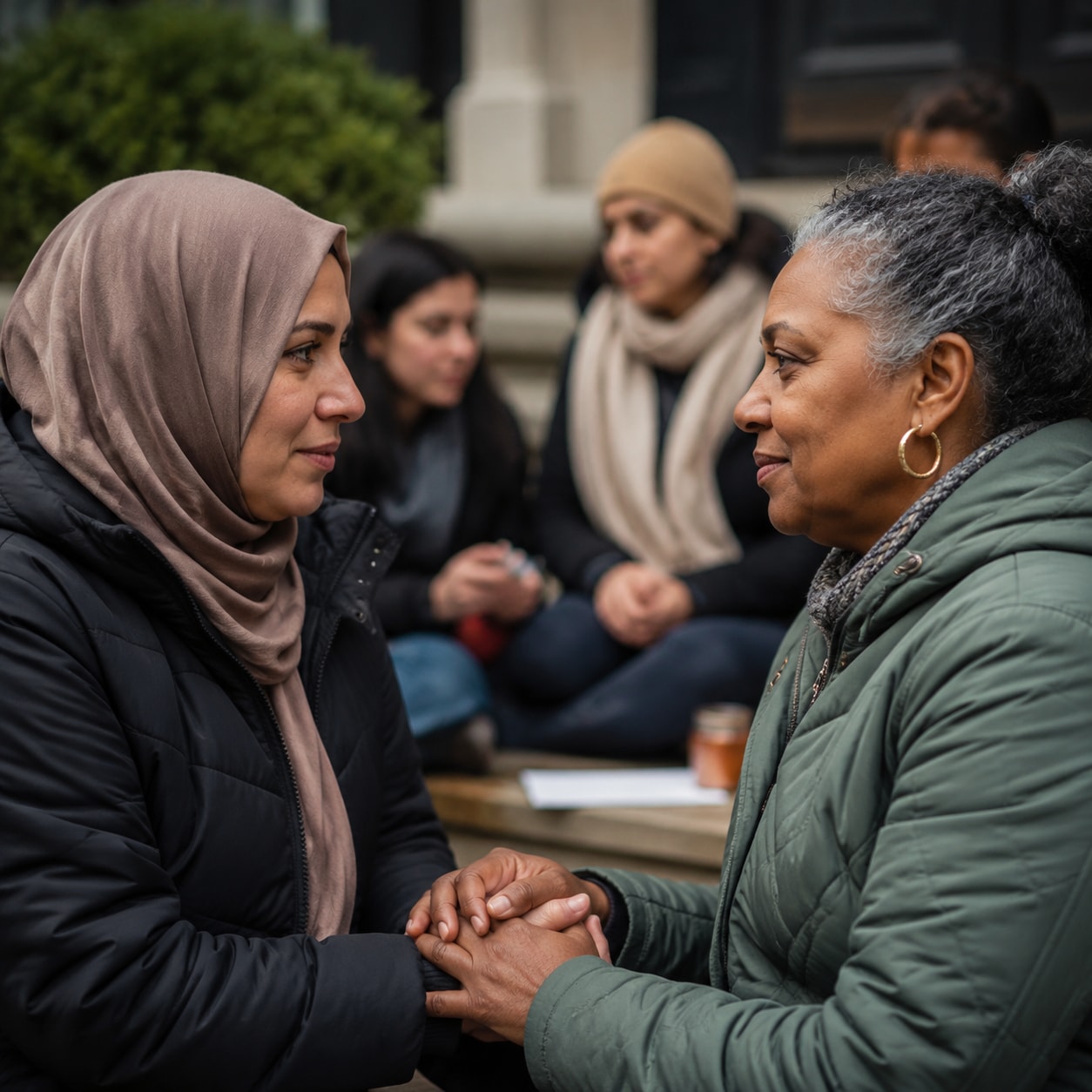
A practical framework for recognizing personal, community, and structural harm, responding in partnership with affected people, and turning immediate solidarity into sustained action.
What anti-Muslim bigotry can look like
Anti-Muslim bigotry is broader than an openly hateful remark or an isolated confrontation. A Canadian government guide describes Islamophobia as a range extending from prejudice and discrimination to racism and hate, occurring in workplaces, schools, public spaces, and institutional systems.
The Institute for Social Policy and Understanding (ISPU) offers another useful framework: personal, community-level, and structural forms. Personal harm can include harassment or violence. Community-level harm can include organized opposition to a mosque. Structural harm can appear in legislation or in bias within media and legal systems.
These forms may overlap. A hostile stereotype can influence interpersonal treatment, become a message around which a local campaign organizes, or help normalize an institutional practice. Recognizing that range prevents communities from treating every problem as a matter of individual attitude. It also helps identify whether the needed response is personal support, community organizing, institutional change, or a combination of all three.
Identify the level of harm before choosing a response
Begin by locating where the harm is happening and who has the power to change it.
Personal incidents: These involve conduct directed at or experienced by individuals, such as harassment, threats, or violence. The immediate concern is the affected person’s needs and the circumstances of the incident.
Organized community activity: This includes coordinated activity such as opposition to a mosque. It generally calls for a response beyond a private conversation because the activity involves a wider audience, organization, or local decision-making process.
Structural problems: These are embedded in policies or influential systems, including legislation, media, or legal institutions. They require attention to the rule, practice, or recurring pattern—not only the behavior of one person.
Ask four questions before acting: What happened? Who is affected? Which person or institution can change the conditions? Is this an isolated interaction, organized activity, or part of a continuing policy or pattern? The answers can reveal the appropriate scale of response. Education may address a harmful assumption, coalition work may confront an organized campaign, and policy advocacy may be necessary when the problem is institutional. Because categories can overlap, responses may need to operate at several levels.
Respond after a hateful incident
Center the people directly affected rather than beginning with an organization’s preferred public response. Listen to what they identify as necessary, discuss how supporters can help, and avoid assuming that a visible event, statement, or gathering is automatically the right intervention. ISPU’s guidance emphasizes working with affected communities, mobilizing support, building alliances, and organizing interfaith solidarity.
A response can combine an immediate act of support with a longer-term commitment. The immediate action might be coordinated solidarity shaped with affected people. The continuing work might focus on education, coalition building, or an institutional practice connected to the harm. This keeps the response from ending when public attention fades.
Context also matters. The OSCE Office for Democratic Institutions and Human Rights reports that anti-Muslim hate crimes and incidents can rise after terrorist attacks and around their anniversaries, with mosques and women wearing headscarves among reported targets. This international finding can inform awareness and preparation, but it should not be presented as current evidence of incidence in a particular US community.
Do not use the incident to generalize about Muslim communities or speak over those affected. Treat solidarity as a relationship: clarify what support is wanted, identify who will remain involved, and connect the immediate response to sustained work.
Replace stereotypes with sustained education
Anti-Muslim narratives may associate Muslims with terrorism or extremism, or portray diverse Muslim communities as one threatening group. A single corrective statement is unlikely to address all the settings in which such narratives circulate. Education should therefore be treated as continuing community work rather than a one-time reaction.
ING describes several formats for encouraging cross-cultural and interfaith understanding: educational resources, professional training, customized presentations, panel discussions, and opportunities for exchange among people from different backgrounds. These formats provide a useful menu, but the research package does not establish that any one format is universally effective.
Choose a format based on the setting and the problem. A facilitated discussion can examine assumptions that arise in conversation. Training may suit an organization reviewing recurring conduct. A panel or cross-background exchange can expose participants to perspectives that a single presentation cannot represent. Throughout the process, avoid asking one Muslim participant to represent all Muslims.
Education should also connect to action. Participants can identify which stereotypes are appearing in their setting, where those messages are being repeated, and whether organizational practices reinforce them. When a policy or institutional pattern is involved, learning is a starting point—not a substitute for changing the practice.
Build solidarity with Muslim communities
Solidarity moves beyond expressing opposition to bigotry. ISPU recommends learning about the issue, mobilizing support for American Muslims, working with affected communities, building coalitions, and organizing interfaith actions. The sequence matters: informed collaboration helps supporters avoid designing responses on behalf of people whose priorities they have not consulted.
Start by identifying Muslim people or organizations already connected to the issue. Ask what form of participation would be useful and what decisions should remain with those most affected. Partners can then distinguish between an immediate public response and longer-term shared work.
Coalitions can include individuals, congregations, educators, volunteers, and community organizations, but a larger list of participants is not itself evidence of accountability. Make the relationship concrete by agreeing on the concern being addressed, the contribution each partner can make, and how affected communities will remain involved in decisions.
Interfaith and cross-background spaces can support this work. ING’s approach includes educational programming, training, discussions, and exchange across different communities. Such activities can create opportunities for learning and connection, while coalition work carries that connection into coordinated action.
A useful test is whether the work would continue after the immediate incident passes. If not, choose one sustained commitment—education, coalition participation, or institutional advocacy—and assign responsibility for maintaining it.
Create safer and more inclusive faith spaces
Faith communities can apply the broad principle that religious spaces should be safe, supportive, and inclusive. The Tyler Clementi Foundation source in this research package discusses that principle in the context of anti-LGBTQ bullying, not as evidence about anti-Muslim incidents. Its general organizational lesson can still prompt useful reflection when combined with ISPU’s recommendations on learning, collaboration, coalition building, and interfaith solidarity.
Move from a general statement of welcome to an organizational review. Consider where exclusion or bullying could arise in gatherings, education, leadership communication, or relationships with neighboring communities. Identify who is responsible for receiving concerns and who has authority to change an organizational practice. Include Muslim partners when decisions concern anti-Muslim bigotry rather than presuming what inclusion should look like.
A congregation can also examine whether its outward solidarity is reflected internally. Educational programming may help members recognize stereotypes; interfaith collaboration may strengthen relationships; and a review of institutional practices may reveal issues that goodwill alone cannot resolve.
The purpose is not to claim that every faith community has documented anti-Muslim incidents. It is to translate broad commitments to safety and inclusion into responsibilities, relationships, and practices that can be reviewed over time.
Address policies and institutional practices
Interpersonal education is insufficient when the problem is built into an organization or public system. ISPU’s framework includes institutionalized legislation and bias in media and legal systems, while the Canadian government guide notes that Islamophobia may occur within institutional systems as well as workplaces, schools, and public spaces.
Look for the mechanism that reproduces the harm. Is there a written policy, a recurring organizational practice, a decision-making process, or a pattern in public communication? Identifying the mechanism helps define an appropriate goal. A structural response focuses on changing the relevant rule or practice instead of treating each outcome as an unrelated personal incident.
This work can coexist with education and solidarity. Learning can help participants recognize the problem; affected communities can help define priorities; coalitions can organize support; and institutional advocacy can pursue the necessary change. None of these roles should erase the leadership or perspective of those affected.
Keep claims proportional to the available evidence. The research package establishes that anti-Muslim bigotry can operate structurally, but it does not provide current US prevalence figures or prove that a particular institution has discriminatory practices. Local conclusions require appropriate local evidence.
Find support while checking jurisdiction and scope
A resource may be credible yet still fall outside the geography or type of problem involved. Check both jurisdiction and subject matter before treating any directory or government page as a complete path to assistance.
In the United States, the Department of Justice’s Immigrant and Employee Rights Section says it receives and investigates certain employment practices under the Immigration and Nationality Act’s anti-discrimination provision. These include, under specified conditions, discrimination based on citizenship status or national origin, unfair documentary practices, and retaliation or intimidation. That page addresses a defined part of employment law; it is not a comprehensive guide to every form of anti-Muslim discrimination, and the cited material is not legally binding.
The European Union Agency for Fundamental Rights maintains a database of anti-Muslim hatred resources organized by European country. It includes cases and rulings, research and data, and victim-support materials, with filters covering subjects such as discrimination, hate crime, hate speech, religion, and online activity. It may assist comparative research or help readers locate European materials, but it is not a substitute for US reporting channels or local legal guidance.
Before relying on a resource, verify the country or locality covered, the conduct it addresses, who may use it, and whether it offers information, victim support, investigation, or another service.
Turn concern into an accountable action plan
Choose one immediate step and one long-term commitment. Develop both with Muslim people or organizations affected by the issue rather than acting on their behalf without consultation.
For the immediate step, name the harm, the affected community, the form of solidarity requested, and the person responsible for follow-through. For the long-term commitment, select a continuing path such as education, coalition participation, interfaith collaboration, or institutional advocacy. Identify the partners involved and set a point to review whether the work still reflects their priorities.
ISPU’s recommendations connect learning with mobilization, collaboration, coalition building, and interfaith action. ING’s programming illustrates possible formats for education and cross-background exchange. Together, these sources support an approach that links understanding to sustained relationships and coordinated work.
Accountability is not measured only by the visibility of a response. It also depends on whether affected communities participate in decisions, whether responsibility is assigned, and whether the commitment continues beyond the immediate moment.
Disclosures and limitations
– This article was prepared with AI assistance from the supplied Content Plan and Research Package and should receive human editorial review before publication. – Material claims are attributed through source IDs supplied in the Research Package. Several sources did not include publication dates, and international materials provide conceptual or comparative context rather than current US incidence data or comprehensive US legal guidance. – No commercial products are recommended, and no affiliate links or affiliate relationships are represented in this article.
Sources
– Portal:Law – Wikipedia — en.wikipedia.org – Resources for Faith Communities • Tyler Clementi Foundation — Tyler Clementi Foundation – Global Participant Directory – World Movement for Democracy — World Movement for Democracy – Anti-Muslim Hatred database — Anti-Muslim Hatred database – The Canadian Guide to Understanding and Combatting Islamophobia: For a more inclusive Canada – Canada.ca — canada.ca – Types Of Discrimination — justice.gov – Anti-Muslim hate crime | HCRW — hatecrime.osce.org – Friday Video Tsunami… It’s All About Israel, Iran and Trump — sonar21.com – Countering and Dismantling Islamophobia – Institute for Social Policy and Understanding — Institute for Social Policy and Understanding – Intercultural Networks Group (ING): Fostering Peace and Unity — ING