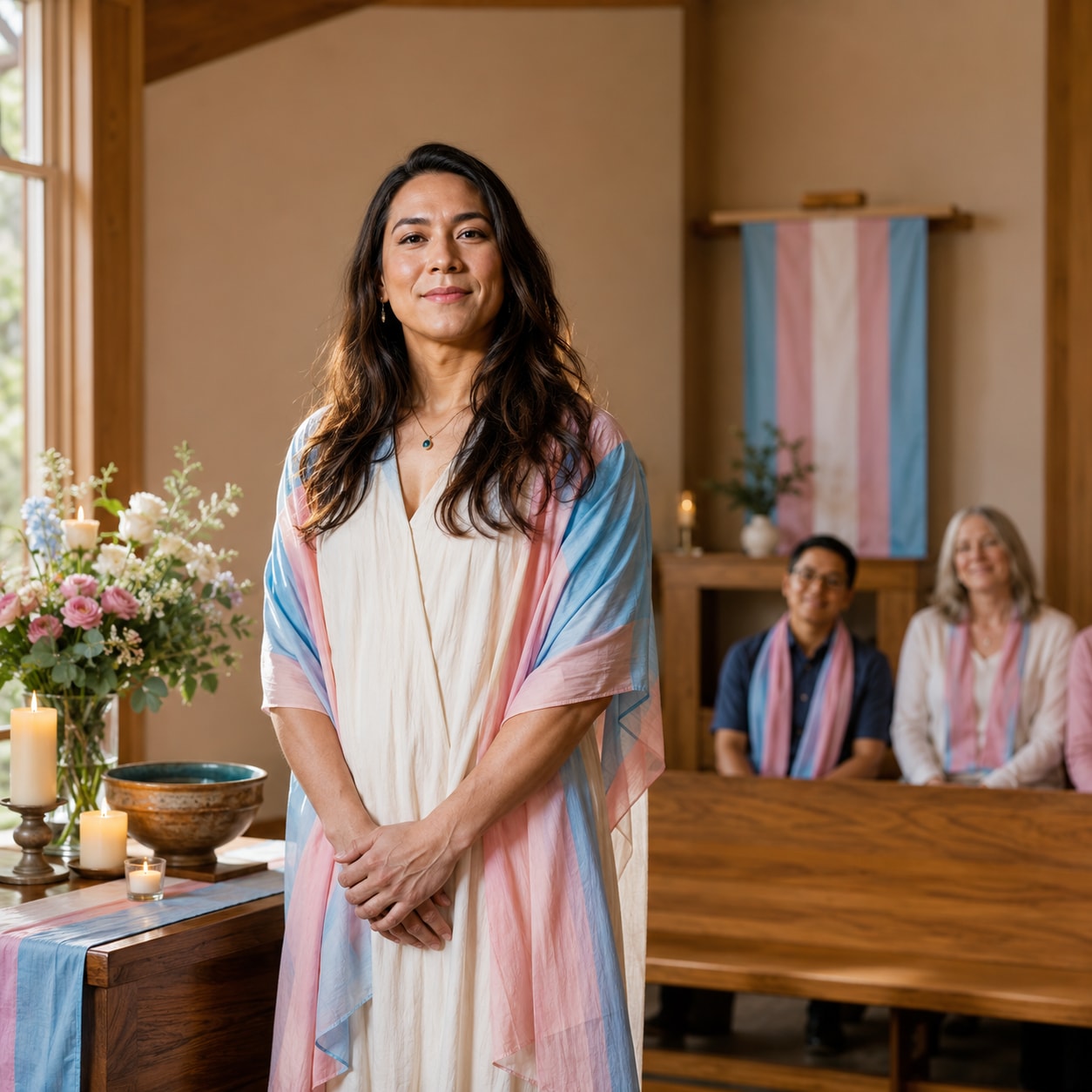
A consent-centered framework for faith communities considering a ceremony of welcome and recognition, with clear boundaries between sourced principles and suggested planning ideas.
Why affirmation matters in faith communities
For some transgender people, participation in a faith community can involve tension between identity and religious belonging. Affirmation, an organization serving LGBTQIA+ people connected with the Latter-day Saint tradition, says misunderstanding and insufficient education can lead to inconsistent treatment of transgender people and their families. The organization seeks to create a community in which transgender, gender-nonconforming, and nonbinary people can be safe and fully express their authentic selves.
That perspective helps explain why a congregation might explore a visible expression of welcome. A ceremony could be one such expression, but it should not be treated as a universal need or an automatic solution. Affirmation speaks from a particular organizational and religious context; its account cannot represent every transgender person, family, congregation, or faith tradition.
The starting point, therefore, is not the ceremony itself. It is the community’s willingness to recognize the individual’s agency and address misunderstanding. Leaders should first ask whether the member wants any public or private recognition. If the answer is no, respecting that decision is itself essential to an affirming approach. If the answer is yes, the community can begin a collaborative conversation about what recognition would mean to that person.
What a celebratory ceremony can—and cannot—represent
The available general overview describes a ceremony as a special activity used for an important occasion and conducted according to certain traditions or rules. It notes that ceremonies often include music, speeches, or symbolic actions. These broad categories provide a vocabulary for imagining how a faith community might mark a meaningful moment.
Using a ceremony to affirm a transgender member is an editorial possibility derived from that general description—not a practice directly documented or evaluated by the supplied sources. A community might understand such a gathering as an expression of welcome, recognition, or shared commitment, but the evidence provided does not establish what the event should be called, how it should be structured, or what effects it will have.
A ceremony also cannot substitute for respectful conduct in everyday community life. Nor should organizers describe it as a medical intervention, a guaranteed source of well-being, or a verified remedy for discrimination. Its meaning must come from the person being recognized and the community’s stated purpose. Before planning, participants should agree on what the gathering is intended to communicate—and avoid promises that the available evidence cannot support.
Center the transgender member’s voice and choices
Affirmation says transgender voices are essential to its discussions about its own work and to efforts to correct misunderstandings about gender identity and expression. Applied to ceremony planning, this supports a simple principle: the transgender member should speak for themselves rather than being assigned a story, set of needs, or preferred form of recognition by others.
Organizers should not infer what someone wants from the fact that the person is transgender. The American College of Obstetricians and Gynecologists notes that not every transgender person experiences gender dysphoria and not everyone wants hormone therapy. Although that guidance concerns health care rather than ceremonies, it demonstrates why assumptions about a person’s experience or choices are inappropriate.
As editorial planning guidance, begin by asking whether any ceremony is desired. If it is, invite the member to decide or approve:
– The purpose and name of the gathering. – Whether it is private, invitation-only, or open to a wider community. – Who may participate, speak, take photographs, or share information afterward. – Which parts of the person’s identity or life, if any, may be discussed. – Whether music, remarks, readings, or symbolic actions feel meaningful. – How the plan can be changed or canceled.
Consent should be treated as ongoing within the planning process. A previous expression of interest need not be interpreted as approval of every later detail. These points are suggested applications of the sourced emphasis on transgender voices; the sources do not identify them as tested ceremony standards.
Use respectful, inclusive language
The American College of Obstetricians and Gynecologists advises health-care teams to learn appropriate terminology and understand transgender patients’ health needs. Its guidance is directed toward clinical care, not religious ceremonies, but its emphasis on informed and inclusive language is relevant background for communities seeking to avoid disrespectful assumptions.
For a ceremony, organizers can translate that principle into a direct conversation with the person being celebrated. As editorial guidance, ask the person to approve the name, pronouns, identity terms, introductions, printed wording, and spoken language that will be used. Do not assume that terminology preferred by one transgender person will be preferred by another.
Privacy deserves a separate conversation. A person may approve particular language among invited participants without approving its use in public announcements, recordings, photographs, livestreams, newsletters, or later retellings. Organizers should clarify those boundaries before preparing materials or inviting others. They can also give speakers the approved wording and ask them not to improvise personal history or disclose information beyond the agreed scope.
These ceremony-specific steps are planning suggestions rather than findings from validated ceremonial research. Their purpose is to help the community apply a sourced call for appropriate terminology while keeping authority over personal language and disclosure with the individual.
Possible ceremony elements to discuss together
The general ceremony overview identifies music, speeches, and symbolic actions as common elements of ceremonies. Those categories can serve as optional conversation prompts, not as a prescribed script.
Music: Ask whether music is wanted and, if so, who should select or perform it. The person being celebrated may prefer a congregational song, instrumental music, another selection, or no music. The sources do not identify any selection as especially appropriate for transgender affirmation.
Remarks or readings: The member might choose to speak, invite others to offer brief remarks, approve a reading, or decline all spoken contributions. Because Affirmation emphasizes the importance of transgender people’s own voices, organizers should avoid creating a narrative about the person without their direction. No one should be expected to recount private experiences or educate attendees as the price of being recognized.
Symbolic actions: A community could discuss whether an agreed symbolic action would express the intended meaning of the gathering. The action and its interpretation should be chosen with the member rather than presented as an established transgender ritual. The supplied materials provide no verified examples or evidence that a particular symbol produces a beneficial outcome.
Participation: Discuss whether family, friends, allies, faith leaders, or other community members should have roles. Inclusion should follow the member’s preferences and privacy boundaries rather than an organizer’s assumption that a larger event is necessarily more affirming.
Format: The gathering could be considered within the community’s existing traditions or as a separate occasion, but the sources do not establish a preferred setting. Organizers should examine whether proposed traditions or rules support the person’s stated wishes.
All of these possibilities remain optional. They are editorial applications of a broad description of ceremonies combined with Affirmation’s emphasis on transgender voices—not sourced best practices, templates, or guarantees of impact.
Prepare the wider community without placing the burden on one person
Affirmation identifies a need for education, peer stories, and support resources for transgender people as well as their families, friends, and allies. It also describes misunderstanding and uneven treatment in its particular faith context. These observations suggest that affirmation requires community learning, not only a single event.
The person being celebrated should not have to become the congregation’s sole instructor. Leaders and organizers can seek trusted, community-specific educational resources before the gathering and establish expectations for respectful participation. Peer perspectives can be useful, but they should not be treated as interchangeable with the experience or wishes of the individual involved.
The American College of Obstetricians and Gynecologists reports that transgender people broadly encounter social and economic marginalization associated with health inequities and worse health outcomes. It recommends that medical teams learn appropriate language and transgender health needs. This clinical guidance does not establish how a congregation should run a ceremony, but it reinforces the importance of addressing knowledge gaps and bias rather than expecting transgender people to absorb their consequences.
As an editorial planning approach, organizers can separate two conversations: one in which the member directs the ceremony’s personal details, and another in which leaders take responsibility for general community education. The second conversation should stay within reliable resources and should not disclose the member’s private information. A ceremony may provide an occasion for the community to state its commitments, but the supplied evidence does not show that holding an event by itself changes behavior or eliminates inequity.
Limitations of the available evidence
The supplied sources offer relevant principles but limited direct evidence. Affirmation provides the perspective of a specific organization connected with LGBTQIA+ Latter-day Saints; it does not document a validated ceremony model or speak for every transgender person or faith community. The American College of Obstetricians and Gynecologists provides guidance about inclusive medical care and the effects of marginalization, not evidence about ceremonial practices.
The general ceremony overview explains that ceremonies may mark important occasions through music, speeches, or symbolic actions. It is a secondary educational source without a stated publication date in the research package, and it does not address transgender affirmation specifically.
Taken together, the materials do not supply tested scripts, participant feedback, comparisons among ceremony formats, or evidence of social or health outcomes. They also do not establish a trend, search volume, growth rate, or breaking-news event around this topic. Consequently, the planning ideas in this guide should be understood as consent-centered editorial suggestions. Communities should supplement them with trusted resources relevant to their own tradition and context before proceeding.
A consent-centered planning checklist
The following checklist is an editorial framework, not a set of validated best practices. It combines Affirmation’s emphasis on transgender voices with the general description of ceremonies as occasions that may involve traditions, music, speeches, or symbolic actions.
– Confirm the invitation: Ask whether the member wants a ceremony at all. Make declining a complete and respected option. – Define the purpose together: Agree on what the gathering will recognize and what it will not claim to accomplish. – Choose the participants: Let the member guide who is invited, who has a role, and who may speak. – Approve the language: Confirm names, pronouns, identity terms, titles, readings, introductions, and written materials. – Set privacy boundaries: Agree on what may be announced, photographed, recorded, streamed, published, or discussed afterward. – Discuss optional elements: Consider music, remarks, or symbolic actions only if the member finds them meaningful. – Review traditions and rules: Examine whether the proposed format supports the agreed purpose and the member’s choices. – Consider access needs: Ask participants what arrangements are needed rather than assuming; this is a planning suggestion not addressed by the supplied sources. – Prepare other participants: Give speakers and organizers the approved language and boundaries without requiring the member to teach the whole community. – Create revision points: Reconfirm the plan before materials are distributed and again before the gathering. Allow details to change or the event to be canceled.
The central question is not how elaborate the ceremony can be, but whether the form of recognition reflects the person’s own choices. Before proceeding, the community should add reliable resources suited to its tradition and local setting, since the supplied evidence does not provide a complete ceremonial model.
Disclosures and limitations
– This article was prepared with AI assistance from the supplied Research Package and approved Content Plan; no independent interviews, product testing, or personal experience informed it. – The article relies on materials attributed in the Research Package to Affirmation, the American College of Obstetricians and Gynecologists, and a general secondary overview of ceremonies. Their scope and limitations are described in the article. – Ceremony-specific checklists and applications are editorial suggestions, not verified best practices or evidence of social or health outcomes. – This article contains no product recommendations or affiliate links.
Sources
– Banning conversion therapy — GOV.UK – What is the Scientology naming ceremony? — Scientology News – Transgender rights in the United States – Wikipedia — en.wikipedia.org – Powertodecide.org Sitemap | Power to Decide — Power to Decide – Transgender – Affirmation: LGBTQ Mormons, Families & Friends — Affirmation: LGBTQ Mormons, Families & Friends – Licensed Spiritual Practitioners – Agape East — Agape East – Simply We are Here for Love – Overview by date – Frank Robben – computer scientist, lawyer, civil servant & lecturer — frankrobben.be – Ceremony Facts for Kids — kids.kiddle.co – Newlyweds from St Helens celebrate with thousands of Pitbull fans — bbc.com – Health Care for Transgender and Gender Diverse Individuals — acog.org