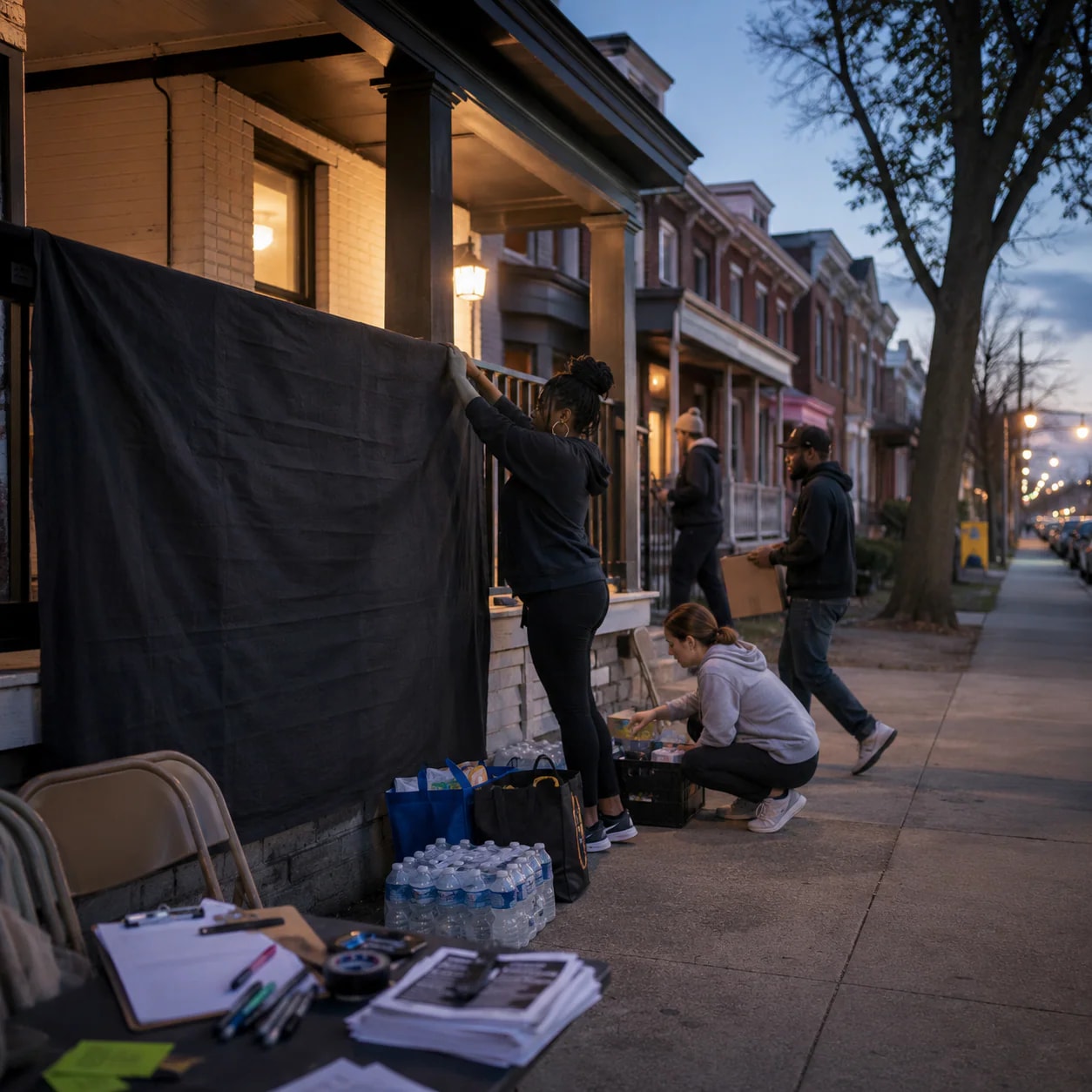
A Black Lives Matter banner can make a faith community’s values visible, but its deeper significance comes from the learning, dialogue, relationships, advocacy, and sustained commitments connected to it.
Why a Black Lives Matter Banner Is More Than a Visual Display
A Black Lives Matter banner is a public statement. Displayed on a house of worship or other community building, it tells neighbors, members, and visitors that racial justice is part of the community’s stated values. Its visibility can also open conversations about racism and what justice requires.
Visibility alone, however, does not show what a community is prepared to do. The meaning of a banner depends partly on whether people connect it to continuing education, difficult conversations, community relationships, advocacy, and other forms of participation. Without that follow-through, observers may reasonably wonder whether the display is only symbolic.
Resources from the Unitarian Universalist Association connect participation in Black Lives Matter with congregational banners as well as learning and worship materials. A dated example from First Parish in Concord similarly presented its banner as a way to encourage discussion of racism and action for racial justice both inside and beyond the congregation.
These examples suggest a practical way to understand the banner’s power: it can serve as an entrance rather than an endpoint. It makes a commitment visible and creates an opportunity for a community to ask what responsibilities should follow from the words it displays.
The Historical Context Behind the Words “Black Lives Matter”
The words on the banner belong to a history that began before they appeared on congregational buildings. In 2013, Alicia Garza, Patrisse Cullors, and Ayọ Tometi initiated the social media hashtag #BlackLivesMatter after George Zimmerman was acquitted. The phrase subsequently became associated with a decentralized political and social movement focused on racism, discrimination, and inequality experienced by Black people and on advancing antiracism.
Black Lives Matter received nationwide attention during demonstrations following the deaths of Michael Brown and Eric Garner in 2014. It gained broader international attention amid the global protests that followed the killing of George Floyd in 2020. This progression—from hashtag to protest slogan to a widely recognized social and cultural force—helps explain why the words carry significance beyond any single sign or institution.
That history also affects how a banner may be received. Some people will encounter it principally as an affirmation of Black dignity. Others may associate it with particular protests, organizations, or political debates. A community displaying the phrase should therefore be ready to discuss its historical context rather than assuming everyone understands it in the same way.
This is historical background, not a claim about a current news event, public-opinion trend, or the movement’s status in 2026. The supplied sources support the movement’s origins and major periods of attention, but they do not establish present-day search interest or breaking developments.
Slogan, Decentralized Movement, and Organizations: A Necessary Distinction
“Black Lives Matter” can refer to several related but nonidentical things: the #BlackLivesMatter hashtag, a public slogan, a broad social movement, or specific organizations using the name. Keeping those meanings distinct is essential for informed discussion.
The broader movement is decentralized. It includes people and groups who may share concern about racism and inequality without belonging to one organization or operating under a single authority. Consequently, the conduct or position of one person, chapter, or named organization cannot automatically be attributed to everyone who uses the slogan or participates in the wider movement.
This distinction matters when a faith community considers displaying a banner. Members may agree with the banner’s affirmation while holding different assumptions about what it signifies institutionally. A useful discussion can begin by asking which meaning the community intends: Is it affirming a moral statement, identifying with the broad movement, supporting a particular organization, or combining more than one of these positions?
Clear language does not eliminate disagreement, but it can make the disagreement more accurate. Instead of debating an undefined label, participants can examine the specific affirmation, relationships, and actions being proposed. Communities can also avoid treating decentralized participation as if it were controlled by a single organization or spokesperson.
Why Faith Communities Choose to Display the Banner
For a faith community, a banner can connect a moral commitment with a visible place. It communicates beyond sermons, meetings, or internal statements because people do not need to enter the building to see it. That public character can invite discussion among members while signaling a stated commitment to the surrounding community.
In June 2015, the Unitarian Universalist Association’s General Assembly passed an Action of Immediate Witness concerning Black Lives Matter. The association’s resource page subsequently directed congregations toward participation, a map of congregational banners, and materials for learning and worship. This institutional example links public display with formation and congregational practice rather than presenting the banner as a self-contained response.
First Parish in Concord offers a specific, dated congregational example. Its governing board voted in December 2015 to hang a Black Lives Matter banner on the front of the church. The congregation described the decision as an effort to encourage discussion of racism and action for racial justice inside and outside the congregation.
These sources describe the positions and practices of the UUA and First Parish; they do not establish that every Unitarian Universalist congregation—or every faith community—understands or uses a banner identically. Their value lies in showing how particular religious institutions connected a visible declaration with discussion, learning, worship, and action.
A Congregational Example: What Followed the Public Statement
The First Parish in Concord account helps illustrate what can come after a banner is raised. According to the congregation’s 2016 page, the December 2015 decision to display the banner was followed by continuing study of white supremacy, worship and community activities concerning race, and participation in criminal justice reform advocacy in Massachusetts.
The sequence is important. The public statement did not replace internal learning or outward engagement. Instead, the congregation connected its visible position to several kinds of practice: examining ideas within the community, incorporating racial issues into worship and community life, and joining advocacy directed toward a public-policy issue.
This example should be read within its limits. It reports the actions and framing of one congregation at a particular time. It does not demonstrate what every congregation did, establish the results of those activities, or provide a universal model that can simply be copied into another setting. Local histories, relationships, capacities, and policy contexts differ.
Even with those limits, the example offers a useful question for other communities: What will people be able to point to after the banner goes up? A credible answer may include scheduled learning, honest discussion, accountable relationships, worship or reflection, and a defined advocacy effort. The precise combination can vary, but the public statement gains substance when responsibilities, activities, and follow-through are visible alongside it.
When a Symbol Becomes Sustained Practice
A symbol becomes sustained practice when it is tied to work that continues after the moment of display. The supplied institutional examples identify several connected areas: education, difficult dialogue, worship or reflection, community engagement, advocacy, and material support. A community does not need to treat these as interchangeable; each answers a different part of the commitment it has made public.
Learning can build a shared foundation for discussing racism and racial justice. Difficult conversations can uncover disagreement, confusion, or resistance that a banner alone cannot resolve. Worship and reflection can connect public values with a congregation’s spiritual life. Community relationships can move the work beyond an institution speaking only to itself. Advocacy can direct concern toward specific systems or policies. Material support can help align resources with stated priorities.
Sustained practice also requires responsibility. Communities can identify who will organize the work, which resources will be used, how community partners will be approached, and when progress will be reviewed. These are practical safeguards against allowing initial attention to fade without follow-through.
The banner should not be asked to prove more than it can. It can communicate a position and create an opening, but it cannot by itself demonstrate learning, repair relationships, or change policy. The cited UUA resources and First Parish account show public display being connected with other forms of engagement. Their examples support a broader principle: the strength of a visible statement depends on the practices a community is willing to build around it.
Questions to Consider Before and After Raising a Banner
Before displaying a banner, a community can clarify what it is promising and how it will respond once that promise is public. The following questions provide a reflection framework grounded in the learning, dialogue, partnership, and advocacy pathways described in the cited congregational resources:
– What does “Black Lives Matter” mean in this community? Have participants distinguished the slogan and decentralized movement from particular organizations? – What shared learning is needed so that members can explain the banner’s historical and moral context accurately? – Where is disagreement likely to arise, and who will prepare spaces for difficult but substantive conversation? – Which existing community relationships should shape the work? How will the congregation listen without assuming that its public statement makes it accountable to every group in the same way? – Which worship, reflection, or educational resources will connect the statement to the community’s ongoing life? – Is there a defined advocacy priority, and does the community understand the policy context in which it will act? – Will financial or other material support accompany the statement, and how will those choices be made transparently? – Who is responsible for follow-through, and when will the community assess whether its actions still match its public words?
The questions remain relevant after the banner is installed. Periodic review can reveal whether learning has continued, conversations have widened, relationships have become more accountable, and advocacy commitments remain active. It can also help a community revise practices without treating the original display as proof that the work is complete.
From Visible Support to a Community Action Pathway
A practical pathway begins by defining the public statement clearly. Community members should understand that Black Lives Matter may describe a slogan, hashtag, decentralized movement, or particular organizations, and they should say which meanings inform their decision.
The next step is to connect the banner with a manageable set of commitments. A congregation might begin with shared learning and facilitated dialogue, then identify community relationships, an advocacy focus, and appropriate material support. Responsibility and review dates can help turn those intentions into continuing work. The UUA’s learning and worship resources and the historical First Parish example show several possible components, but neither represents every congregation or every participant in the broader movement.
A banner’s power is therefore both immediate and conditional. It immediately makes a value visible. Its lasting force depends on whether the community continues to learn, speak honestly, build relationships, devote resources, and act on the concerns it has named.
For a community considering a banner—or evaluating one already displayed—the central question is not simply whether the words are present. It is what learning, difficult conversations, community partnerships, advocacy, and material commitments now accompany them. Answering that question openly can turn visible support into a more accountable path of action.
Disclosures and limitations
– This article was prepared with AI assistance from the supplied Content Plan and Research Package. All factual claims are limited to the sources identified by the accompanying sourceIds; no independent browsing, interviews, product use, or firsthand testing was conducted. – Several sources support historical background or describe institutions’ own positions and practices. The First Parish account was published in 2016, another supplied feature dates to 2022, and several core materials have no stated publication date. They should not be treated as evidence of current 2026 conditions or as representative of every congregation or Black Lives Matter participant. – The supplied package includes a secondary compilation source for portions of the movement’s history. Its original citations were not provided in full, so this article does not extend those historical claims beyond the information in the package. – This article contains no product recommendations or affiliate links. No commission or commercial relationship influenced its content.
Sources
– Black Lives Matter – Wikipedia — en.wikipedia.org – Black Lives Matter and Ending ‘The New Jim Crow’ — UUA.org – About Our Black Lives Matter Banner | Unitarian Universalist Congregation of DeKalb — uufdekalb.org – Black Lives Matter — First Parish in Concord – Hnutí Black Lives Matter odsoudilo útok v Dallasu — www.denik.cz – BLACK LIVES MATTER | LinkedIn — linkedin.com – V době smrti Floyda byl slogan Black Lives Matter jasně identifikovatelným prohlášením, říká amerikanista — ct24.ceskatelevize.cz – Black Lives Matter — Locus – 10 Years Since Trayvon — New York Magazine – SoundPro | Pro Audio, Video & Lighting Gear Since 1972 — SoundPro