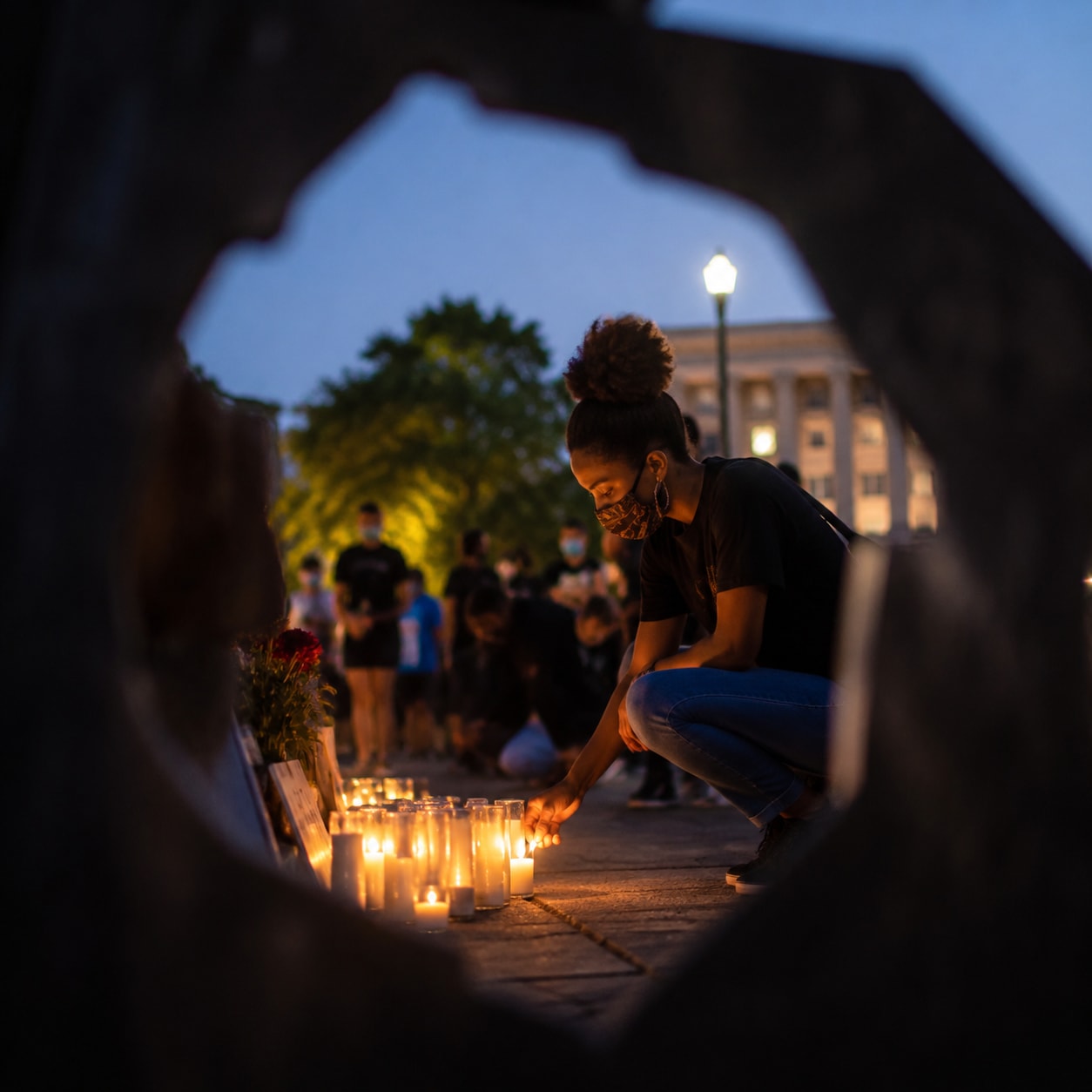
An evidence-backed introduction to the meanings and historical context of Black Lives Matter, with practical guidance for congregations and community groups seeking to turn public solidarity into sustained local action.
What “Black Lives Matter” Can Mean
Clear language is an essential starting point for constructive public witness. “Black Lives Matter” can refer to a hashtag, a slogan, a broad social movement, or a specific organization. These meanings are related, but they are not interchangeable.
The broader movement has been described as grassroots, decentralized, and without a single formal hierarchy. That structure matters when interpreting statements or actions associated with the name. The conduct of one organization, chapter, or participant should not automatically be presented as the position of everyone who uses the slogan or participates in the wider movement.
Before beginning a congregational discussion or issuing a public statement, identify which meaning is intended. A group might be affirming the moral claim expressed by the slogan, discussing the history of the hashtag, evaluating a particular organization, or considering participation in a locally organized action. Naming that scope can reduce confusion and help participants examine the same question rather than debating several different subjects at once.
Careful distinctions do not eliminate disagreement, but they make disagreement more precise. They also help communities avoid assigning responsibility too broadly or treating a decentralized movement as if it spoke through a single authority.
Historical Context and the Growth of a Public Message
According to Pew Research Center, the #BlackLivesMatter hashtag first appeared in July 2013 after George Zimmerman was acquitted in the shooting death of Trayvon Martin. Over time, the phrase became a prominent way to discuss racism, violence, and the criminal justice system in public forums.
Pew reported that the hashtag had appeared in more than 44 million tweets since its emergence. Its use rose sharply after George Floyd was killed in May 2020, reaching a peak of more than 1.2 million tweets in a single day. These figures illustrate the historical reach of the message and the intensity of online attention at particular moments.
They should not be treated as evidence of current social-media activity in 2026. The statistics were published in 2023 and describe an earlier period. Nor can tweet counts alone show what participants believed, how local communities responded, or whether online attention resulted in lasting institutional change.
For congregations and community groups, this history offers a useful distinction: a public message can rapidly focus attention, while sustained public witness requires decisions and relationships that continue after a peak moment has passed. Historical context can therefore inform present reflection without being mistaken for a measurement of current opinion or participation.
What 2023 Public-Opinion Research Shows—and Does Not Show
Pew Research Center’s 2023 survey found that 51% of U.S. adults supported Black Lives Matter: 22% said they strongly supported it, and 29% said they supported it to some extent. Pew also reported notable differences in support across racial, age, and partisan groups.
Views of the movement’s effectiveness were similarly divided. In the same research, 32% of U.S. adults said the movement had been extremely or very effective at bringing public attention to racism experienced by Black people. Another 35% described it as somewhat effective, while 30% said it had been not too effective or not at all effective.
These findings show that a congregation or community should not assume its members begin with a shared assessment. Some may strongly identify with the movement, some may affirm the underlying concern while questioning its methods or effectiveness, and others may oppose it. The reported differences among demographic and political groups also suggest that an apparently unified discussion may contain experiences and assumptions that have not yet been voiced.
The survey has clear limits. It describes responses gathered for Pew’s 2023 research; it does not establish public opinion in 2026. It also measures broad attitudes rather than the views of a particular congregation, neighborhood, or partner organization. Groups can use the findings to anticipate disagreement, but they should listen locally rather than treating national percentages as a substitute for local knowledge.
Public Witness as More Than a Statement
A statement of solidarity can make values visible, but public witness becomes more durable when an institution also examines its continuing practices. In a 2020 statement, The Public Domain Review described actions that included increasing Black and other BIPOC voices, adding historical context, and broadening editorial participation. Its example concerned a cultural institution, but it illustrates a wider pattern: public expression can be joined to internal review and ongoing responsibility.
For a congregation or community organization, that pattern may prompt questions rather than prescribe a single program. Whose perspectives are represented in teaching, leadership, events, and public communications? Where might historical context be missing? Who participates in decisions, and who is affected without having a meaningful role in them?
This kind of reflection helps distinguish a one-time response from an institutional commitment. A statement tells others what a group wishes to affirm. Continued review tests whether its choices, representation, and participation reflect that affirmation over time.
The cited example is one institution’s stated response, not proof that the same actions will fit every setting or produce a particular result. Each group must assess its mission, capacity, relationships, and local conditions. The transferable lesson is narrower: visible solidarity can be connected to specific practices that are revisited and made accountable.
Why Congregational Community Organizing Matters
The Unitarian Universalist Association describes congregational community organizing—also called faith-based, broad-based, or institution-based community organizing—as a grassroots approach that builds relationships across faith, class, racial, and ethnic lines. Its aims include strengthening connections and coordinating efforts for change at local, state, and national levels.
This approach gives public witness a relational structure. Instead of beginning only with what one congregation wants to announce, participants can learn which concerns are already being addressed locally, who is most affected, and which organizations possess relevant knowledge and experience. Cross-institutional relationships can also connect people whose backgrounds or priorities differ but who can identify a shared concern.
Organizing does not guarantee agreement. Its value lies in creating a way to develop relationships, identify issues, and coordinate action beyond a single event. For faith communities, this can connect moral commitments with participation in civic life while avoiding the assumption that one congregation should act alone or define a community’s needs on everyone else’s behalf.
The scale of action can vary. Some concerns are local, while others involve state or national decisions. The organizing model described by UUA accommodates those different levels, but a group still needs to determine where its relationships, knowledge, and capacity make responsible participation possible.
A Practical Path from Solidarity to Sustained Action
The following framework is practical guidance synthesized from sources about institutional reflection, justice leadership, partnerships, and congregational community organizing. It is not a claim that one pathway will suit every community.
1. Clarify the commitment. State what the group means by Black Lives Matter and which moral, civic, or institutional commitments it is prepared to examine. Separating the slogan, broad movement, and specific organizations can prevent later confusion.
2. Review institutional practice. Examine representation, historical framing, participation, and decision-making. The Public Domain Review’s 2020 statement offers one example of linking public solidarity to continuing changes in whose voices are included and how context is presented.
3. Identify learning needs. The United Church of Christ describes its Justice Leadership Program as helping individuals and congregations develop the knowledge, tools, and confidence needed for community justice action. A group can similarly identify what it does not yet understand and seek appropriate learning before claiming expertise.
4. Build local relationships. Congregational community organizing emphasizes multifaith, multiracial, and cross-class grassroots connections. Identify a community partner already engaged with the concern, listen to its understanding of local conditions, and discuss a form of participation that respects existing work.
5. Choose one bounded action. Select a step that fits the group’s mission and current capacity. Define the intended contribution, the person or team responsible, and the relevant partner. Avoid treating visibility by itself as evidence of impact.
6. Set a review date. Decide in advance when the group will examine what happened, what it learned, and whether the work should continue or change. Review representation and participation as well as task completion.
A workable starting point is modest and specific: gather a small group, name one local racial justice concern, identify one community partner, assign responsibility for one next step, and schedule a review. This turns a general aspiration into a commitment that can be examined and sustained.
Navigating Disagreement Within a Congregation or Community
Disagreement should be anticipated rather than treated as evidence that discussion has failed. Pew’s 2023 findings show divided assessments of both Black Lives Matter and its effectiveness, with substantial differences among racial, age, and partisan groups. Those national findings do not define any particular congregation, but they caution against assuming consensus.
Begin by defining the subject. Ask whether participants are discussing the slogan, the hashtag’s history, the decentralized movement, a named organization, or a specific local action. This prevents criticism of one entity from being silently applied to the entire movement and keeps support for a broad moral claim from being interpreted automatically as endorsement of every associated person or organization.
Next, identify the shared commitment that makes the conversation necessary. Participants may differ about terminology or tactics while still being able to discuss racism, public responsibility, historical understanding, or the congregation’s mission. Shared commitments should not be used to hide real differences; they provide a basis for deciding which differences require further learning and which decisions the group is actually prepared to make.
Finally, keep the immediate decision proportionate. A congregation does not have to settle every national debate before it can learn about one local concern or speak with one community partner. It should, however, be candid about unresolved questions and avoid presenting partial agreement as unanimous consent.
Questions for Discernment and a Concrete Next Step
Use these questions to connect public witness with mission, relationships, capacity, and accountability:
– What do we mean when we use the words “Black Lives Matter”? – Which part of our mission calls us to address racial justice publicly? – Whose voices are present in our leadership, learning, historical framing, and decisions? Whose are missing? – What knowledge, practical tools, or confidence do we need before acting? – Which local organizations or faith communities are already working on the concern? – What can we contribute without displacing existing community leadership? – Who will be responsible for the next step, and when will we review it? – How will affected people and community partners participate in that review?
Then make one time-bound commitment: convene a small group, clarify the shared commitment, identify one local racial justice concern and one potential community partner, and assign a person to initiate contact. Put a review date on the calendar at the same meeting. The purpose is not to declare the work complete, but to establish a responsible next action that can lead to learning, partnership, and continuing participation.
Disclosures and limitations
– This article was drafted with AI assistance and should receive human editorial review before publication. – The factual claims in this article were synthesized only from the supplied Research Package, including material attributed there to Pew Research Center, the Unitarian Universalist Association, the United Church of Christ, The Public Domain Review, and a secondary reference concerning the movement’s terminology and structure. – Pew figures cited here describe research published in 2023 and are not presented as measurements of public opinion or social-media activity in 2026. Some other supplied sources did not include confirmed update dates. – The explanation of Black Lives Matter’s terminology and decentralized structure relies on a secondary compilation source and should be checked against its original citations before formal publication. – No products are recommended, and no affiliate relationship or commercial compensation is represented in this article.
Sources
– DOMŮ – RADIO DIXIE — radiodixie.cz – Black Lives Matter – Wikipedia — en.wikipedia.org – Congregation-Based Community Organizing — UUA.org – Black Lives Matter — The Public Domain Review – Congregational and Community Engagement – United Church of Christ — United Church of Christ – 8 facts about Black Lives Matter — Pew Research Center – BLACK LIVES MATTER | LinkedIn — linkedin.com – If ‘Black Lives Matter’, do ‘Asian Lives Matter’ too? Impact trajectories of organisation activism on wellbeing of ethnic minority communities | University of Southampton — University of Southampton – United States racial unrest (2020–2023) – Wikipedia) — en.wikipedia.org – Black Lives Matter – Wikipedia — gpe.wikipedia.org