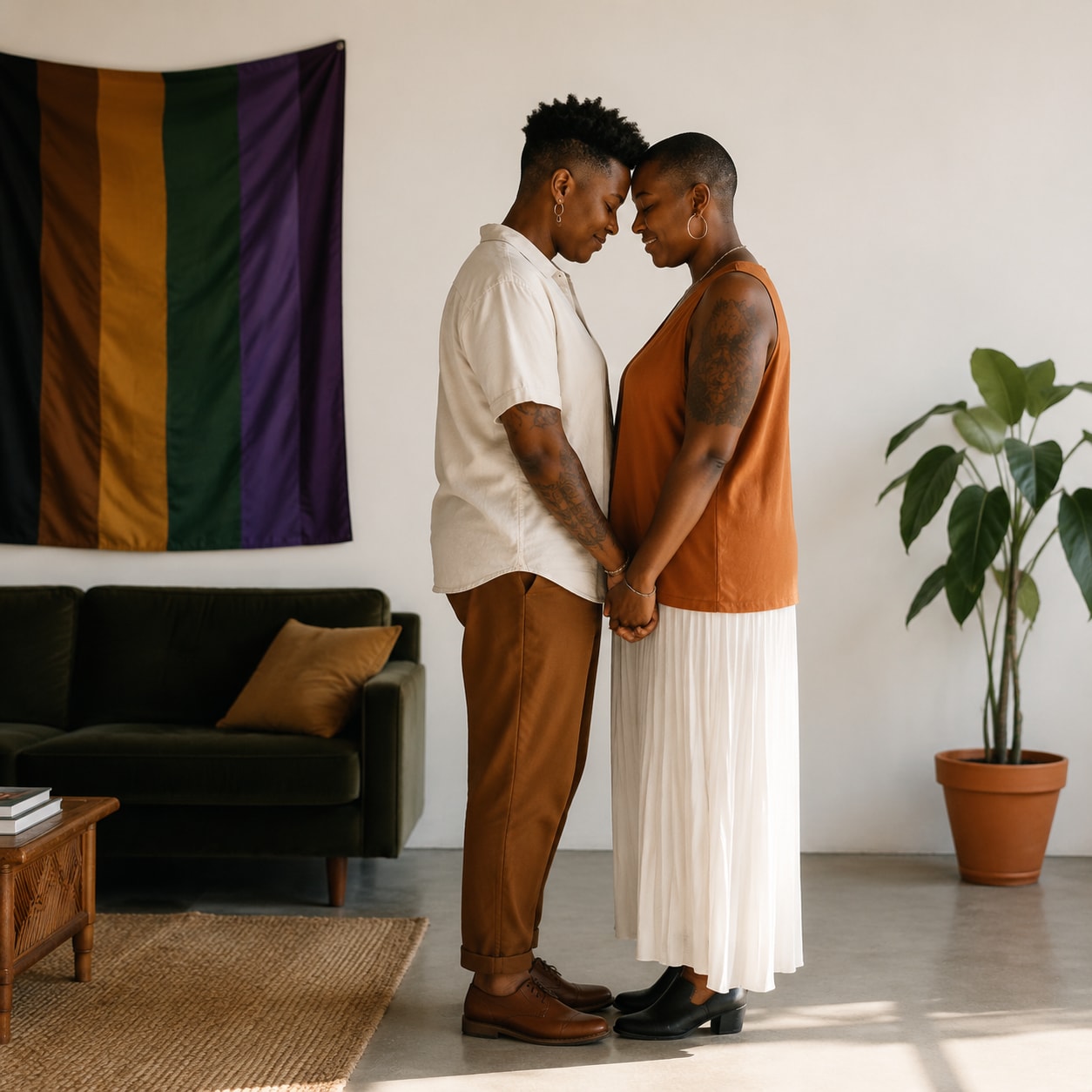
An evidence-conscious introduction to intersectionality, queer community spaces, and dignity-centered participation—with clear limits on what the available sources establish about Black queer life.
What “Black, Queer, and Standing on the Side of Love” Means
“Black, queer, and standing on the side of love” names a way of approaching identity and justice through human dignity. It asks us to consider how identities meet rather than treating race, gender, or queer identity as separate parts of a person’s life.
The relevant framework is intersectionality. An explainer from It Gets Better describes how intersecting identities can change the ways people experience racism and sexism. That framework can help communities recognize why a single-category view may overlook important differences.
The available research does not provide a comprehensive account of Black queer life, however. It offers conceptual background—not evidence about the experiences of every Black LGBTQ+ person or about conditions in 2026. This article therefore focuses on careful interpretation, reflection, and bounded guidance rather than speaking for Black queer people.
Intersectionality: Why a Single Identity Lens Is Not Enough
The term “intersectionality” was first used in a feminist context by civil-rights scholar and advocate Kimberlé Crenshaw, according to the It Gets Better explainer. The concept draws attention to the way multiple identities operate together.
The source illustrates this with Black women. Their experiences of racism may differ from those of Black men, while their experiences of sexism may differ from those of white women. Looking only at race or only at gender can therefore miss how those forces combine in a particular person’s circumstances.
This does not mean every person who shares an identity has the same experience. It means that analysis becomes less complete when it assumes one category can explain everything. For congregations, schools, and community organizations, an intersectional lens can prompt more precise questions: Whose circumstances are treated as typical? Whose needs disappear when a group discusses race without gender, or gender without race?
Intersectionality is thus a tool for noticing complexity. In this research package, it is supported as conceptual background, not as a complete description of any community’s present circumstances.
Applying an Intersectional Lens to Black and Queer Identity
Applied to Black and queer identity, an intersectional lens asks readers to consider race, gender, and queer identity together. It cautions against assuming that a general discussion of racial justice automatically accounts for queer identity, or that a general LGBTQ+ discussion necessarily captures how race may shape a person’s circumstances.
This application should remain appropriately limited. The source explains intersectionality and provides an example involving race and gender, but it does not document the full range of Black queer experiences. It also does not establish how those experiences may have changed by 2026.
A responsible use of the framework is therefore to ask better questions rather than announce universal answers. Community leaders might examine which identities their language assumes, whether a program treats one experience as representative of everyone, and whether people facing overlapping forms of exclusion have meaningful opportunities to describe their own needs. The framework supports attention to differences within communities; it does not authorize outsiders to define those differences on other people’s behalf.
Why Queer Community Spaces Matter for Belonging
The description of *A Place of Our Own* presents six kinds of spaces in a cultural history of queer women during the second half of the twentieth century: lesbian bars, softball fields, rural communes, sex-toy stores, vacation destinations, and feminist bookstores. Together, these examples show that community formation has not been confined to one kind of institution.
Such spaces could serve different functions: gathering, self-expression, identity formation, and connection with others. A sports field and a bookstore, for example, are materially different settings, yet each can provide an occasion for people to meet and form community. The range also suggests that belonging can be built through recreation, commerce, travel, shared living, or cultural exchange.
The evidence here requires an important qualification. The available source is a Google Play description of the book, not the book’s full text or an independent historical review. It supports the list of spaces and the description’s broad framing, but it should not be treated as independent verification of every historical interpretation the book may contain. It also does not establish how accessible these spaces were to Black queer people specifically.
The Tension Between Greater Inclusion and More Dispersed Community
The source describing *A Place of Our Own* observes that queer gathering spaces became more inclusive while also becoming more dispersed. These developments need not be opposites: a wider range of people and settings may expand possibilities for connection, even as the absence of a concentrated gathering place can make a close-knit center harder to find.
That tension raises practical questions about access and belonging. Who can locate and enter a community space? Does greater inclusion appear only in stated values, or is it reflected in participation? When gathering becomes dispersed across many places, how do newcomers find connection?
The source does not answer these questions for contemporary Black queer communities. It nevertheless supports a broader reflection: inclusion concerns both who is welcomed and whether people can find, reach, and meaningfully participate in places of belonging.
Dignity and Participation in a Current LGBTQ+ Rights Dispute
A BBC report describes a US Supreme Court ruling concerning state bans on transgender women participating in girls’ and women’s sports at schools and colleges. According to that report, the Court held that states may impose such bans.
The legal conclusions described by the BBC should be distinguished carefully. All nine justices agreed that the state bans at issue did not violate Title IX. The justices were divided, however, on whether the restrictions violated the Equal Protection Clause of the Fourteenth Amendment.
For transgender students affected by these policies, the dispute concerns the ability to participate on teams consistent with their gender identity. It also places questions of antidiscrimination, equal protection, and public participation in direct tension.
This report does not specifically address Black transgender students, so it cannot support conclusions about their particular experiences or the degree to which they are affected. Its relevance here is narrower: it demonstrates that LGBTQ+ equality and participation remain subjects of consequential legal disagreement, while also showing why distinct legal questions should not be collapsed into a single claim.
Questions for Congregations, Educators, and Community Groups
The sources suggest three connected areas for reflection: intersecting identities, access to community space, and dignity in participation. Groups can use these themes to examine their practices without presenting the limited research as a complete action framework.
Consider asking:
– When we discuss racial justice, do we make room for differences involving gender and queer identity? – When we discuss LGBTQ+ equality, do we assume one experience represents everyone? – Who can find, enter, and participate meaningfully in our gathering spaces? – Could a more dispersed community make connection difficult for newcomers or people with limited access? – Which participation policies affect a person’s ability to take part in community or institutional life? – How do we distinguish between listening to people and claiming to represent them? – What additional testimony and evidence would we need before drawing conclusions about Black queer people locally?
These questions are editorial prompts derived from the documented themes. They are not findings about a particular congregation, school, or Black queer community.
Ways to Act Without Speaking for Black Queer People
A dignity-centered response begins with recognizing the limits of secondhand material. The following actions are editorial guidance derived from the sources’ themes, not a sourced account of what all Black queer people want:
1. Listen directly. Create appropriate opportunities for people affected by decisions to describe their own experiences, while avoiding the expectation that one person should represent an entire community. 2. Review gathering spaces. Examine whether people can find, enter, and participate in community settings, and whether stated inclusion is matched by meaningful access. 3. Use more than one identity lens. When assessing a program or policy, consider whether focusing on only race, gender, or queer identity could conceal overlapping circumstances. 4. Examine participation policies. Track how institutional rules shape who may take part, and distinguish among the legal, practical, and dignity-related questions involved. 5. Keep learning within the evidence. Treat conceptual explainers, product descriptions, and news reports according to their actual scope. Seek direct, current evidence before making claims about a specific community.
A concrete next step is to identify one gathering space or participation policy in your community, ask whose circumstances may have been overlooked, and invite input without presuming the answer.
What the Available Sources Do—and Do Not—Establish
The sources support a limited introduction, not a comprehensive portrait of Black queer life.
The It Gets Better material supports the definition and illustrative use of intersectionality. Published in 2021, it provides older conceptual background and cannot establish conditions or trends in 2026. The description of *A Place of Our Own* supports the six named types of queer women’s spaces and the broad observation that spaces became more inclusive yet dispersed. Because it is a product description rather than the full book or an independent review, its evidentiary scope is narrow. The BBC report supports the stated account of the Supreme Court’s transgender-sports ruling and the distinction between the justices’ Title IX agreement and equal-protection division. It does not specifically address Black queer or Black transgender experiences.
Standing on the side of love here means holding dignity and evidence together: noticing intersecting identities, valuing belonging and participation, and refusing to turn limited sources into sweeping claims.
Disclosures and limitations
– This article was prepared with AI assistance from the supplied research package and content plan; factual claims were limited to the cited source IDs. – The source base is limited: it includes a 2021 conceptual explainer, a Google Play book description rather than the full book or an independent review, and a BBC report that does not specifically address Black queer or Black transgender experiences. – This article contains no product recommendations or disclosed affiliate links. The referenced book appears only because its supplied product description was part of the research package.
Sources
– DOMŮ – RADIO DIXIE — radiodixie.cz – Vyberte místo v oblasti Connecticut — foreca.cz – The Swamp — SMS.cz – Intersectionality — It Gets Better – US Conservatives organise ‘Nationwide Day of Protest against the unchecked and unwanted expansion of AI data centers’ – organisation pledges to give grassroots Americans “a voice in the critical debate over policies” — TechRadar – Wikipedia:Artificial intelligence resources – Wikipedia — en.wikipedia.org – – YouTube — youtube.com – US Supreme Court upholds bans on transgender athletes in female school and college sports — bbc.com – Powertodecide.org Sitemap | Power to Decide — Power to Decide – A Place of Our Own: Six Spaces That Shaped Queer Women’s Culture by June Thomas – Audiobooks on Google Play — play.google.com