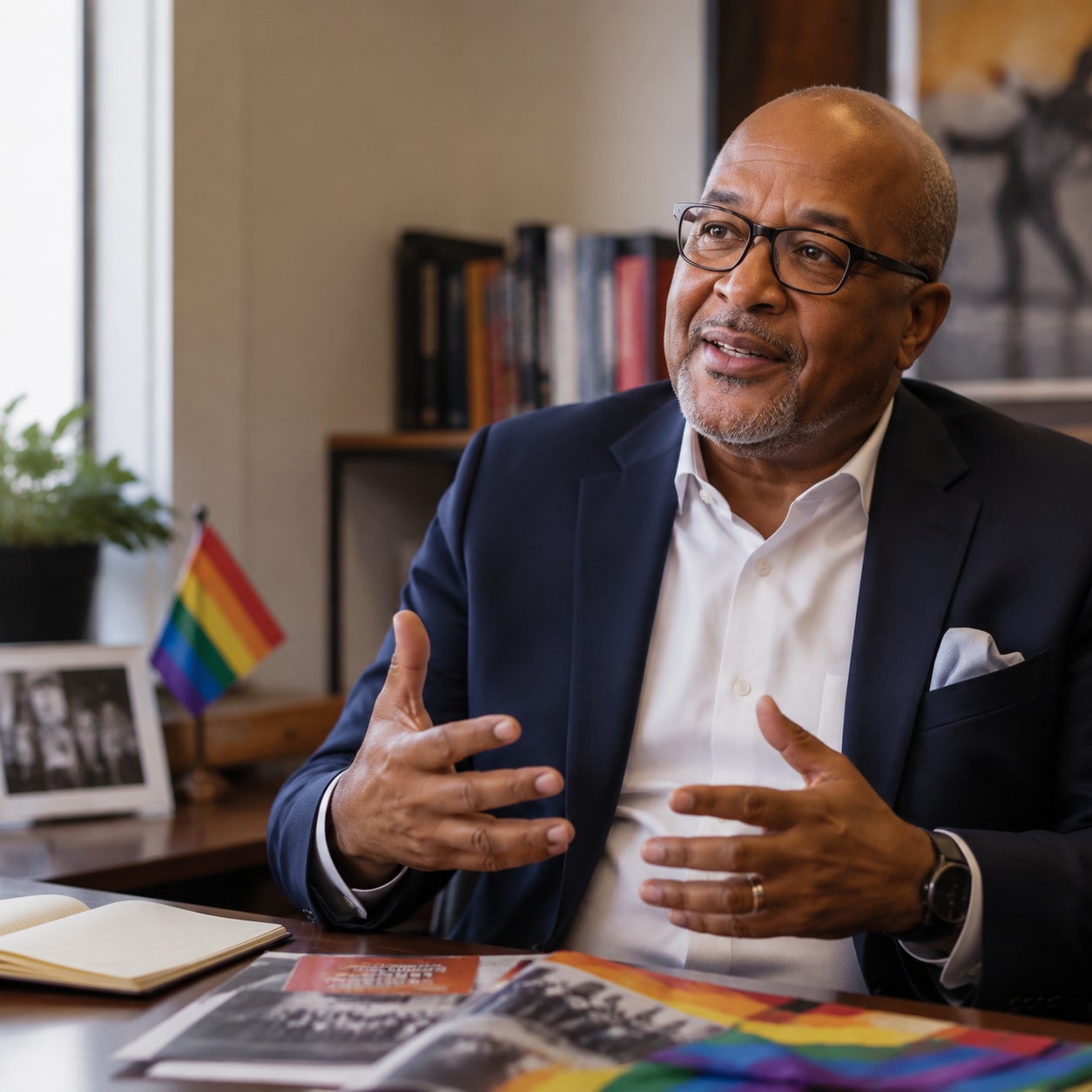
The available record documents Howard J. Bayless III’s public service, healthcare career, and LGBTQ+ organizational leadership—but it does not include an interview, direct quotations, current views, or verified updates after 2018.
What the available record can—and cannot—tell us
Despite the title’s invitation to conversation, the available material does not contain an interview with Howard J. Bayless III. It offers biographical details about his career, electoral history, and organizational leadership, but no direct quotations, personal reflections, or statements about current justice issues.
This distinction matters. Presenting a biographical summary as though it were Bayless’s own account would put words in his mouth and obscure the limits of the evidence. What follows is therefore a sourced profile: an introduction to the public record supplied for this article, accompanied by historical context about LGBTQ+ exclusion from government.
The record can support a discussion of representation and public leadership. It cannot reveal Bayless’s motivations, describe his private experiences, or establish his present-day views, residence, employment, or organizational affiliations. Those questions would require a verified interview or recent primary documentation.
Who is Howard J. Bayless III?
The biographical source reports that Howard J. Bayless III was born in 1965 and is an American healthcare professional and political figure from Birmingham, Alabama. It also describes a long connection to the healthcare sector, stating that he began working at Bradford Health Services in 1989.
According to the same source, Bayless and his husband, Peter Bonventre, moved to Indio, California, in 2018. It reports that Bayless subsequently served in a management role at Telecare Corporation. Because the supplied record does not provide authoritative updates beyond that period, these details should be understood as dated biographical information rather than a description of his current circumstances.
This documented combination of healthcare work, electoral service, and LGBTQ+ organizational leadership provides the basic framework for understanding Bayless’s public record. It does not, however, establish how he interprets those experiences today.
A landmark election to the Birmingham Board of Education
The supplied biographical source states that Bayless was elected to the Birmingham Board of Education on October 9, 2007. It identifies him as the first openly gay man elected to public office in Alabama.
The reported election result was decisive: Bayless received 4,059 votes, or 77.9 percent, while his opponent received 1,154 votes, or 22.1 percent. These figures document the outcome, but they do not by themselves explain voters’ motivations, the campaign’s central issues, or how Bayless understood the historical significance of his election.
The importance of the result lies in the reported milestone for openly gay political representation in the state. Public representation can make previously excluded identities visible within civic institutions, but a milestone should not be treated as a complete account of the person who achieved it. The available record establishes Bayless’s election and the vote totals; it does not provide his reflections on serving, an evaluation of his board record, or testimony from constituents.
Bayless did not seek reelection to the board in 2009. His term concluded in December of that year, according to the biographical source.
From school-board service to a City Council campaign
Rather than run for another term on the Birmingham Board of Education in 2009, Bayless sought a seat on the Birmingham City Council. The supplied source reports that he lost that race by 38 percent to 60 percent. His school-board tenure then ended in December 2009.
Those facts show a transition from one form of local public service to a campaign for another. They do not establish why Bayless chose to pursue the council seat, how he assessed the result, or what political and community factors shaped the race. Without campaign records, direct statements, or an interview, assigning a motive would be speculation.
A responsible reading therefore keeps the conclusion narrow: Bayless served on the education board following his 2007 election, chose a City Council campaign instead of board reelection in 2009, lost the council race by the reported margin, and completed his board term that December.
Leadership across LGBTQ+ equality organizations
The biographical record also reports that Bayless held leadership roles in Equality Alabama, the Equality Fund of Alabama, and the Equality Federation. Together, these entries place LGBTQ+ equality work alongside his healthcare career and elected service in the documented outline of his public life.
The source package does not provide enough detail to evaluate particular initiatives, dates of every role, organizational outcomes, or Bayless’s individual contribution to them. It would therefore be unsupported to attribute specific policy victories, campaign strategies, or present-day affiliations to him.
Even with those limits, the record shows that Bayless’s leadership was not confined to elected office. It extended across multiple organizations associated with LGBTQ+ equality. For congregations, educators, and community groups studying leadership, that record can prompt useful questions about how civic service and movement organizations relate to one another. Answers about Bayless’s own approach, however, would need to come from him or from stronger primary documentation.
Why LGBTQ+ public representation carries historical weight
LGBTQ+ representation in public life exists against a history of institutional exclusion. The supplied historical source describes the Lavender Scare, a period in the mid-20th century when gay people in the United States government were treated as national-security risks and dismissed on a large scale. According to that account, these practices normalized institutional homophobic persecution.
That history helps explain why openly LGBTQ+ participation in government can carry significance beyond an individual election. Government institutions once used policy and security claims to exclude gay people from public service. Later instances of openly gay electoral representation can therefore be considered within a much longer struggle over who is permitted to serve visibly in public institutions.
The historical context must also be handled carefully. It does not prove that Bayless personally experienced the Lavender Scare or equivalent treatment. It does not establish his interpretation of that history, and it cannot substitute for his testimony. The source is useful for understanding a broad institutional backdrop, not for filling gaps in one person’s biography.
Keeping those levels of evidence separate allows readers to recognize the weight of LGBTQ+ representation without turning a general history into an unsupported personal narrative.
Reading one leader’s record without turning it into a universal story
Bayless’s reported election, public service, healthcare work, and organizational leadership offer one documented example of openly gay participation in civic and institutional life. The Lavender Scare history supplies a broader contrast: gay people were once systematically treated as security risks within the federal government, while Bayless was later reported to have won elected office openly in Alabama.
Connecting these facts is an editorial interpretation, not evidence that Bayless’s life represents a single, universal LGBTQ+ experience. LGBTQ+ communities contain many identities, histories, regions, and approaches to leadership. One person’s record cannot stand in for all of them.
The most defensible lesson is therefore limited but meaningful. Historical exclusion gives context to the significance of visible representation, while Bayless’s documented record provides a specific case for discussion. Readers should resist converting that case into claims about his private experience or the experiences of LGBTQ+ people generally.
For faith communities and civic groups, the profile can serve as a starting point for discussing who has historically been excluded from public institutions, how representation changes, and what responsible storytelling requires when the available evidence is incomplete.
Questions that remain open
The supplied sources leave important questions unanswered. They do not reveal how Bayless reflects on his 2007 election, what he learned from service on the Birmingham Board of Education, why he pursued the 2009 City Council seat, or how he understands his work in LGBTQ+ equality organizations.
They also do not establish his current employment, residence, organizational relationships, or positions on present-day justice issues. The latest reported career and relocation details date to 2018, so treating them as current would go beyond the record.
These are appropriate subjects for a future verified interview or for research using recent primary sources. Until such material is available, they should remain questions rather than being answered through inference. Transparent uncertainty is essential when writing about a living person whose own voice is absent from the research package.
Source limitations and responsible next steps
This profile rests on a narrow source base. The biographical material comes from a secondary Wikipedia entry, and the research package warns that some of its citation links are no longer active. The Lavender Scare material also comes from a Wikipedia entry—in Czech—and supports only general historical context. Neither source provides an interview with Bayless or verifies his circumstances after 2018.
Before publication, key biographical and electoral claims should be checked against authoritative primary records where possible. Any description of Bayless’s current work, affiliations, location, or views should rely on recent primary documentation or a verified conversation with him.
Readers can use this evidence-limited profile to begin a discussion about LGBTQ+ representation in public life. Its boundaries should remain visible: the documented record offers a starting point, not a substitute for Bayless’s own voice or for more current research.
Disclosures and limitations
– This article was drafted with AI assistance from the supplied Content Plan and Research Package and should receive human editorial review before publication. – The article relies on two secondary Wikipedia-based sources: one for Bayless’s biography and one Czech-language entry for general Lavender Scare history. The research package warns that parts of the biographical entry rely on inactive citation links, so key claims should be verified against authoritative primary records. – No interview with Howard J. Bayless III was supplied. The article does not attribute direct quotations, personal reflections, current views, or verified post-2018 circumstances to him. – This article contains no product recommendations or disclosed affiliate links. If commercial links are added later, any affiliate relationship or compensation risk should be clearly disclosed.
Sources
– Howard Bayless – Wikipedia — en.wikipedia.org – 2. Zdroje k příspěvkům PNPM — Google Docs – #babcockinternational | John Howie MBE | 164 comments — LinkedIn – TV program: 20. 12. 2021 — Česká televize — Česká televize – Lynn Gunn From PVRIS Talks Album 3, Touring & Supporting LGBTQ Causes – YouTube — youtube.com – ACPA Resolutions | ACPA — ACPA | College Student Educators International – JLA : World War III – Grant Morrison, J. M. Dematteis, Howard Porter, Mark Pajarillo — knihobot.cz – New York – Wikipedie — cs.wikipedia.org – Levandulová panika – Wikipedie — cs.wikipedia.org – Imperial Dade | LinkedIn — linkedin.com