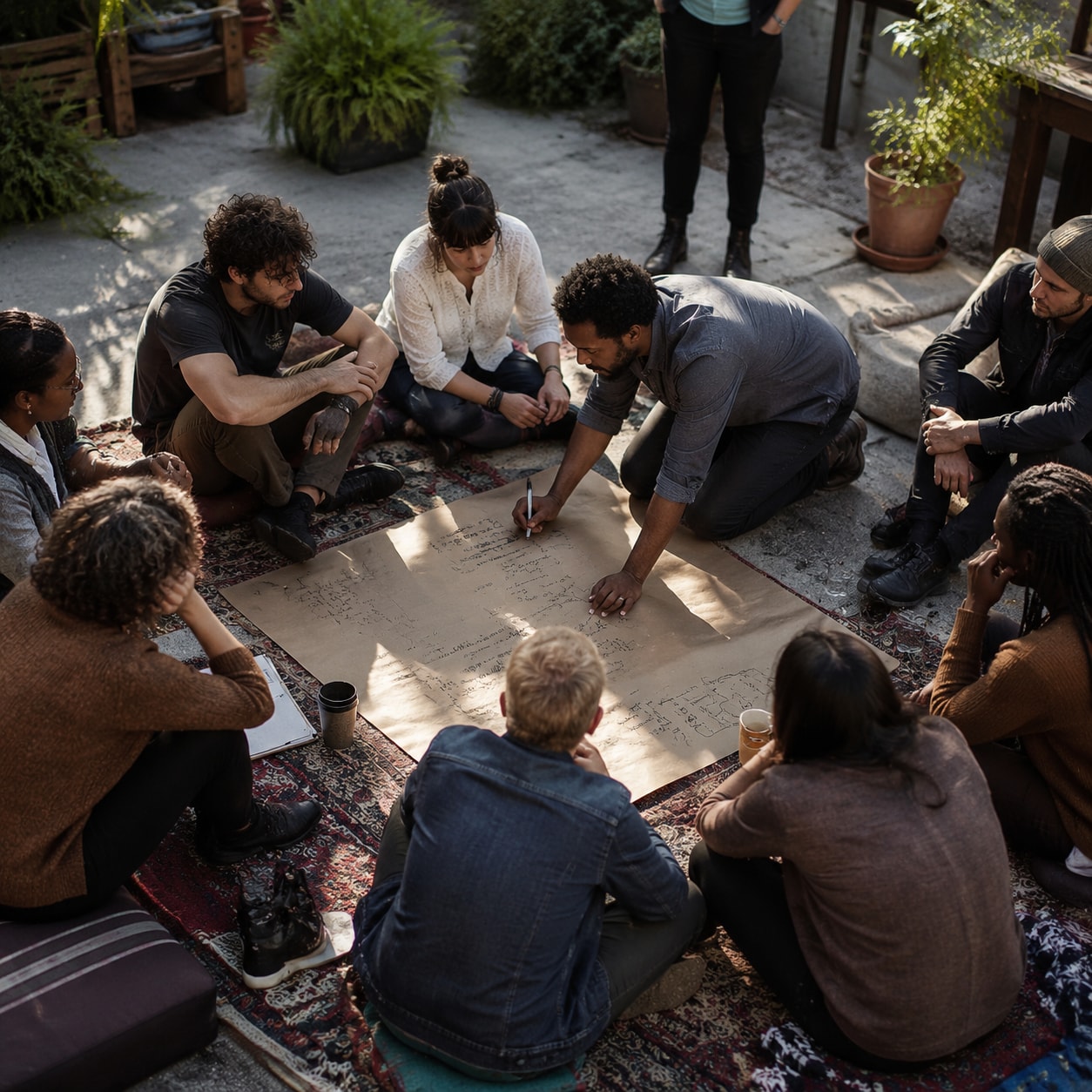
A practical reflection on what Occupy’s history and organizational practices can teach justice-seekers and faith communities about relationships, inclusion, democratic participation, trust, and sustained accountability.
What the Occupy Movement Was—and What This Reflection Can Support
The Occupy movement emerged in 2011 with a focus on social and economic inequality. It drew inspiration from movements in places including Egypt and Spain. In New York, the occupation of Zuccotti Park lasted about 60 days and helped inspire hundreds of occupations around the world.
That history makes Occupy a useful case for studying collective action, but it does not support every conclusion people might wish to draw from it. The available sources do not establish that the movement shared one philosophy of love or that every local occupation organized in the same way. “Love” is therefore used here as a reflective framework, not as a documented movement-wide doctrine.
Within that boundary, Occupy’s history can be placed in conversation with evidence about relationship-building, inclusion, democratic decision-making, trust, and accountability. The goal is neither to romanticize the movement nor to dismiss it. It is to ask what its reach and organizational complexity can teach groups seeking to act together while honoring human dignity.
Understanding “Love” as an Organizing Practice
In collective action, love can remain an inspiring but undefined word. A more useful approach is to express it through practices that people can observe, discuss, and evaluate.
The Solutions Project describes community organizing as a process that connects people from different backgrounds around a shared analysis of a problem and a shared vision for the future. Its guidance emphasizes inclusive participation and action sustained over time. Viewed through that framework, love-grounded organizing might mean building relationships across differences, making room for people who have traditionally been overlooked, and connecting stated values to continuing commitments.
This interpretation also places limits on uplifting rhetoric. Encouraging language and good intentions do not by themselves establish an inclusive or accountable organization. A group must ask whether its relationships are strong enough to support honest disagreement, whether its common vision reflects the people most affected, and whether participants are prepared to keep acting after an energizing meeting or public event.
Love, in this practical sense, is not a substitute for strategy. It shapes how strategy is created and carried out: who helps define the problem, whose knowledge influences the response, how responsibility is distributed, and whether commitments survive beyond a moment of public attention.
Lesson One: Relationships Can Turn Shared Concern Into Collective Capacity
People may recognize the same injustice without yet possessing the relationships needed to respond together. Community organizing can bridge that gap by connecting people around a common understanding of a problem and possible futures.
This work requires more than assembling supporters who already agree. Relationship-building across different backgrounds can reveal where experiences, priorities, or definitions of success diverge. Those differences may complicate a campaign, but acknowledging them can help a group form a more genuinely shared analysis and vision.
For organizers, the practical questions are concrete: Who knows whom? Which relationships are strong enough to carry disagreement? Who is connected to the people most affected by the issue? Where does the group depend on a few individuals rather than durable networks?
This is organizing guidance, not a claim that every Occupy camp operated through the same relational model. Occupy was varied and decentralized. The transferable lesson is narrower: shared concern becomes collective capacity when people develop relationships, a common interpretation of the problem, and a commitment to continued action.
Lesson Two: Inclusion Requires Attention to Power
Open participation does not automatically produce meaningful inclusion. People can enter the same meeting while having very different access to information, time, confidence, social connections, or influence. A group committed to dignity must therefore examine not only who is present, but also whose participation affects decisions.
The Solutions Project’s organizing guidance emphasizes involving people who have traditionally been overlooked. It also warns that division can weaken the collective power of ordinary people. These ideas point toward an active approach to inclusion: identify who is missing, build relationships beyond the group’s familiar networks, and remove avoidable barriers to participation.
Attention to power also means examining internal habits. Who sets agendas? Whose vocabulary defines the discussion? Who is expected to provide labor without helping shape priorities? Whose disagreement is treated as valuable information, and whose is treated as disruption? These questions help distinguish a broad invitation from a genuinely shared process.
Accountability turns inclusive values into practice. A group can name responsible participants, define what inclusion should look like in a particular decision, and revisit whether the result matched the promise. The aim is not to claim that every imbalance can be eliminated. It is to prevent good intentions from becoming a reason to ignore patterns of exclusion.
Lesson Three: Democratic Participation Needs Clear Processes
Research comparing assembly records from Occupy camps in Wall Street, Oakland, and London found varied democratic decision-making procedures as well as explicit and implicit forms of rule-making. The camps were not simply gatherings without structure. They developed complex organizational practices, even when some of their rules were informal or not immediately visible.
That finding complicates simple judgments about decentralization. A decentralized group is not automatically more democratic, and the existence of procedures does not by itself make participation equitable. The practical issue is whether participants understand how decisions are made, how rules arise, and how they can question or change those rules.
Explicit procedures can clarify matters such as who facilitates, how proposals enter discussion, what constitutes agreement, and how unresolved objections are handled. Implicit rules may be harder to see. They can emerge through custom, personal relationships, repeated meeting habits, or assumptions about who is entitled to speak. Because such rules still shape outcomes, groups should make them discussable.
Clear process does not require every movement to adopt one governance model. It does require transparency about the model in use. Groups can document decisions, explain participant roles, distinguish consultation from decision-making authority, and establish a way to revise procedures. These practices help people evaluate whether democratic aspirations are reflected in everyday organizational life.
Lesson Four: Hold Achievements and Limitations Together
The Zuccotti Park occupation lasted about 60 days and helped inspire hundreds of occupations around the world. That spread is part of Occupy’s historical significance. Yet reach alone cannot answer every question about a movement’s organization, effectiveness, or lasting effects.
A 2024 Commons Library retrospective approached Occupy by asking what worked, what did not, and what future action could learn from the experience. That framing offers a disciplined alternative to both nostalgia and dismissal. It allows participants to recognize achievements while investigating limitations.
Groups using this approach can separate different kinds of assessment. One question is whether an action attracted attention or participation. Another is whether it built durable relationships, included people who had been overlooked, improved decision-making, or supported sustained action. A campaign can perform differently across these measures.
Honest reflection also requires specificity. Rather than declaring a movement a success or failure in the abstract, organizers can identify which practice produced which result, for whom, under what conditions, and over what period. They can then decide what to preserve, revise, or leave behind. Holding achievements and shortcomings together is not disloyal to a movement. It is a form of accountability that can make future collective action more thoughtful.
A Role for Faith Communities: Trust, Coordination, and Service
Faith communities often participate in public life alongside organizers, public agencies, service providers, and other institutions. In such settings, goodwill does not remove the need for careful coordination.
The DHS Center for Faith describes part of its work as building relationships and trust among government, faith organizations, emergency managers, and other stakeholders while helping address coordination challenges. This description does not endorse a particular protest strategy, but it does identify capacities that faith communities can consider in their own public engagement: trusted relationships, clear information-sharing, and cooperation across organizational boundaries.
A congregation might contribute meeting space, volunteers, pastoral care, practical support, or connections among institutions. Before acting, it should clarify what partners actually need, who has authority to speak for each organization, how information will be shared, and what commitments can realistically be sustained. Service should respond to stated needs rather than allow a supporting institution to displace the leadership of people most affected.
Trust grows through dependable conduct. Faith communities can state their role clearly, follow through on agreed responsibilities, communicate when circumstances change, and invite partners to assess the relationship. These modest practices can connect spiritual commitments to accountable public service.
A Practical Framework for Love-Grounded Collective Action
A group can translate love from an aspiration into a working discipline through six connected practices:
1. Develop a shared vision. Ask participants to describe the problem, the people affected, and the future they seek. Record important differences instead of declaring agreement too early. Community organizing guidance connects collective action with both a shared analysis and a shared vision.
2. Broaden meaningful participation. Identify people who have traditionally been overlooked and determine what would enable them to shape priorities, not merely attend. Review who speaks, facilitates, proposes, decides, and performs ongoing work.
3. Make decisions transparent. State how proposals advance, what form of agreement is required, who records decisions, and how a decision can be reconsidered. Research on three Occupy camps shows that democratic activity can involve varied procedures and both visible and implicit rules.
4. Invest in relationships. Map the relationships needed within the group and across affected communities. Create repeated opportunities for people to understand one another’s experiences, interests, and concerns. Treat disagreement as information about the strength and limits of the group’s shared vision.
5. Define sustained commitments. Convert broad intentions into actions with responsible participants and realistic dates. Long-term organizing requires more than a compelling message or a single event.
6. Schedule accountability. Decide in advance when the group will review participation, decisions, relationships, and follow-through. Ask what happened, who benefited, who carried the burden, and what must change.
These practices do not guarantee agreement or success. They create observable standards by which a group can compare its conduct with its stated values. To begin, choose one practice, name a concrete next step and its responsible participants, and set a date for reflection.
Questions for Congregations and Organizing Groups
Use these prompts before an action, during a campaign, or in a scheduled review:
– What problem do we believe we are addressing, and do participants share that analysis? – Who is directly affected but absent from this conversation? – Who attends, who speaks, and whose views influence the final decision? – Which rules are written down, and which expectations operate informally? – How can participants raise disagreement or seek reconsideration without losing meaningful access to the group? – Which relationships require attention before coordinated action is possible? – What information must partner organizations share, and who is responsible for sharing it? – What have we promised, who will carry out each commitment, and when will we review progress? – What worked, what did not, and what evidence supports that assessment? – What should we preserve, revise, or stop before the next action?
The purpose of these questions is not to produce a perfect process. It is to help a group connect relationship, inclusion, democratic participation, coordination, and sustained action. Choose one area now, define a concrete next step, name the responsible participants, and put a reflection date on the calendar.
Disclosures and limitations
– This article was drafted with AI assistance and should receive human editorial review before publication. – All material claims and recommendations were synthesized exclusively from the supplied Research Package and are attributed through sourceIds; no independent reporting, interviews, product testing, or personal experience are claimed. – This article contains no product recommendations or affiliate links. If commercial links are added later, any affiliate relationship or financial incentive should be disclosed clearly.
Sources
– Occupy (book) – Wikipedia) — en.wikipedia.org – Occupy Protestors Vow to Return – YouTube — youtube.com – Occupy and the constitution of anarchy | Global Constitutionalism | Cambridge Core — Cambridge Core – Lessons from Occupy Wall Street — Commons Library – October 12, 2023 – Israel-Hamas war news | CNN — CNN – Faith Communities Today (FACT) Survey – United Church of Christ — United Church of Christ – Racial Justice Archives – The New Press — The New Press – Border Collies | Wag! — WagWalking – DHS Center for Faith | Homeland Security — U.S. Department of Homeland Security – Community Organizing – The Solutions Project — The Solutions Project