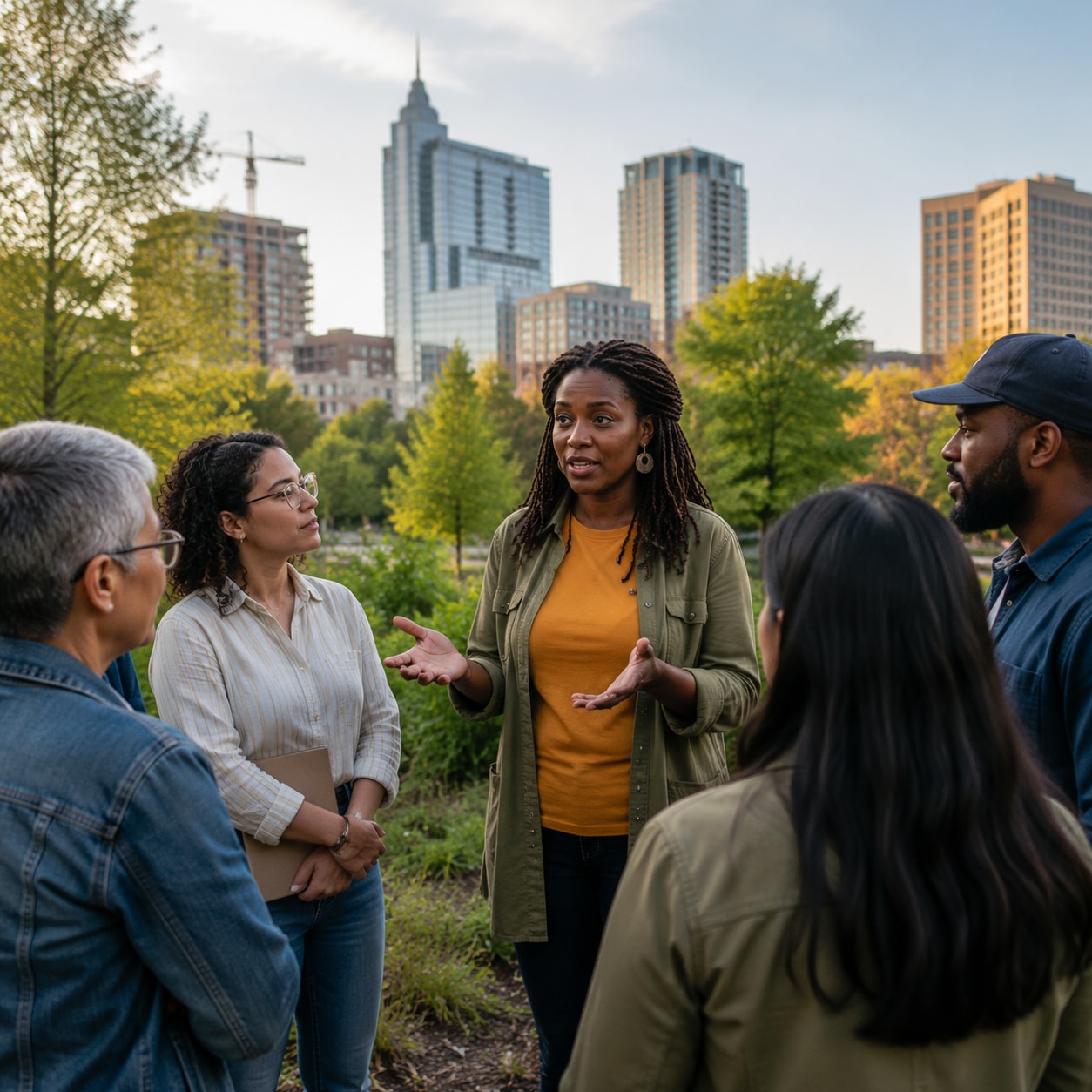
A practical introduction to environmental justice in Southeast Raleigh, the Walnut Creek Watershed Action Team, and documented ways to support locally coordinated watershed work.
What “Join Me in Raleigh” Means in This Guide
“Join Me in Raleigh” is an invitation to learn about local environmental justice participation, not an announcement for a confirmed gathering. The available research does not identify a specific event date, venue, organizer, or registration process.
This guide focuses on the Walnut Creek watershed and the Walnut Creek Watershed Action Team, a local coordination effort that seeks to improve environmental, economic, and social conditions in watershed communities. It explains why the work matters, how participating organizations coordinate their efforts, and which forms of public involvement are identified by the source. Because current opportunities may change, readers should verify details directly with the organization before making plans.
Why Environmental Justice Matters in Southeast Raleigh
The source describes pollution, flooding, and economic disparities as interconnected challenges facing communities in Southeast Raleigh. Viewed through an environmental justice lens, these concerns cannot be separated neatly into environmental and social categories: watershed conditions affect communities that are also navigating unequal economic circumstances.
Responding to these overlapping issues requires coordination among communities, government agencies, nonprofit organizations, and other participants. The source also emphasizes the need to prioritize community needs within that work. This matters because technical watershed projects, public communication, education, and policy advocacy all intersect with the experiences and priorities of people living in the affected area.
The available research does not quantify pollution, flooding, or economic disparities, so this guide does not make claims about their scale or recent direction. It instead uses the source’s documented framing to show why locally grounded participation and cross-sector coordination are central to the Walnut Creek effort.
How the Walnut Creek Watershed Action Team Coordinates Local Work
The Walnut Creek Watershed Action Team aims to improve environmental, economic, and social conditions in watershed communities. According to the source, its core stakeholders have met since December 2017 to coordinate education, outreach, and watershed-improvement projects.
That structure reflects the breadth of the work described. Community participation, public information, agency responsibilities, nonprofit involvement, and project implementation all need to connect. Coordination can help participating groups share information and organize related efforts while keeping community needs visible.
The source identifies the team as one local coordination effort; it does not provide evidence that the team represents every organization or resident working on environmental justice in Raleigh. It also does not establish particular project outcomes. Readers can therefore understand the team as a documented pathway into the issue without assuming that it is the only avenue for participation or that any specific result is guaranteed.
Who Is Involved in the Watershed Effort
The source names participants from several sectors. Listed partners include Partners for Environmental Justice, North Carolina State University, the City of Raleigh, the Town of Cary, Wake County Government, the North Carolina Department of Environmental Quality’s Division of Water Resources, the North Carolina Department of Transportation, the U.S. Geological Survey, and the Carolina Wetlands Association.
This list brings together nonprofit, academic, municipal, county, state, and federal participants. Their inclusion illustrates the range of institutions involved in coordinated watershed work. It should not, however, be read as proof that every listed organization has the same responsibilities, priorities, or level of involvement. Nor does the available source establish endorsements or particular results for any partner.
For prospective volunteers or community groups, the breadth of the partnership can be useful context when considering where education, policy, research, public administration, and community priorities may meet.
How the Team Organizes Education, Communication, and Implementation
The Walnut Creek Watershed Action Team has three subcommittees with distinct areas of responsibility.
The education and outreach subcommittee handles events and educational opportunities. This function can provide a route for residents and community groups seeking ways to learn about the watershed or participate in related activities.
The communications subcommittee focuses on sharing information and resources. That role addresses a practical challenge identified in the research: residents may need clearer access to local activities, projects, resources, and participation channels.
The implementation subcommittee works on carrying out projects within the watershed action plan. Its focus distinguishes project delivery from the team’s education and communications functions.
Together, these areas connect public learning, access to information, and implementation. The source defines their responsibilities but does not provide a current calendar, project status report, or comprehensive list of available opportunities. Anyone interested in a particular activity should therefore confirm its present status directly with the team.
Ways to Participate in Raleigh
The source identifies five participation pathways: volunteering, attending events, advocating for policy change, donating, and partnering.
Volunteering may suit people who want to contribute time to an available activity. Attending an event may offer an entry point for those who first want to learn about the watershed and the organizations involved. Policy advocacy provides a route for people interested in supporting changes connected to the team’s mission. Donations offer financial support, while partnerships may be relevant to congregations, nonprofits, educational institutions, public bodies, or other groups exploring coordinated involvement.
These are general pathways documented by the source, not confirmed openings or invitations to a particular event. The research package does not supply current dates, locations, eligibility rules, donation terms, partnership requirements, or registration instructions. Before acting, review the Walnut Creek Watershed Action Team’s current information and confirm the details directly with the organization.
A practical next step is to choose the pathway that best matches your available time, resources, and role. You can then seek current information about that option rather than assuming that an older description remains unchanged.
Choosing a Next Step That Centers Community Needs
Participation can begin with a simple question: which documented pathway fits both your capacity and the needs identified by the community? An individual with time may explore volunteering or events. Someone focused on public decisions may consider policy advocacy. A congregation or organization may investigate donating or forming a partnership.
Whichever route you consider, the source-supported priority is to keep community needs central to coordinated watershed work. That means learning how an opportunity is currently structured and avoiding assumptions about what residents need. It also means recognizing that education, communication, and implementation are connected parts of the broader effort.
Review the team’s current opportunities, verify the applicable details, and select a next step that is appropriate to your role and resources. The goal is informed participation grounded in the organization’s current work and the stated needs of watershed communities.
Source and Timeliness Note
This guide relies on one source judged directly relevant to Raleigh environmental justice and the Walnut Creek watershed. No publication date was available for that source; the research package records it as observed on July 30, 2026. The supplied material also contains no confirmed event date, venue, or registration process for “Join Me in Raleigh.” Programs, events, partnerships, and other opportunities may change, so readers should confirm current information directly with the Walnut Creek Watershed Action Team before participating or contributing.
Disclosures and limitations
– This article was prepared with AI assistance and reviewed against the supplied Content Plan and Research Package. – All material claims in this article are based on the single supplied source identified as source-9d43495475d5d21d885313c8. Its publication date was unavailable, and the research package records the page as observed on July 30, 2026. – No products are recommended, and no affiliate relationship or commission claim is presented. Readers should independently verify current events, programs, donation details, and participation requirements with the organization.
Sources
– File:Blank.png – Wikipedia — en.wikipedia.org – Bid to raise min age of criminal responsibility formally fails — bbc.com – The Christian Walk is About Faith – J.D. Greear | The Summit Church, Raleigh, NC | – YouTube — youtube.com – Rescuers ‘pulling people out with their bare hands’ as earthquakes kill 920 — BBC News – CivicPlus | LinkedIn — linkedin.com – FaithGateway Store – Christian Books, Bibles, and Studies — FaithGateway – Watershed Action Team | Partners For Environmental Justice | Raleigh, NC — pejraleighnc.org – NC.gov — NC.gov – Powertodecide.org Sitemap | Power to Decide — Power to Decide – Wikipedia:Artificial intelligence resources – Wikipedia — en.wikipedia.org
