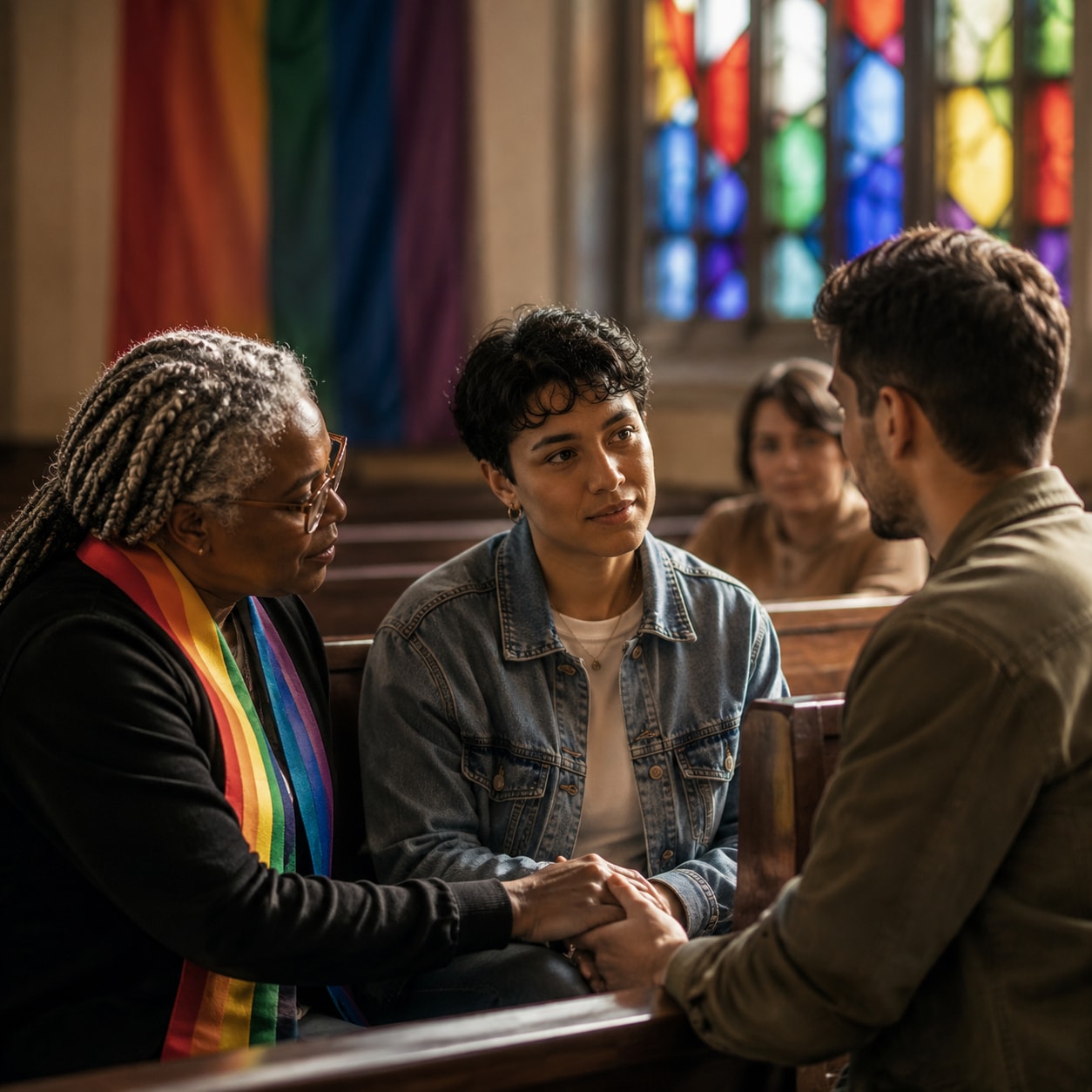
Faith communities can move beyond declarations of welcome by treating LGBTQ+ inclusion as an ongoing practice of learning, accountability, relationship-building, organizing, and care.
What LGBTQ+ Justice Can Mean in a Faith Community
Within a faith community, LGBTQ+ justice can begin with a commitment to every person’s inherent worth and dignity. The Unitarian Universalist Association describes its LGBTQ Welcome and Equality ministry as supporting congregations and communities in becoming welcoming, affirming, and supportive of people across sexual orientations, gender identities, and gender expressions.
That description provides a useful framework for examining congregational life. Welcome concerns whether people can enter and participate. Affirmation concerns whether their identities and dignity are recognized. Support concerns whether the community’s relationships and practices consistently reflect those commitments.
These principles should not be confused with independent evidence that a particular ministry or congregation has achieved its intended results. The available source is the UUA’s description of its own work. It establishes the ministry’s stated purpose, but it is not an external evaluation of its impact.
Why Welcome Is a Continuing Practice, Not a Finish Line
A statement of welcome can express an important intention, but the UUA presents inclusion as work that continues through resources, relationships, shared learning, and covenantal practice. Its ministry includes the Welcoming Renewal program and other activities intended to accompany congregations, leaders, and individuals as they deepen their commitments.
This emphasis on renewal changes the central question. Instead of asking only whether a congregation has previously adopted an affirming statement or completed a program, leaders can ask how that commitment is being practiced now. They can examine whether learning continues, whether relationships are being maintained, and whether the community has a way to revisit its commitments.
Accountability fits within this continuing approach. If welcome is treated as a completed achievement, a community may have little reason to reconsider how its practices affect people. If it is treated as an ongoing covenant, reflection and renewal become part of the commitment itself. The available source does not establish a single formula for every congregation, but it does support understanding LGBTQ+ inclusion as a process rather than a one-time endpoint.
Building a Congregation’s Capacity for LGBTQ+ Justice
Sustained work requires more than good intentions. The United Church of Christ describes its Congregational and Community Engagement work as providing congregations with programs, vision, and strategic support. Its listed partnerships and resources address areas including justice-action training, community organizing, resilience building, and education for local churches.
Together, these areas suggest several dimensions of congregational capacity:
1. Education can help participants develop the knowledge needed to engage an issue. 2. Leadership and strategic support can help a congregation connect its stated commitments with plans and responsibilities. 3. Justice-action training and community organizing can provide tools for collective work. 4. Resilience-building resources can support communities engaged in sustained justice efforts. 5. Relationships with local or regional partners can connect a congregation with knowledge and work beyond its own institution.
A congregation does not need to treat every resource as equally relevant. It can begin by identifying a specific gap—such as limited education, an unclear strategy, or a lack of community connections—and then look for support that addresses that need. The presence of a program or partner does not guarantee a particular outcome; the source describes the UCC’s offerings and collaborations, not an independent assessment of their effectiveness.
Responding to Anti-LGBTQ+ Narratives With Care
Faith voices operate within a wider public environment in which anti-LGBTQ+ narratives are not limited to one ideological movement. An article published online by Cambridge University Press in March 2025 reports that ideologically different extremist groups—including jihadists, right-wing extremists, QAnon adherents, and involuntary-celibate communities—use anti-LGBTQ+ narratives.
That context calls for care when congregations communicate. A response can reject demeaning narratives while avoiding unnecessary repetition that gives those narratives more attention. Faith leaders and community members can keep their focus on human dignity, accurate communication, and the safety of people who may be affected.
The breadth of movements identified by the Cambridge article also cautions against assuming that anti-LGBTQ+ rhetoric comes from only one setting. Responses should be attentive to the actual narrative and risk present in a community rather than relying on a single political or ideological template.
The available research does not justify sweeping predictions about when rhetoric will lead to harm. It does, however, establish that anti-LGBTQ+ narratives appear across distinct extremist environments. Faith communities can therefore approach public messaging as a matter of both moral witness and responsible communication, without exaggerating what the evidence proves.
Making Support Safer and More Trauma-Informed
The Cambridge article identifies an important evidence gap: empirical research on how extremist groups harm LGBTQ+ people remains insufficient. It calls for further attention to queer experiences in both domestic extremism in the United States and conflicts overseas.
That gap matters for communities trying to offer support. Limited research should not be mistaken for evidence that harm is absent, but it also means congregations should avoid making unsupported assumptions about what people have experienced or what response they need. Care can begin by recognizing the limits of available evidence and by centering the needs expressed by affected people.
Trauma-informed support, inclusive policies, and appropriate referral pathways are areas that require deliberate attention. Within the evidence provided, they should be approached as needs for careful practice and further learning—not as interventions whose results have been established here. A congregation can review whether its policies are inclusive, whether people know where to seek suitable support, and whether leaders are prepared to respond without demanding unnecessary disclosure or presenting themselves as specialists.
Because the source highlights unresolved research needs, humility is essential. Faith communities can offer relationship and solidarity while recognizing when a situation requires knowledge or care beyond the congregation’s capacity.
Choosing Partners and Resources Thoughtfully
LGBTQ+ justice work involves organizations operating across many countries, regions, and issue areas. The supplied directory illustrates that breadth, but it comes from Wikipedia and has no publication date in the research package. It can help readers see the range of organizations listed, but it should not be treated as complete, current, or sufficient to verify any organization’s present status.
A careful selection process can start with the congregation’s actual need. Is it looking for education, justice-action training, community organizing support, regional relationships, or another form of assistance? The United Church of Christ’s engagement resources demonstrate that faith-based capacity building can involve several different kinds of partnership rather than a single general-purpose solution.
Before relying on an organization, readers should independently confirm its current status and whether its geographic and issue focus match the local need. A directory can be a starting point for discovery, while current information from the organization is needed for verification. Congregations can also consider whether a potential partner offers the relevant kind of support and whether its work fits the community being served.
This approach avoids treating the largest list as the best answer. The goal is to identify a suitable and current connection for a defined need, while acknowledging that no supplied directory establishes a complete map of LGBTQ+ advocacy.
A Practical Path From Reflection to Action
A congregation can translate reflection into a manageable sequence of action:
1. Review one current practice. Examine how an existing policy, program, leadership process, or community relationship reflects the congregation’s commitment to welcome, affirmation, and support. 2. Identify the gap. Decide whether the immediate need concerns learning, accountability, strategy, organizing capacity, resilience, partnership, public communication, or safer support. 3. Listen before selecting a response. Make room for the needs expressed by people affected by the congregation’s practices, without assuming that leaders already understand every experience. 4. Seek relevant education or training. Use the identified gap to guide the search rather than adopting a program simply because it is available. 5. Choose partners carefully. Look for a current organization whose regional reach and issue focus fit the need, and independently verify information found through broad directories. 6. Communicate with care. When addressing anti-LGBTQ+ narratives, prioritize dignity, accuracy, and community safety while avoiding claims that extend beyond available evidence. 7. Establish a point of renewal. Decide how and when the congregation will revisit the practice, relationship, or commitment so that welcome remains an ongoing process.
The next step need not attempt to resolve every issue at once. Readers can assess one congregational practice, identify one suitable training resource or community partner, and commit to one concrete action that can later be reviewed. This joins the UUA’s emphasis on continuing renewal with the UCC’s focus on education, strategy, organizing, and partnerships, while respecting the Cambridge article’s warning that significant gaps remain in knowledge about harms to LGBTQ+ people.
Disclosures and limitations
– This article was prepared with AI assistance from the supplied Research Package and approved Content Plan; no independent browsing, interviews, product testing, or firsthand experience was used. – Material claims are based on institutional information from the Unitarian Universalist Association and United Church of Christ, a Cambridge University Press article published online in March 2025, and a Wikipedia directory of LGBTQ+ rights organizations. – The UUA and UCC sources describe their own ministries, programs, and partnerships and should not be read as independent evaluations of effectiveness. The organization directory is useful for illustrating breadth but is not established here as complete or current. – This article contains no product recommendations or affiliate links. No affiliate relationship is represented or implied.
Sources
– List of LGBTQ rights organizations – Wikipedia — en.wikipedia.org – Global Participant Directory – World Movement for Democracy — World Movement for Democracy – LGBTQ Welcome and Equality — UUA.org – Limited English Proficiency — justice.gov – LGBTQ+ rights — dw.com – LGBTQ+ Victimization by Extremist Organizations: Charting a New Path for Research | PS: Political Science & Politics | Cambridge Core — Cambridge Core – Congregational and Community Engagement – United Church of Christ — United Church of Christ – LGBTQ+ Archives – The New Press — The New Press – LGBTQ+ Section — American Medical Association – Vyberte místo v oblasti Severní Dakota — foreca.cz