A values-based framework for connecting dignity across differences with justice, shared responsibility, and practical local action.
What “Because Love Knows No Borders” Means
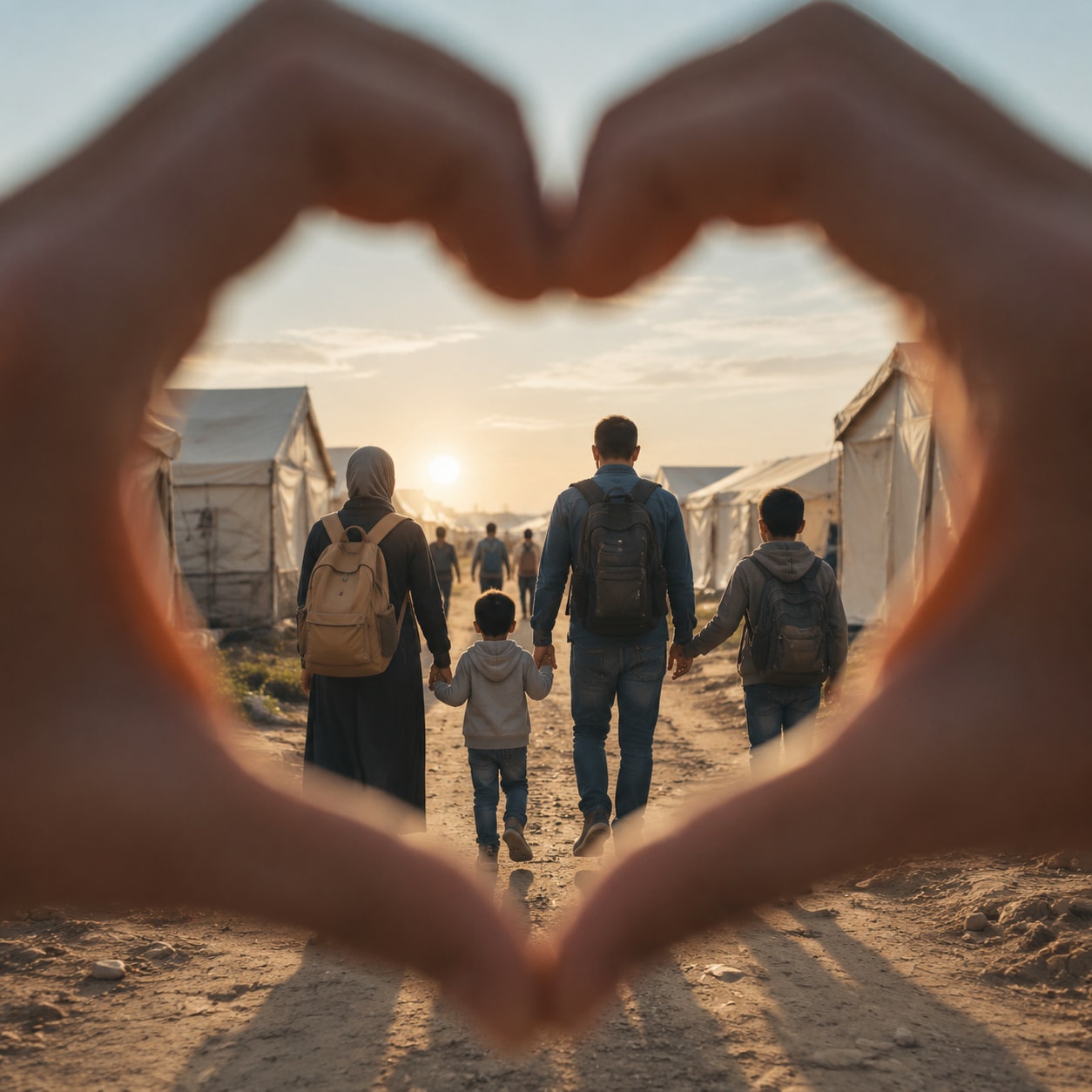
“Because Love Knows No Borders” can be understood as a commitment to recognize dignity across lines of geography, race, and identity. A cited video description presents kindness as a basis for unity and calls for respect without regard to those boundaries. That language expresses the publisher’s values; it does not independently demonstrate that kindness produces a particular, measurable social result.
As a framework for reflection, however, the phrase poses a useful question: What would it mean to let care extend beyond the people, identities, and places most familiar to us? In this sense, a border may be geographic, but it may also be a social distinction that determines who is welcomed, heard, or treated as part of a community.
The phrase therefore offers a starting point rather than a complete program. Respect across differences establishes an orientation, while the work of justice asks how that orientation shapes responsibilities and choices. Moving from the slogan to action requires identifying who is excluded, what burdens people carry, and how a community can respond without reducing love to sentiment alone.
How Love Connects With Justice and the Beloved Community
A retail description of Raphael G. Warnock’s *The Crooked Places Made Straight* places love alongside justice, democracy, and the “beloved community” in a moral account of American public life. This framing suggests that love can be considered not only as a private feeling but also as a way of evaluating how people live together.
Within that framework, justice concerns the structures and public choices that affect a community. Democracy concerns participation and the distribution of political voice. The beloved community names an aspiration toward shared life shaped by care and justice. Taken together, these ideas offer a lens for asking whether public arrangements reflect the dignity people affirm in principle.
This connection also challenges a separation between personal compassion and public responsibility. Care for an individual and concern about the conditions affecting groups of people can be treated as related commitments. The framework does not supply a single answer for every issue, but it can organize reflection: Who is affected? Whose voice is restricted? Which burdens are being ignored? What would shared responsibility require?
The source for this framing is a Google Play retail page, not an independent assessment of the book’s arguments. The page lists the ebook as 224 pages and gives June 16, 2026, as its publication date. Those details help identify the work, but the retail description should not be treated as independent verification of its claims.
Seeing Interconnected Justice Issues Through This Framework
The Google Play description names six crises in American life: voting rights and voter suppression, gun violence, mass incarceration, persistent poverty, dark money in politics, and the climate emergency. These are the concerns selected by the book description; the available research package does not independently establish the description’s analysis of them.
Viewed through the moral framework presented on that page, the six concerns can be approached with a common set of questions about love, justice, democracy, and community:
– Voting rights and voter suppression: Who is able to participate in public decisions, and whose political voice faces barriers? – Gun violence: What responsibilities arise when considering safety, loss, and the burdens carried by affected communities? – Mass incarceration: How should dignity and justice inform reflection on confinement and its effects? – Persistent poverty: What does shared responsibility mean when people continue to experience material need? – Dark money in politics: How should communities think about political influence in relation to democratic participation? – The climate emergency: How might care extend across communities and beyond immediate interests when considering a shared crisis?
These questions do not prove that every issue has the same causes or solutions. Their value is organizational: they keep attention on dignity, voice, burdens, and responsibility while readers consider distinct public concerns. The framework also discourages treating justice as a collection of wholly isolated topics. A person can ask how political participation, safety, incarceration, poverty, political influence, and climate concerns appear within the same vision of communal life without claiming that the cited retail page has independently proven specific connections among them.
For justice-seekers, this provides a manageable point of entry. Rather than mastering every issue at once, a group can choose one concern, identify the people and responsibilities involved, and examine it through the same moral questions. The result is not a ready-made policy platform; it is a disciplined way to connect stated values with attention to public life.
From an Abstract Value to Concrete Practices
NAMI FaithNet’s collection of faith texts and quotations provides practical directions for moving from care as an idea to care as a practice. Its themes include welcoming strangers, bearing one another’s burdens, caring for people in need, defending the rights of people experiencing poverty, and expressing love through action rather than words alone.
Those themes can become a simple practice framework:
1. Welcome. Examine whether newcomers and unfamiliar people are genuinely received. Welcoming can begin with listening, clear information, and attention to barriers that keep someone from participating. 2. Share burdens. Ask what another person or group is carrying and which part of that burden a community can responsibly help bear. This shifts the focus from distant concern to shared responsibility. 3. Care for people in need. Direct attention toward concrete needs rather than leaving compassion at the level of intention. The appropriate response will depend on the local context and the capacity of the people involved. 4. Speak for rights and dignity. The FaithNet material includes concern for the rights of people experiencing poverty. Groups can therefore consider when care also requires advocacy, especially when affected people need their rights supported. 5. Make love visible through action. A stated value becomes accountable when it is connected to a specific choice, responsibility, or commitment.
This framework does not require a group to address every need at once. A small, clearly defined commitment can be more actionable than a broad declaration: welcome a particular group, share a defined burden, support a concrete need, or advocate around a clearly identified right. The central test is whether the action reflects the dignity and care the group says it values.
These practices are derived from a faith-oriented resource collection, so communities should interpret them in ways appropriate to their own setting. They offer directions for action, not evidence that any particular intervention will produce a guaranteed outcome.
A Reflection Guide for Congregations and Community Groups
Congregations and community groups can use the following prompts to examine the distance between their values and practices. The questions draw on the FaithNet themes of welcome, mutual support, care, and advocacy, alongside the video publisher’s call for respect across borders, race, and identity.
– Whom do we currently welcome, and who may still experience a boundary to belonging? – Do our practices communicate respect across differences of geography, race, or identity? – What burdens are people in our community carrying, and which of those burdens could we share responsibly? – Where do we see unmet needs, and what form of care is within our capacity? – Whose rights or dignity require support, particularly among people experiencing poverty? – When do we speak about love without connecting it to a concrete action? – What is one commitment we can define clearly enough to carry out and revisit?
A useful discussion can separate three stages. First, name the value: dignity, welcome, care, or shared responsibility. Second, identify the relevant people and circumstances without assuming that the group already understands their needs. Third, choose an action that is specific enough to evaluate.
Groups can also distinguish reflection from evidence. The idea that love crosses borders is a moral position communicated by the video publisher, not proof of a measurable outcome. The discussion prompts are guidance derived from that value position and the FaithNet collection. Making that distinction visible allows a group to draw spiritual or ethical direction from the materials without overstating what the sources establish.
Finding Support and Choosing a Local Next Step
Choose one locally relevant way to welcome, support, advocate for, or share responsibility with others. Define the action narrowly: identify whom it concerns, what the group will do, and how the commitment will be revisited. This keeps the next step connected to an actual need rather than an abstract intention.
When mental health support is relevant, the cited NAMI page directs readers toward nearby NAMI affiliates and mental health support resources. That pathway can help people look for an appropriate local point of connection. The available source does not establish that a NAMI affiliate is present in every location or that one form of support will meet every need, so readers should use the local pathway to determine what is available and suitable.
A practical next step might center on welcome, burden-sharing, care for someone in need, or support for the rights of people experiencing poverty. The choice should reflect local circumstances and the community’s real capacity. The guiding question is straightforward: What can we responsibly do now that makes our stated care more concrete?
Source Limits and Responsible Interpretation
The available materials support a values-based reflection, but they have important limits. The YouTube description communicates its publisher’s position on kindness, unity, and respect; it does not demonstrate measurable social effects. Information about Warnock’s book comes from a Google Play retail description, not an independent review or verification of its arguments. The NAMI FaithNet page is a collection of faith texts, quotations, and support directions rather than an evaluation of specific justice interventions.
The retained sources do not provide independent publication-date fields. The research package also contains no evidence establishing search growth, trend status, or breaking-news relevance. Accordingly, this article uses the sources to identify themes, examples, and possible reflection questions without presenting them as proof of outcomes or as a comprehensive account of the justice issues named.
Disclosures and limitations
– This article was prepared with AI assistance from the supplied Research Package and approved Content Plan. – The article relies on a YouTube publisher description, a Google Play retail book description, and a NAMI FaithNet resource collection. Their viewpoints and claims are attributed and should not be read as independently verified outcomes. – No products are recommended, and no affiliate relationship or affiliate compensation is represented in the supplied materials.
Sources
– Love Knows No Borders ❤️🌍 | May Peace Fill the World 🕊️ — YouTube – Portal:Biography – Wikipedia — en.wikipedia.org – Eurovision Song Contest texty | KaraokeTexty.cz — KaraokeTexty.cz – Under-16s to be banned from social media by next spring, Starmer says — BBC News – DOMŮ – RADIO DIXIE — radiodixie.cz – The Crooked Places Made Straight: Reflections on the Moral Meaning of America by Raphael G. Warnock – Books on Google Play — play.google.com – Upíří deníky – hudba ze seriálu — SerialZone.cz – Yesteryear: The Sunday Times Number One Bestseller – ‘Everyone will be talking about it’ Bella Mackie: Amazon.co.uk: Burke, Caro Claire: 9780008742768: Books — amazon.co.uk – Facilitating without slides: Know your content inside out | Lisa Matomola posted on the topic | LinkedIn — LinkedIn – Quotes, Verses and Passages | NAMI — nami.org