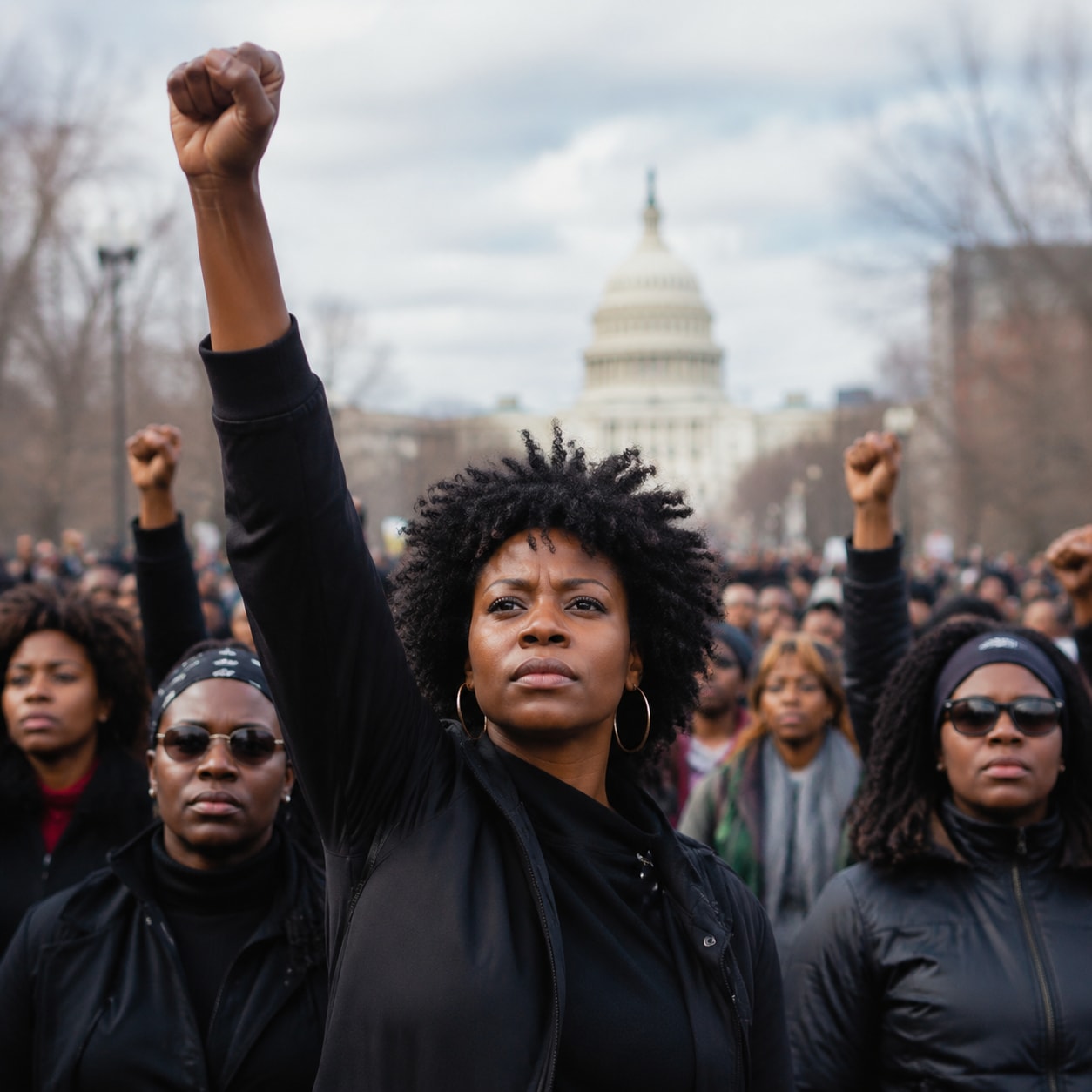
A carefully sourced introduction to the 1999 Washington, D.C., march, its federal-accountability demands, and the distinct but related debates surrounding police responses to racial-justice demonstrations in 2020.
What “National March Against Police Brutality” Refers To
The shortened name “National March Against Police Brutality” refers here to an event documented more specifically as the National Emergency March for Justice Against Police Brutality. It was held in Washington, D.C., on April 3, 1999.
Using the full name matters because it identifies a particular historical gathering rather than police-accountability protests generally. It also helps prevent the 1999 march from being confused with later racial-justice demonstrations. This explainer therefore uses the documented event name when discussing the march itself while retaining the shortened phrase as the topic readers may encounter.
Why the 1999 March Was Organized
The February 1999 police killing of Amadou Diallo was identified as the catalyst for the march. Diallo was an unarmed, 23-year-old Black immigrant from Guinea. His death became the immediate focus of a gathering also shaped by concern about other people who had been killed by police.
The Center for Constitutional Rights and relatives of people killed by police participated in planning the march. Their involvement placed both organized legal advocacy and the experiences of affected families within the event’s public call for accountability.
This history should be described with precision. The supplied evidence establishes the march’s stated catalyst, date, location, and planning participants. It does not provide a complete history of the organizing process or the experiences of every person involved. Even within those limits, the available account shows that the march was organized in response to a specific killing and a broader concern about deaths involving police.
What Marchers Asked the Federal Government to Do
According to the supplied historical account, marchers sought several forms of federal action. Their calls included a presidential commission, congressional hearings, and funding for federal reporting on cases of police abuse.
These demands addressed different parts of public accountability. A presidential commission could create a formal venue for examining the issue. Congressional hearings could place evidence and testimony before federal lawmakers. Funding for federal reporting could support the collection of information about alleged police abuse.
The source documents these as demands made by marchers; it does not establish what action followed or assess the effectiveness of any later response. The clearest conclusion supported by the record is that participants were asking federal institutions to investigate, hear evidence, and improve reporting—not merely expressing generalized opposition to police brutality.
Keeping the 1999 March and the 2020 Protest Wave Distinct
The 1999 march and the racial-justice demonstrations of summer 2020 belong to different historical settings. The first was a specific event in Washington, D.C., organized after the killing of Amadou Diallo. The second was a geographically broad wave of demonstrations across the United States.
A Thurgood Marshall Institute brief states that more than 7,000 racial-justice demonstrations occurred in over 2,400 U.S. locations during summer 2020. That scale alone makes clear why evidence about the later protest wave should not be presented as evidence about what happened at the single 1999 march.
The two periods can nevertheless inform a shared discussion. The 1999 demands raised questions about federal oversight and reporting, while the 2020 research examined how law enforcement responded to racial-justice demonstrations. Placing those records beside one another reveals the persistence of questions about accountability and protest rights, but it does not show that the events, participants, policing practices, or political circumstances were identical.
What the 2020 Research Brief Reports About Demonstrations and Police Response
The Thurgood Marshall Institute brief describes a large and widely distributed protest wave during summer 2020. It reports more than 7,000 racial-justice demonstrations across more than 2,400 U.S. locations and cites an estimate that 93% involved no violence, property destruction, or road blockades.
The brief also reports differences in law-enforcement responses. In its analysis, police were more likely to be present at racial-justice demonstrations than at similar demonstrations unrelated to racial justice. They were also more likely to deploy an escalated presence and to use arrests, projectiles, or chemical weapons.
These findings make comparison important. The brief is not merely describing whether police appeared at protests; it is reporting that the likelihood and character of the response differed according to whether a demonstration concerned racial justice. That distinction bears directly on questions about whether people encounter protest rights on equal terms.
The quantitative claims require careful attribution. They come from an advocacy and research brief, and the supplied material does not include its underlying citations and complete methodology. The figures should therefore be understood as findings reported by the Thurgood Marshall Institute, not as independently verified conclusions within this explainer.
Why Judgments About Proportionality Require Context
One incident reviewed by ProPublica illustrates why assessments of police tactics can be contested. In a protest video, an officer appeared to throw a smoke-and-rubber-pellet grenade after a protester threw a water bottle. Experts quoted by ProPublica disagreed about whether the officer’s response was justified under the circumstances.
The disagreement matters because proportionality cannot be evaluated solely by naming a tactic. Analysis can depend on the sequence of events, what threat officers could reasonably perceive, the characteristics of the device used, and the risks imposed on protesters and others nearby. Observers can examine the same episode and reach different conclusions about whether the response matched the perceived threat.
The example also has a firm evidentiary limit: it is one documented incident. It cannot establish how often officers used that tactic, whether comparable encounters unfolded in the same way, or what conclusions should be drawn about every 2020 demonstration. Its value here is narrower. It shows why claims about justification should be attributed, why competing interpretations should be preserved, and why a single video should not be converted into a sweeping account of protest policing.
Police Accountability, Protest Rights, and Human Dignity
Read together, the sources identify an ongoing set of public questions without making the 1999 and 2020 contexts interchangeable. The 1999 marchers asked federal institutions to investigate, hold hearings, and support reporting about police abuse. The 2020 research brief later reported that racial-justice demonstrations were more likely than similar non-racial-justice demonstrations to encounter police presence, escalated presence, arrests, projectiles, or chemical weapons. ProPublica’s account of a disputed incident shows that judgments about particular uses of force may still turn on context and competing interpretations.
The connection among these records is an editorial synthesis, not proof of one continuous event or an unchanged pattern. Together, they support questions about who records alleged abuse, who reviews government conduct, how protest tactics are assessed, and whether racial-justice demonstrators can exercise protest rights on equitable terms.
A human-dignity framework keeps the people affected by these decisions in view. It invites attention to those killed by police and their relatives, people assembling to demand change, and people exposed to arrests or crowd-control weapons. It also calls for factual discipline: the dignity of affected communities is not served by conflating events or overstating what limited evidence can prove.
For congregations, classrooms, and community groups, a constructive discussion can begin with both accountability and proportionality. Participants can ask what information public institutions should collect, what review mechanisms are needed, and what standards should govern escalated responses. They can also distinguish a broad statistical finding from the evaluation of an individual incident.
Evidence Limits and Questions for Community Discussion
The evidence supplied for this explainer has important limits. The event-specific account is a tertiary source without a supplied publication date, so its historical details should be checked against primary or authoritative archival records before publication. The Thurgood Marshall Institute document is an advocacy and research brief whose underlying citations and full methodology were not provided here. The ProPublica material concerns one incident and includes competing expert views; it cannot show how common the described tactic was.
These limits do not make the sources unusable. They define how narrowly their claims should be stated and where further research is needed. A careful discussion might consider:
– What additional archival records would help verify and deepen the history of the 1999 march? – How do a presidential commission, congressional hearings, and federal reporting address different dimensions of accountability? – What information is necessary to evaluate whether a police response to a protest was proportionate? – How should communities interpret a broad comparative finding without assuming that every demonstration followed the same pattern? – What would equitable protection of protest rights require at racial-justice demonstrations?
Use these distinctions and source notes to support an informed conversation in a congregation, classroom, or community about police accountability, protest rights, and human dignity.
Disclosures and limitations
– This article was drafted with AI assistance strictly from the supplied research package and approved content plan; it does not reflect personal attendance, interviews, product use, or independent firsthand reporting. – Historical and quantitative claims are attributed to the supplied sources. The event account is tertiary and should be checked against primary or authoritative archives before publication; the supplied research brief did not include its complete underlying methodology, and the ProPublica example concerns only one disputed incident. – This article contains no product recommendations or disclosed affiliate links.
Sources
– National Emergency March for Justice Against Police Brutality – Wikipedia — en.wikipedia.org – 1960s Civil Rights Protestors Beaten & Attacked – YouTube — youtube.com – EUR-Lex – 52026DC0538 – EN – EUR-Lex — eur-lex.europa.eu – Philippines: Sara Duterte impeachment trial live updates — BBC News – We Reviewed Police Tactics Seen in Nearly 400 Protest Videos. Here’s What We Found. — ProPublica – Police and Protests: The Inequity of Police Responses to Racial Justice Demonstrations — The Thurgood Marshall Institute at LDF – Rules for Authors English version – Policie České republiky — policie.gov.cz – Tractors on the Autobahn — sonar21.com – Checking your browser – reCAPTCHA — pmc.ncbi.nlm.nih.gov – USSR anti-religious campaign (1958–1964) – Wikipedia) — en.wikipedia.org