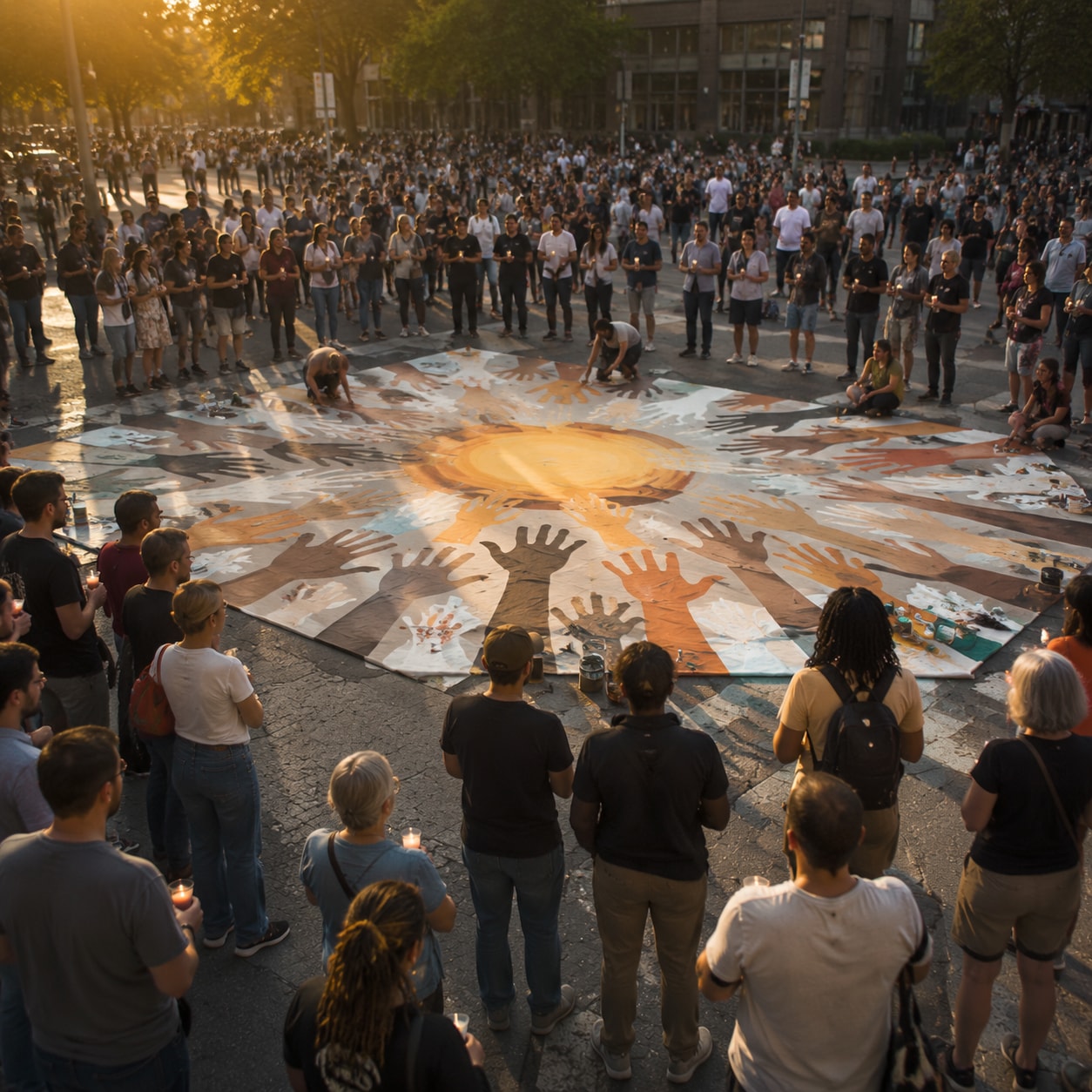
A careful framework for reflecting on collective action through civic participation, universal human rights, human dignity, and the common good—without making unsupported claims about the May 29 event itself.
What This Reflection Can—and Cannot—Establish
The available research does not document the May 29 National Day of Action. It does not verify the event’s organizers, demands, participants, locations, activities, or outcomes. This reflection therefore cannot serve as an account or assessment of what happened.
What the sources do provide is a principled framework for considering collective action. The U.S. Department of Justice’s 2026 Law Day statement connects democracy with an informed and engaged citizenry and points toward learning about rights, laws, and civic responsibilities. A Vatican World Day of Peace message presents universal human rights, the dignity of every person, and commitment to the common good as foundations for peace.
These sources allow us to ask careful questions about public action without presuming answers about May 29. The goal is not to praise or criticize an undocumented event, but to consider how civic participation can be informed, rights-respecting, and grounded in human dignity.
Collective Action Through the Lens of an Engaged Citizenry
Collective action can be examined as one expression of civic participation. The Department of Justice’s 2026 Law Day statement says democracy requires an informed and engaged citizenry. It encourages Americans to learn about their rights, understand the Constitution and laws, and serve on juries.
That emphasis suggests that reflection should begin with knowledge. Before evaluating a public action, participants and observers can ask which rights and laws are relevant, whether available information is reliable, and how the action relates to civic institutions and responsibilities. These questions do not determine whether a particular action is justified, but they help move discussion beyond assumptions or slogans.
The history of Law Day offers additional civic context. According to the Department of Justice, Law Day was established through Presidential Proclamation 3221 in 1958 and designated by Congress under Public Law 87-20 in 1961. The statement’s practical guidance—learning about rights, understanding governing documents, and considering jury service—shows that civic engagement includes both public expression and sustained participation in legal and democratic life.
Applied cautiously to a reflection on May 29, this lens asks: What did we know about the rights and legal questions involved? What did we still need to learn? How might greater civic understanding shape what comes next? Because the supplied sources do not document the event, these remain reflection prompts rather than conclusions about its participants or activities.
Human Dignity and Universal Rights as a Moral Grounding
A second lens begins with the worth of every person. The Vatican’s 1999 World Day of Peace message describes human rights as universal and indivisible, rooted in the inherent dignity of the human person. In this framework, rights are not reserved for people who share the same identity, beliefs, politics, or social position.
Universality asks whether concern extends to everyone affected, including people whose experiences may be less visible. Indivisibility asks whether one right is being pursued while other rights are ignored. Human dignity asks whether people are treated as persons of inherent worth rather than as instruments, obstacles, or abstractions.
These principles can guide reflection on collective action without supplying missing event facts. A group might consider whose dignity it sought to uphold, whose rights were central to its concern, and whether anyone’s humanity was diminished in its language or methods. It might also ask whether people most affected by an injustice had meaningful space to speak and participate. These are evaluative questions, not claims about what occurred on May 29.
A dignity-centered reflection also leaves room for honest self-examination. Commitment to justice is strengthened when communities examine both their aims and the ways they pursue them. Universal and indivisible rights provide a standard broader than agreement with a particular campaign: every person’s dignity remains morally significant.
The Common Good as a Test for Justice Work
The Vatican message links respect for human rights, the dignity of every person, and commitment to the common good with the foundations of peace. The common good can therefore function as a demanding question for justice work: Does an action seek conditions in which human dignity and rights are respected across the community?
This does not mean avoiding disagreement. Instead, it invites reflection on whether the means and goals of collective action remain connected to the well-being and dignity of people beyond one’s immediate circle. It also warns against defining success so narrowly that broader human consequences disappear from view.
For personal or group reflection, consider:
– Which human rights are relevant to the issue? – Whose dignity is most at risk, and whose perspective may be absent? – Are rights being treated as universal and indivisible? – Do the language, methods, and goals recognize the inherent worth of every person? – How might the action contribute to the common good and the conditions for peace? – What unintended effects deserve further consideration?
The supplied research cannot answer these questions for the May 29 event. Their value lies in helping communities assess their own commitments carefully, identify gaps in their understanding, and connect justice work with a consistent concern for rights and dignity.
From Reflection to Informed Civic Participation
Reflection becomes practical when it leads to an informed and rights-respecting next step. The Department of Justice’s Law Day statement identifies several general pathways: learn about legal rights, understand the Constitution and laws, and consider civic service such as jury participation.
For an individual or community, a reasonable next step could be to identify the rights and laws connected to an issue, then study them using reliable legal and civic materials. A congregation or discussion group might devote time to understanding how constitutional principles and governing laws shape the issue under consideration. Eligible community members can also recognize jury service as a concrete civic responsibility highlighted by the Department of Justice.
These pathways are general; they are not instructions from or about the May 29 event. The research package supplies no verified event-specific campaign, organizer, or follow-up action. Readers should therefore avoid attributing any next step to that event based on this article.
A useful commitment is both modest and concrete: choose one form of civic participation that increases understanding or fulfills a civic responsibility. The purpose is not action for its own sake, but participation informed by knowledge of rights and the legal system. That approach reflects the Department of Justice’s emphasis on an informed and engaged citizenry.
Questions for Personal or Congregational Discussion
Use these prompts for individual writing, a congregational conversation, or a community discussion. They are grounded in the supplied sources’ general principles and do not assume facts about the May 29 event.
1. What do we know about the rights, laws, and constitutional principles connected to the issue—and what do we still need to learn? 2. How does informed civic participation differ from reacting without adequate information? 3. Which people or perspectives are missing from our current understanding? 4. What would it mean to treat human rights as universal and indivisible in this context? 5. How can our language and conduct affirm the inherent dignity of every person, including those with whom we disagree? 6. Does our understanding of justice account for the common good as well as the concerns of our immediate group? 7. What tensions exist among rights, responsibilities, methods, and intended outcomes? 8. What is one informed, rights-respecting form of civic participation that we can take next?
The final question is the practical invitation: move from reflection toward one concrete step rooted in civic understanding, universal rights, human dignity, and concern for the common good.
Disclosures and limitations
– This article was drafted with AI assistance and should receive human editorial review before publication. – The article uses only the supplied U.S. Department of Justice 2026 Law Day statement and the Vatican’s 1999 World Day of Peace message as source material. – The supplied sources do not document the May 29 National Day of Action; event-specific details and conclusions have therefore been excluded. – No products, affiliate links, or compensated recommendations are included.
Sources
– Canada Masters – Wikipedie — cs.wikipedia.org – May 29-30, 2026 — US military ready to resume combat in Gulf if needed, defense secretary warns | CNN — CNN – Celebrating Law Day 2026: The Foundation of Justice and Democracy — justice.gov – Fox News 2026 May 29 Video Sitemap — foxnews.com – From tourist tax to digital ID: BBC correspondents on key bills in King’s Speech — bbc.com – Billy Graham (Pořadí knih (chronologicky)) | knihobot.cz — knihobot.cz – Eurostat | LinkedIn — linkedin.com – XXXII World Day For Peace 1999,Respect for human rights: the secret of true peace — vatican.va – EUR-Lex – 52023PC0148 – EN – EUR-Lex — eur-lex.europa.eu – United States Army – Wikipedia — en.wikipedia.org