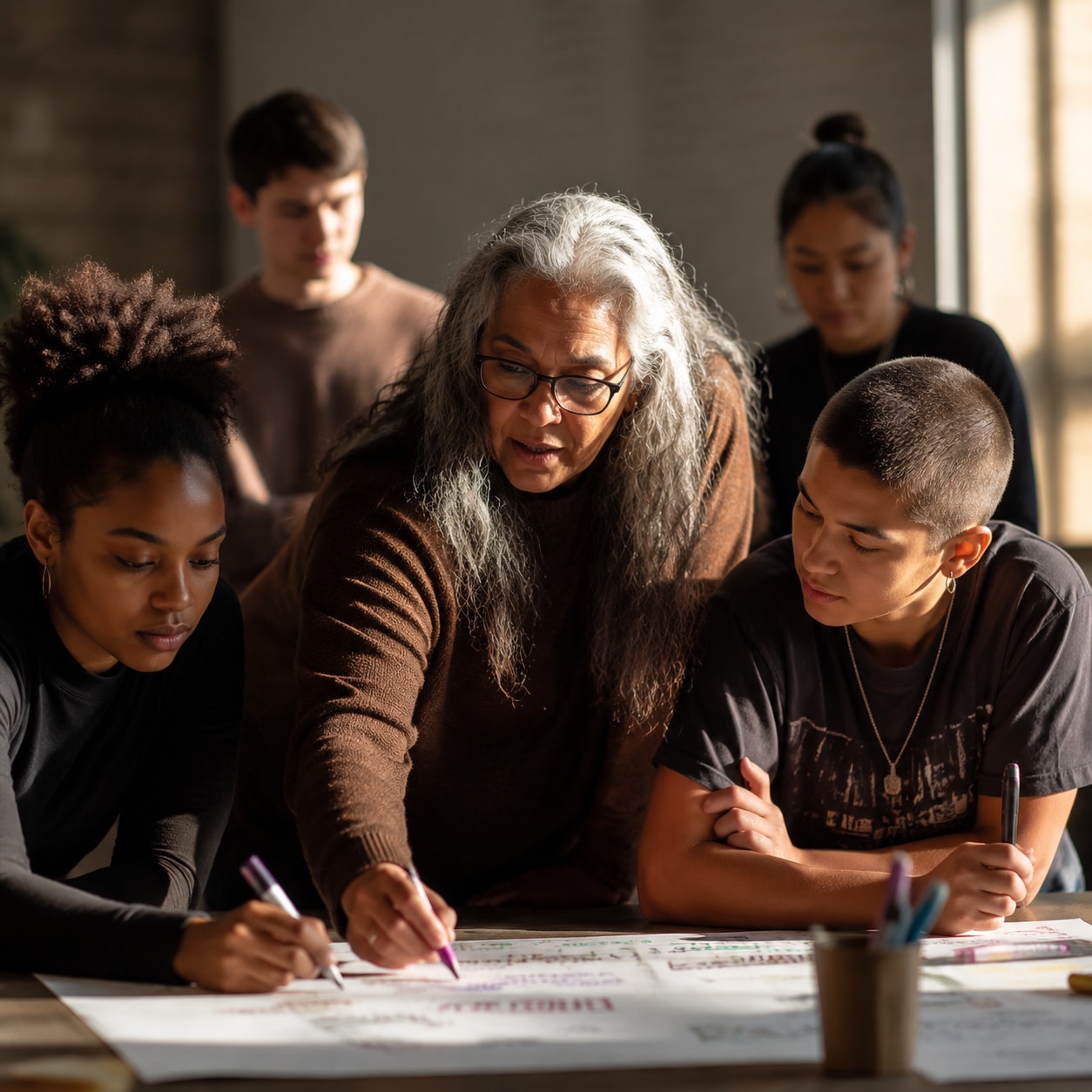
Intergenerational justice work requires more than bringing people together. Organizational experience points toward shared decisions, attention to local context, intentional leadership roles, and a long-term commitment to community power.
What “Not by Bridges Alone” Means
Building bridges can bring generations, organizations, and communities into relationship. But connection alone does not determine who makes decisions, shapes strategy, or develops as a leader.
Collective Power, reflecting on a series of workshops it held in Cambridge, Massachusetts, identified three priorities for collaboration between young people and community organizers: share power rather than merely assign tasks, understand the local context, and intentionally design intergenerational participation. These are recommendations drawn from one organization’s experience, not independently verified guarantees of success.
A supplied overview of community organizing adds a longer-term perspective. It describes people affected by common problems or geographic proximity organizing for shared interests, with durable community power and local leadership among the central aims. Seen together, these sources suggest the idea behind “Not by Bridges Alone”: relationships may open the door, but lasting collective action also depends on how authority, roles, and influence are structured.
The Limits of Participation Without Shared Power
An organization can invite young people into its work without giving them meaningful influence over it. Collective Power cautions against treating students and youth primarily as people who handle routine administrative tasks. Participation becomes limited when others continue to make the important decisions, determine the strategy, and control which knowledge counts.
Its workshop summary calls instead for sharing power. In practice, that means involving young participants in decision-making, strategy development, and knowledge-sharing—not simply expanding their task lists. The distinction is between helping to carry out a plan and having a role in creating that plan.
Organizations can examine this distinction by asking who has authority at each stage of a partnership. Who defines the problem? Who chooses priorities? Who can revise the strategy? Who contributes knowledge when decisions are made? If young people appear only after these choices have been settled, the partnership may provide activity without shared power.
This reflection does not require assuming that every participant must hold an identical role. It does require taking seriously the source’s central concern: young people should have opportunities to influence decisions and strategy rather than being confined to assigned support work.
Start With the Local Context
Before launching a new initiative, organizers can first learn what is already happening locally. Collective Power’s workshop summary emphasizes understanding existing work and paying attention to the particular context of a place.
That inquiry can focus on current projects, expressed needs, and established organizing networks. The purpose is not merely to compile a directory. It is to determine whether a proposed effort strengthens work already underway or repeats it. The source warns that insufficient local knowledge can produce duplicated work and shift potential collaboration toward competition.
For a congregation, school, volunteer group, or community organization, this creates a practical starting point: identify the people and groups already active around the issue before defining a new program. Ask what work exists, what needs have been identified, and where relationships or networks are already operating. Then consider whether the proposed contribution fills a gap or recreates an existing effort.
Local awareness also changes the posture of partnership. Instead of arriving with a finished plan, an organization can begin by learning how its resources and participation might connect with existing local capacity. This approach follows the workshop guidance without claiming that it will automatically resolve conflict or produce a particular result.
Design Intergenerational Collaboration Intentionally
Sustained intergenerational collaboration is unlikely to be defined by an invitation alone. Collective Power argues that it should be actively designed so students and young people can participate as co-creators, strategists, and movement leaders.
That design begins with roles. A short-term assignment may bring someone into a project, but it does not by itself create a continuing route into strategy or leadership. Organizations can therefore examine whether participants know how to move from an initial task into deeper responsibility. They can also ask whether decision-making and knowledge-sharing are built into those roles from the beginning.
Intentional design links several questions: When can young people help shape the work? Where can they contribute knowledge? What opportunities exist to develop strategy? Which roles carry real leadership responsibility? Are those opportunities sustained, or do they end with a single event or project?
These questions reflect the participation gaps identified in the workshop summary. They do not prescribe one universal structure. Rather, they help reveal whether an organization’s current structure makes the desired form of collaboration possible. If young people are expected to become co-creators and leaders but are offered only administrative assignments, the stated goal and the available pathway do not align.
The practical challenge is therefore structural as well as relational: create ongoing routes through which participants can contribute to decisions, strategy, knowledge, and leadership.
Connect Collaboration to Long-Term Community Power
Intergenerational partnership can also be considered within the broader purpose of community organizing. The supplied overview describes community organizing as people connected by shared problems or proximity forming organizations and acting for common interests. It identifies developing local leaders and building lasting community power as core aims.
That perspective widens the measure of collaboration. The question is not only whether a project brings people together or completes an immediate activity. It is also whether community members gain durable capacity to act together and influence decisions over time.
This matters where resources and influence are unevenly distributed, both within communities and between communities and outside centers of power. A partnership focused solely on short-term participation may leave those differences untouched. A longer-term organizing perspective instead asks who is developing the relationships, leadership, and collective capacity needed to represent community interests in future decisions.
The underlying overview is an editable secondary source, so it should not be treated as the final authority on the history or full meaning of community organizing. Within the limited research available here, however, it provides a useful frame: collaboration is connected to power-building when it cultivates local leadership and supports sustained collective influence, not only temporary involvement.
A Reflection Framework for Organizations and Congregations
Organizations and congregations can use the following questions to review a current intergenerational partnership. They are grounded in the supplied sources’ emphasis on shared power, local context, intentional participation, local leadership, and durable collective capacity.
Decision-making and strategy
– Who defines the partnership’s priorities and decides what action to take? – At what point are youth and community participants invited into those decisions? – Can they shape strategy and share knowledge, or are they mainly assigned implementation and administrative tasks?
Local context
– What related projects, needs, and organizing networks already exist locally? – Has the partnership learned from people already doing the work? – Does the proposed activity strengthen an existing network, fill an identified gap, or risk duplicating current efforts?
Roles and pathways
– Are young people able to participate as co-creators, strategists, or movement leaders? – Is there a continuing path from initial participation to greater responsibility? – Do the formal roles match the organization’s stated commitment to shared leadership?
Long-term power
– Does the partnership help develop local leaders? – Does it strengthen the community’s durable capacity to act for shared interests? – Are community members gaining greater influence over decisions, or only helping deliver a short-term project?
These questions are a reflection tool, not a validated scoring system. Their value lies in making the structure of participation visible so an organization can identify where its practices do—or do not—match its commitments.
From Connection to a Concrete Organizational Change
Choose one current partnership and review it through three lenses: power, local alignment, and leadership pathways. Then identify one specific structural change.
That change might involve bringing young people into a strategy discussion before decisions are finalized, learning how a planned initiative relates to existing local work, or defining a sustained route from initial participation into co-creation and leadership. The appropriate choice depends on the partnership’s present structure and local setting.
The supplied sources do not establish that any single change will guarantee stronger collaboration. They do support a clear direction for reflection: move beyond the existence of a relationship and examine who influences the work, how it connects to local networks, and whether it builds enduring leadership and collective capacity. A bridge creates a connection; shared power and intentional design determine what people can build across it.
Disclosures and limitations
– This article was produced with AI assistance and is based only on the supplied research package and content plan. – The article draws on Collective Power’s account of its own workshops and a supplied editable secondary overview of community organizing. The workshop recommendations should not be read as universally effective or independently verified conclusions, and the community-organizing overview should not be treated as a substitute for authoritative primary sources. – No products are recommended, and no affiliate relationship or affiliate compensation is represented in this article.
Sources
– Linkin Park texty | KaraokeTexty.cz — KaraokeTexty.cz – DOMŮ – RADIO DIXIE — radiodixie.cz – Craft: Notes, Documents, AI App – App Store — App Store – How to Unite Community and Student Organizing: Three Takeaways on Building Bridges for Social Change — Collective Power for Reproductive Justice – EUR-Lex – 52026DC0538 – EN – EUR-Lex — eur-lex.europa.eu – Possessing Your Healing: Taking Authority Over Sickness in Your Life od autorů Kynan Bridges – Knihy na Google Play — play.google.com – Community organizing – Wikipedia — en.wikipedia.org – Ruth Ellis – last woman to be hanged in UK – gets conditional posthumous pardon — BBC News – Executive Order 13166 Limited English Proficiency Resource Document: Tips and Tools from the Field — justice.gov – Yellowstone (2018–2024) — Databáze DIV