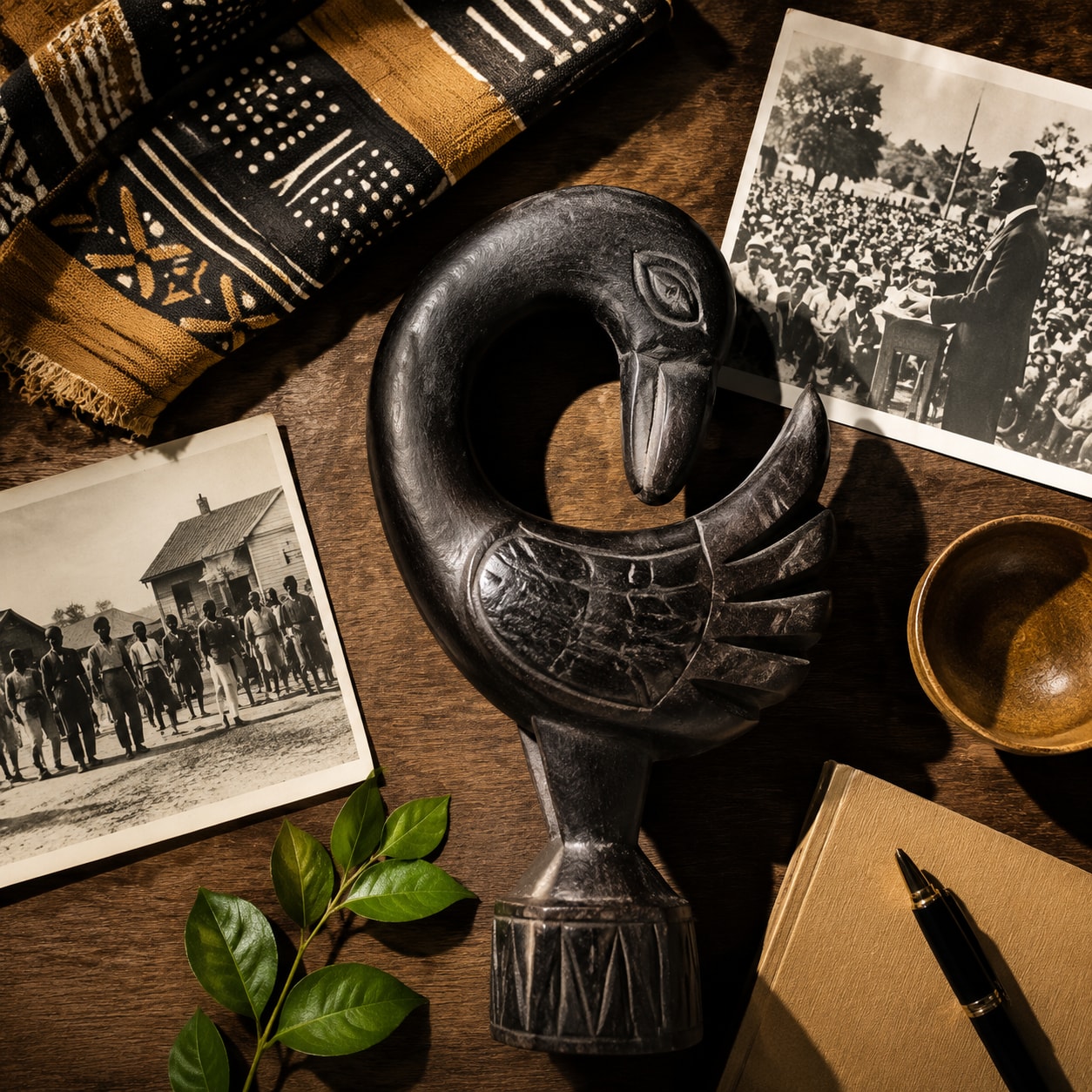
Sankofa offers a culturally rooted invitation to recover valuable knowledge from the past. Used carefully as an editorial framework, it can help communities reflect on history, understand interconnected justice issues, and choose responsible collective action.
Why This May Be Our Sankofa Moment
Calling this “our Sankofa moment” is an editorial invitation, not a claim about a current trend. It asks what communities might understand differently if they deliberately looked back before deciding how to move forward.
Sankofa is associated with retrieving valuable knowledge or experience from the past and carrying it into the present for the sake of future progress. That meaning offers a useful frame for justice work: remembrance can be more than an exercise in recounting events. It can help a community recognize neglected lessons, reconsider inherited assumptions, and approach present responsibilities with greater care.
This application should remain grounded in the concept’s Akan cultural origins. Sankofa is not simply a general slogan about nostalgia, nor does looking backward guarantee agreement about what should happen next. The invitation is narrower and more demanding: recover what has been forgotten, examine why it matters now, and let that learning inform the future.
What Sankofa Means
Sankofa is a word and Adinkra concept rooted in the Akan language and culture of Ghana. Its literal meaning is commonly summarized in English as “go back and get it.” A related proverb conveys that it is not wrong to return for something that has been forgotten.
The idea does not ask people to remain in the past. It presents return as a purposeful act of recovery. What is retrieved—knowledge, experience, memory, or another valuable inheritance—is brought into the present and used in moving toward the future.
That distinction matters when Sankofa is discussed in justice settings. Remembering history is not automatically the same as learning from it. A community can commemorate the past without asking which voices were excluded, which lessons were neglected, or how inherited patterns remain relevant. A Sankofa-centered reflection presses further: What was left behind that needs to be recovered, and how might it shape what happens next?
The available sources for these linguistic and cultural descriptions are secondary sources, and most do not provide publication dates. Their explanations support this introductory account, but culturally specific interpretations should be checked against authoritative Akan cultural or academic sources before formal publication or use as definitive teaching.
Reading the Sankofa Symbols
Sankofa is commonly represented in two visual forms. One is a bird whose feet point forward while its head turns backward to retrieve an egg. The other is an abstract, heart-shaped design.
The bird holds together two directions: its body is positioned to move ahead, but it turns back for something valuable. The egg can be understood as the knowledge or experience being recovered. The image therefore communicates movement toward the future without abandoning what the past can teach.
The abstract form carries the same broad principle without depicting the action literally. Both forms have been used to express the value of retrieving knowledge from the past, bringing it into the present, and applying it to future progress.
These symbols should be approached as culturally rooted forms rather than decorative shorthand. In a community setting, learning where they come from and what they communicate can be part of the reflective work itself. The central lesson is not merely to look backward; it is to recover something of value and carry it forward with purpose.
Memory, Cultural Roots, and Identity
Sankofa imagery has been adopted in African American communities and across the wider African diaspora as an expression of historical reflection, cultural reconnection, and identity affirmation. In these settings, looking back can support efforts to understand histories that have been disrupted, neglected, or separated from everyday community life.
Cultural recovery can also influence how people locate themselves in the present. Learning about inherited traditions and historical experiences may help a community name what it values, recognize sources of resilience, and consider what it wants to carry forward. Identity affirmation, in this sense, is connected to memory rather than detached from it.
No single account can represent every African American or African diaspora experience. Communities differ in history, geography, tradition, and relationship to Sankofa. The symbol’s adoption across diaspora contexts should therefore not be treated as evidence that everyone understands or uses it identically.
A responsible community discussion can acknowledge that variety while keeping the documented themes in view: historical reflection, reconnection with cultural roots, and affirmation of identity. This approach allows Sankofa to open inquiry without turning a culturally specific concept into a universal formula.
Connecting Memory to Interconnected Justice Issues
Racial justice work spans multiple, related areas. Open Society Foundations identifies education, housing, voting rights, public memory, hate speech, and community power building among the fields relevant to its racial justice work. Placing these issues beside one another helps show why justice cannot always be understood through a single policy area.
Historical reflection can clarify those connections. Public memory influences whose experiences are preserved and how a society explains its institutions. Education affects which histories people encounter. Housing and voting rights concern access to resources and civic power. Hate speech can shape who is treated as belonging, while community power building concerns people’s capacity to participate in decisions that affect them.
Using Sankofa to organize this reflection is an editorial application, not a documented universal method. One way to apply it is to begin with a defined present issue and ask what relevant history has been overlooked. A group examining education, for example, might first identify which community experiences are absent from its shared account. A group concerned with public memory might ask how existing narratives affect present belonging and power.
The purpose is not to force every issue into one explanation. It is to examine whether historical knowledge reveals relationships that a narrow view would miss. Once those relationships are visible, a community can choose a more focused area for action while remaining aware of the wider context. Looking back becomes a means of understanding the present more fully, not a substitute for present-day participation or decision-making.
What a Supportive Community Practice Can Include
The Sankofa Black Alliance at Carnegie Mellon University provides one documented example of community practice. Its stated mission includes fostering a friendly, supportive environment. Its activities include workshops, discussion groups, and social events intended to encourage community participation, cultural-awareness education, and support for members.
This example suggests several components that congregations and community groups can consider:
– A sense of belonging, so participants are welcomed as members of a community rather than treated only as an audience. – Mutual support, recognizing that engagement involves relationships as well as information. – Cultural learning, supported through intentional educational opportunities. – Structured conversation, giving participants space to examine ideas together. – Social connection, which can help sustain participation beyond a single formal event.
These elements do not constitute a universal template. A university alliance and a congregation, neighborhood group, or volunteer organization operate in different settings. Each group must consider its own participants, responsibilities, and capacity.
The example nevertheless demonstrates that cultural awareness and community support can be joined with practical forms of participation. A group exploring Sankofa might therefore ask not only what program it wants to hold, but also what kind of environment participants need in order to learn, contribute, and remain connected.
A Reflection-to-Action Framework for Groups
The following sequence is editorial guidance derived from the sourced themes. It is not an established or universal Sankofa method.
1. Identify a neglected history. Choose a specific event, experience, tradition, or community contribution that has been forgotten, minimized, or left outside the group’s usual account. Keep the inquiry bounded enough to support careful learning.
2. Listen to affected communities. Ask who carries knowledge of that history and who is most closely connected to the present issue. Create opportunities for participation rather than deciding in advance what the recovered lesson must mean.
3. Connect the past to one defined issue. Consider whether the recovered history clarifies a present concern such as education, housing, voting rights, public memory, hate speech, or community power building. Name the connection carefully instead of assuming that every past pattern continues unchanged.
4. Choose a bounded next step. Select an action appropriate to the group’s role and capacity. It might involve cultural education, a workshop, a discussion group, stronger mutual support, or another form of community participation. The choice should follow from what the group has learned rather than from a predetermined program.
5. Return and reflect again. After taking action, review what participants learned, whose perspectives shaped the process, and what remains absent. Sankofa’s emphasis on retrieval can support an ongoing practice: communities may need to revisit the past as their understanding develops.
This framework moves from remembrance toward accountable participation without treating reflection alone as the completed work. It also avoids requiring a group to address every interconnected justice issue at once. The immediate goal is to recover one meaningful lesson, connect it to a defined present concern, and take one informed, community-centered step.
Questions for Congregational or Community Reflection
A congregation or community group can begin with questions that connect memory, participation, and responsibility:
– Whose histories are preserved in our shared stories, and whose histories receive less attention? – What knowledge, experience, or cultural memory might our community need to recover? – Which present justice issue becomes clearer when we examine that history? – Who is most closely connected to this history and issue, and how will those people help shape the response? – Does our community provide belonging, cultural learning, mutual support, and meaningful opportunities to participate? – What one action is appropriate to our role and current capacity? – When will we return to assess what we learned, what changed, and what we still need to understand?
The call to action is intentionally focused: invite your congregation or community group to identify one lesson that should be recovered from its history, examine how it relates to a present justice issue, and choose one informed, community-centered next step. The aim is not to settle the past in a single conversation. It is to establish a practice in which memory informs participation and collective action remains open to further learning.
Disclosures and limitations
– This article was drafted with AI assistance from the supplied research package and approved content plan; it should receive human editorial review before publication. – The article relies on the supplied secondary-source summaries, including material concerning Sankofa and institutional descriptions from Carnegie Mellon University and Open Society Foundations. Most supplied sources did not include publication dates, and culturally specific claims should be checked against authoritative Akan cultural or academic sources before publication. – No products, prices, ratings, or user reviews were included in the research package. This article contains no product recommendations or disclosed affiliate offers; any future addition of commercial links should clearly disclose the relevant affiliate relationship.
Sources
– Přehlídka veteránů – zasloužilí mistři sportu v 80. a 90. letech (1. část) — Články — Hard rock & Heavy metal — 80. léta — Svět — Bigbít — Česká televize — ceskatelevize.cz – 🍚🇬🇭 SANKOFA | Read Aloud with the Author | Brightly Storytime – YouTube — youtube.com – John Shehata – NewzDash | LinkedIn — linkedin.com – Sankofa – Wikipedia — en.wikipedia.org – Harvard professor Lawrence Lessig on why AI and social media are causing a free speech crisis for the internet — The Verge – Sankofa Black Alliance – Human Resources – Carnegie Mellon University — cmu.edu – Sankofa — Adinkra Symbols & Meanings – Racial Justice — opensocietyfoundations.org – The UN chief on a visit to Damascus urges the international community to support Syrian people — CTVNews – Politika a současné události – Knihy na Google Play — play.google.com