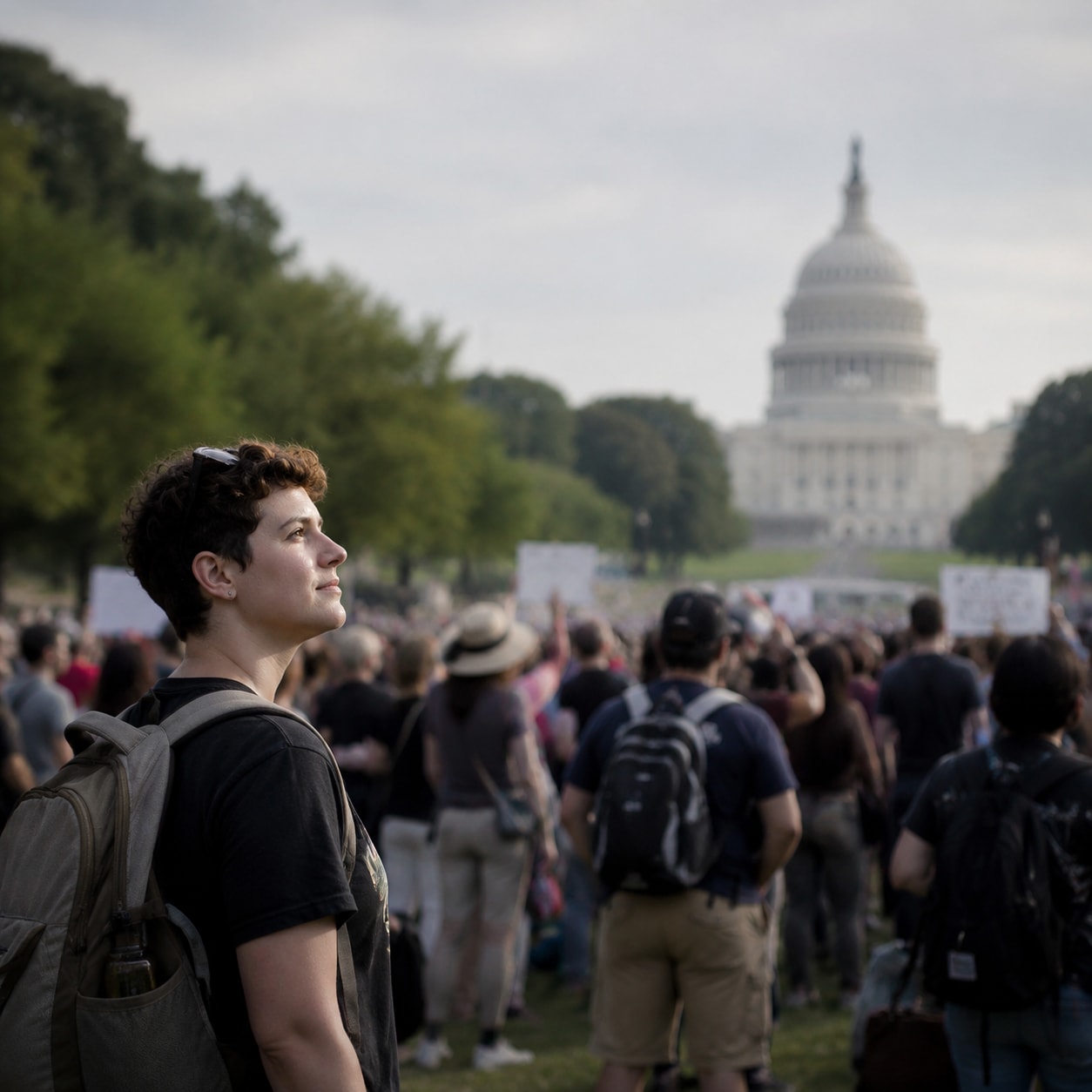
A historically bounded explanation of how the 2012 and 2016 Reason Rally gatherings framed secular identity, community, representation, and participation in public life.
Reason Rally in brief
Reason Rally offers a historical lens for examining how secular Americans sought greater visibility, community, and participation in US public life. The first gathering took place in Washington, D.C., in 2012, followed by a second in 2016.
The rallies were presented as public celebrations of atheist, humanist, and secular identities. Their stated purposes also extended beyond celebration: organizers emphasized challenging stereotypes about non-theists, encouraging openness about secular identity, supporting critical thinking and fact-driven public policy, and demonstrating the political presence of secular Americans.
These events should be understood in their historical context. The available sources document the rallies and their organizers’ stated aims, but they do not establish the present condition of the coalition or secular organizing.
The 2012 and 2016 gatherings
The first Reason Rally was held on the National Mall in Washington, D.C., on March 24, 2012. A second rally took place at the Lincoln Memorial on June 4, 2016. Together, the gatherings created visible public occasions centered on secular identity and the place of non-theists in civic life.
The stated goals attributed to the first rally included encouraging secular Americans and their supporters to be open about their identities, countering negative stereotypes about non-theists, and seeking equal political representation. The second gathering continued Reason Rally’s use of a prominent national setting for collective secular visibility.
The retained evidence does not support a settled attendance figure for the 2012 event. Estimates vary substantially, and no official National Mall crowd estimate is available in the supplied material. Crowd size therefore should not be used here as a measure of the rallies’ meaning or reach.
Visibility and the challenge of secular stigma
One of the first rally’s documented concerns was that negative social attitudes could make some secular people hesitant to disclose their identities. Its stated goals connected greater openness with an effort to challenge stereotypes about non-theists.
In this framing, visibility was not simply a matter of attracting public attention. It was also about making secular people more recognizable as participants in their communities and in public life. Encouraging people and their supporters to speak openly presented secular identity as something that could be acknowledged collectively rather than managed only in private.
The effort to counter stereotypes was closely related to that goal. A large public gathering could show that people identifying as non-theists were present and interested in being represented. The evidence establishes that challenging negative perceptions was an explicit aspiration of the first rally; it does not establish how individual attendees experienced stigma or whether the event changed broader public attitudes.
That distinction matters. The available material can explain what organizers wanted the gathering to accomplish, but it cannot demonstrate that openness became easier or that stereotypes diminished afterward.
Creating community across secular identities
The Reason Rally Coalition described itself as a nonprofit organization holding large events that celebrated atheist, humanist, and secular identity while demonstrating the political presence of secular Americans. This description presents community-building and public participation as connected parts of the rally’s purpose.
A collective event could provide a shared setting for people using several secular or nonreligious identities. The research package identifies atheist, agnostic, humanist, freethinking, secular, and nonreligious people as among those who may seek opportunities for community and collective celebration. The coalition’s own description supports the broader point that the rally was intended to offer such a public occasion.
The event’s framing did not require every participant to use an identical label. Instead, its documented emphasis was on gathering around overlapping secular identities and interests. That offers a useful way to understand belonging at Reason Rally: not as proof of a single, uniform secular community, but as an organized attempt to create common public space across related identities.
The sources establish this intention, not its success for every participant. They do not contain individual testimony sufficient to describe how attendees experienced the gathering.
Political representation and fact-driven public policy
Reason Rally’s stated purposes also concerned political participation. Goals attributed to the first gathering included securing an equal place for non-theists in public decision-making. The coalition described its events as demonstrating the political presence of secular Americans.
Organizers connected that presence with critical thinking and fact-driven public policy. In this context, the rally was framed as more than a celebration of identity: it was also an argument that secular Americans should be recognized as participants in civic and political life.
These themes linked representation to visibility. If people hesitate to identify publicly as secular, their presence may be less apparent; the first rally’s call for openness and its demand for equal representation addressed those concerns together. The rally’s public setting made that connection especially visible, although the supplied evidence does not establish specific policy changes resulting from either event.
The organizers’ language should be read as a statement of values and objectives. It documents an effort to promote fact-driven policy, critical thinking, and political participation, but it does not show that all secular Americans shared one political program or that the rallies produced measurable changes in representation.
From a national gathering to local participation
The coalition said it wanted attendees to carry the rally’s message back to their local and state communities. That aspiration positioned the national gathering as a starting point for continued participation rather than an end in itself.
The available source does not specify a single required form for that local engagement. Its documented point is narrower: organizers hoped the rally’s themes would travel into the communities where attendees lived. Those themes included secular visibility, collective identity, critical thinking, fact-driven policy, and political participation.
For present-day readers, this history can serve as a prompt for local reflection. Communities can examine how they approach secular identity, belonging, respectful participation, and equal representation. Any action based on current circumstances, however, should rely on current local information rather than assuming that the conditions described around a historical rally remain unchanged.
The coalition’s statement records an intention to encourage local and state participation. It should not be treated as evidence that attendees subsequently organized in particular places or achieved particular outcomes.
What the available sources cannot establish
The evidence retained for this explanation is limited and historical. It consists primarily of an organizer page published in 2018 and a secondary summary of events held in 2012 and 2016. These sources support the dates, locations, descriptions, and stated goals discussed above, but they do not provide a current account of the coalition.
They do not establish whether another Reason Rally is planned, the coalition’s status in 2026, or the present condition of secular organizing. They also do not support claims that Reason Rally is currently receiving increased public or search interest.
Attendance at the 2012 rally is another point of uncertainty. Reported estimates vary substantially, and the supplied material identifies no official National Mall count. No single attendance number should therefore be presented as settled fact.
Finally, organizer statements document aspirations, not verified outcomes. Claims that the rallies changed stereotypes, improved representation, strengthened local organizations, or affected public policy would require additional evidence not included in the research package.
Questions for community reflection
Reason Rally’s documented themes can help communities consider how identity, belonging, and public participation intersect. Useful questions include:
– Can people identify as secular or nonreligious without being reduced to negative stereotypes? – How does the community make room for atheist, agnostic, humanist, freethinking, secular, and other nonreligious identities? – Are non-theists able to participate respectfully and equally in shared civic decisions? – How are claims evaluated when a community discusses public policy, and what role do evidence and critical thinking play? – Does the community provide opportunities for people with different identities to gather without assuming that they hold identical views? – What current local information is needed before deciding whether action is appropriate?
These questions draw from the rallies’ stated concerns rather than asserting that every community faces the same conditions. They can support reflection among secular people, faith communities, educators, organizers, and other local participants while keeping current conclusions grounded in current evidence.
Disclosures and limitations
– This article was prepared with AI assistance from the supplied Content Plan and Research Package and should receive human editorial review before publication. – The factual basis is limited primarily to a Reason Rally organizer page published in 2018 and a secondary Wikipedia summary of the 2012 and 2016 events. Organizer statements are presented as stated goals rather than verified outcomes. – The sources do not establish current coalition activity, plans for another rally, conditions in 2026, or a settled attendance figure for the 2012 event.
Sources
– Reason Rally – Wikipedia — en.wikipedia.org – Interactive report dimensions – Nápověda Google Ad Manager — support.google.com – Strategic Reflections From Moscow — sonar21.com – Speeches Archives – CSCE — CSCE – About – Reason Rally — Reason Rally | – This is why Rally is so great 2005 WRC – YouTube — youtube.com – Putin řekl Macronovi, že je odhodlán pokračovat ve válce. Je to špatné, hlásí Paříž | Aktuálně.cz — Aktuálně.cz – Víte, co se právě děje – The Blogs: The Faith & Media Initiative releases new survey findings — blogs.timesofisrael.com – Checking your browser – reCAPTCHA — pmc.ncbi.nlm.nih.gov – 2020–21 United States election protests – Wikipedia — en.wikipedia.org