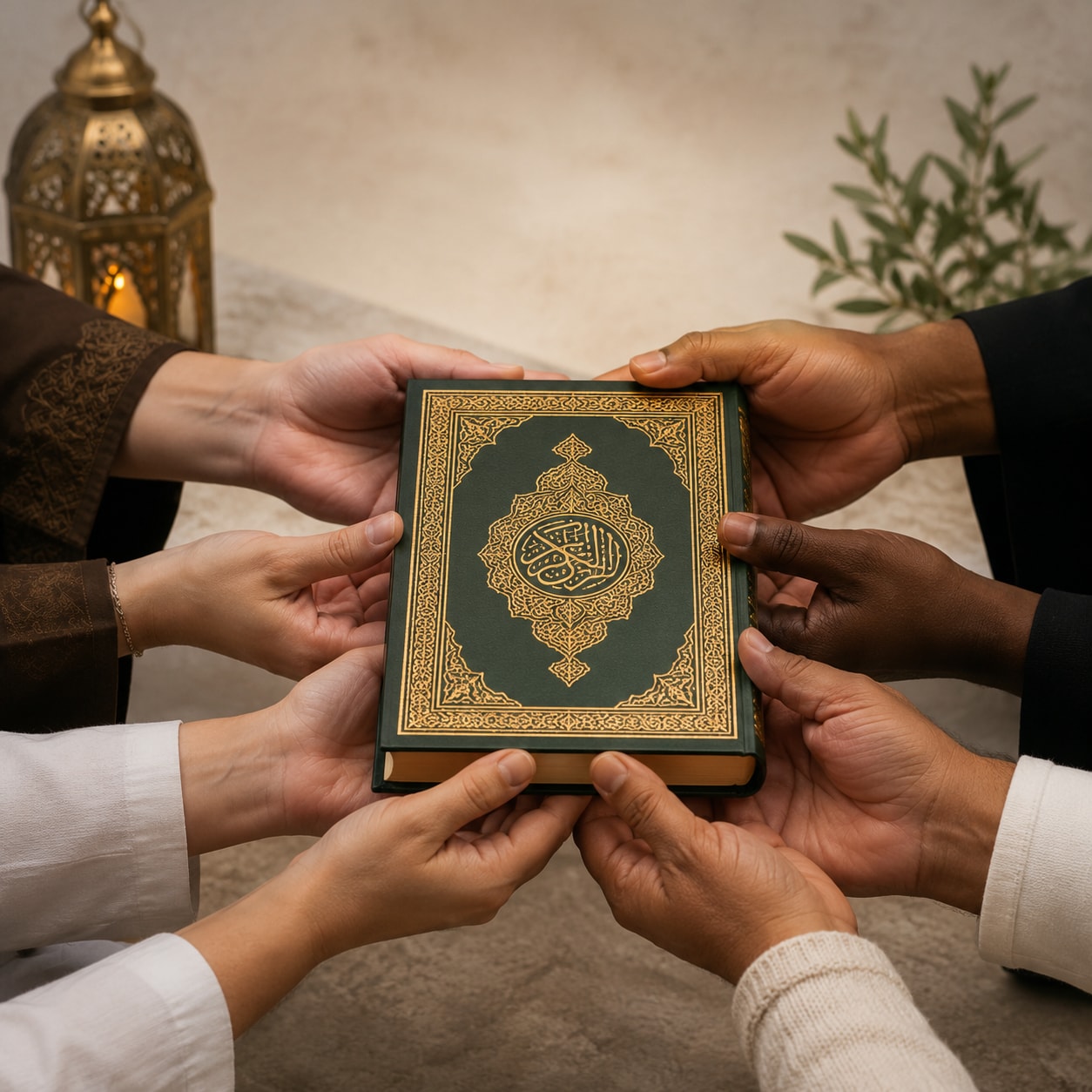
An evidence-based introduction to religious freedom, the significance of the Quran, a documented case of interfaith de-escalation, and practical principles for responding to religious hostility without amplifying unverified claims.
What Religious Freedom and Quran Solidarity Mean
The Quran is the central religious text of Islam and is regarded by Muslims as revelation from God. Respect for the Quran therefore concerns more than an object or publication: it involves respect for a community’s religious commitments and freedom of belief.
In this context, Quran solidarity does not require agreement on theology. It means defending the human dignity and religious freedom of Muslims when their sacred text or religious identity becomes a target of hostility. The same principle applies across religious and nonreligious traditions: people should be able to hold and express beliefs without being treated as less worthy of protection.
This understanding aligns with the human-rights framework for freedom of thought, conscience, and religion. That framework protects both personal conviction and the ability to manifest a religion or belief. Interfaith solidarity can put those protections into practice by supporting affected communities while respecting genuine theological differences.
The U.S. Constitutional Foundation for Religious Freedom
The First Amendment provides the central constitutional foundation for religious freedom in the United States. It states that Congress may make no law “respecting an establishment of religion” or “prohibiting the free exercise thereof.” These establishment and free-exercise protections create a civic basis for opposing both government establishment of religion and government interference with religious exercise.
Together, the clauses help explain why solidarity across faiths can be a constitutional concern as well as a moral one. Protecting a Muslim community’s religious freedom does not establish Islam, just as protecting another community’s freedom does not endorse its theology. It affirms that religious liberty should not depend on whether a belief is held by a majority or minority.
The constitutional language does not eliminate disagreement. Religious-freedom disputes can involve competing legal interpretations, questions about particular practices, and concerns about the relationship between religion and government. A responsible discussion should therefore distinguish the broad constitutional commitment from claims about how that commitment applies in a specific dispute. The First Amendment supplies the governing principles, but it does not justify treating every contested question as already settled.
Religious Freedom as a Universal Human Right
Religious freedom also has an international human-rights foundation. Article 18 of the Universal Declaration of Human Rights protects freedom of thought, conscience, and religion. Its scope includes the freedom to hold or change a religion or belief and to manifest it in public or private, alone or together with others.
This framework matters because religious life can be both inward and communal. It protects personal conviction while also recognizing worship, observance, and other outward expressions of belief. It likewise avoids reducing religious freedom to the concerns of any single tradition.
Applied to Quran solidarity, Article 18 offers a clear starting point: the relevant question is not whether an observer shares Muslim beliefs, but whether Muslims can hold and manifest their religion with the same human dignity owed to others. Solidarity grounded in this principle protects freedom rather than demanding theological agreement.
Case Study: Interfaith De-escalation After an Unproven Quran-Desecration Allegation
A report from Karachi in July 2026 offers a carefully bounded example of interfaith action during a potentially dangerous dispute. According to the report, tensions arose after unproven allegations involving a desecrated Quran page threatened a Christian family and generated risks extending to the wider Christian community.
The allegation’s unproven status is essential context. A sacred-text controversy can spread fear and anger before authorities establish what happened. In this case, authorities promised an investigation, and the protest was called off. The report attributes the de-escalation to timely official action and cooperation among Muslim religious leaders, Islamic seminary students, local politicians, and other community members.
Their participation demonstrates one form that interfaith solidarity can take. Muslim participants could affirm the Quran’s sacred significance while helping prevent an unverified allegation from producing wider harm. Authorities could respond to community concern without treating the accusation as proven. Community relationships helped connect people capable of calming the situation.
The peaceful outcome did not erase the underlying danger. The report says Christian communities remained anxious and vulnerable when blasphemy allegations arose. The incident therefore should not be told simply as a reassuring story. It is also an example of how an allegation concerning a sacred text can place both an accused person and a broader religious minority at risk.
What the Karachi Case Suggests—and What It Cannot Prove
The Karachi account suggests that relationships established before a crisis can support a faster response. The report says long-standing local connections and earlier interfaith-harmony seminars helped the Catholic Commission for Peace and Justice contact authorities and supportive clerics quickly. That sequence indicates the practical value of knowing whom to call before tensions escalate.
The reported response also suggests that effective de-escalation can involve several kinds of participants at once: religious leaders who can address community concerns, public officials who can promise a lawful investigation, and community members who can resist collective blame. None of these roles makes an unproven claim true; their value lies in helping create space for facts and lawful processes.
The limits of the example are equally important. One peaceful resolution does not demonstrate a broad improvement in minority safety, public attitudes, or respect for the rule of law. The account relies substantially on statements attributed to a representative of the Catholic Commission for Peace and Justice. It cannot establish how common similar interventions are or whether they have wider national effects. The case is best treated as a specific episode with cautious practical lessons, not proof of a larger transformation.
Sacred Texts, Public Office, and a Common U.S. Misconception
U.S. controversies involving sacred texts sometimes rest on a mistaken assumption: that eligibility for federal office or a valid oath depends on using a particular religious book. The Constitution prohibits religious tests for federal public office. The House of Representatives’ collective official oath does not use a religious text.
A Bible, Quran, or another text may appear in a later ceremonial reenactment, but that ceremony is distinct from the collective official oath. Recognizing the difference prevents a personal religious choice from being misrepresented as a constitutional qualification.
This distinction has broader importance for religious freedom. Turning an officeholder’s sacred text—or decision not to use one—into a test of eligibility can turn religious identity into a dispute over national belonging. Constitutional rules do not make adherence to one faith, or the use of one faith’s scripture, a condition of federal public service. Public discussion should distinguish official requirements from symbolic choices made during later ceremonies.
A Cautious Framework for Interfaith Solidarity
The available evidence supports a practical but cautious framework for interfaith action:
1. Begin with freedom of belief. Defend each person’s ability to hold and manifest a religion or belief, publicly or privately and individually or with others.
2. Do not amplify an unverified allegation. The Karachi case shows how a claim involving a sacred text can endanger an accused person and a wider religious community. Preserve the distinction between an allegation and an established fact.
3. Build relationships before a crisis. The reported value of established local ties and earlier interfaith seminars suggests that advance relationship-building can make rapid contact possible when tensions arise.
4. Engage people able to de-escalate responsibly. Depending on the circumstances, this may include trusted religious leaders, community members, and public officials. In the Karachi report, cooperation among these groups accompanied a promised investigation and the end of the protest.
5. Reject religious tests of belonging. U.S. federal office does not depend on adherence to a particular religion or use of a religious text in the official House oath. Sacred-text choices should not be turned into proxies for civic legitimacy.
6. Avoid sweeping conclusions. A constructive intervention may offer useful lessons without proving that conditions have broadly improved.
For congregations, educators, organizers, and volunteers, the immediate call is to strengthen trusted interfaith relationships, verify claims before reacting, and use constitutional and human-rights principles to guide solidarity with communities facing religious hostility.
Evidence Limits and Source Notes
This article addresses an editorial topic rather than a demonstrated search or news trend. The supplied research does not document a U.S.-based Quran-solidarity campaign or provide representative public-opinion data, so it cannot establish the prevalence or national impact of such activity.
The Karachi material supports a single case study, not a general conclusion about minority safety or the rule of law. Several background sources are secondary rather than primary legal or institutional records. Constitutional and historical details should therefore be checked against primary sources before publication. In addition, acquisition timestamps show when material was collected but do not establish when every underlying source was published or last updated.
Disclosures and limitations
– This article was drafted with AI assistance strictly from the supplied Research Package and approved Content Plan; no personal testing, purchasing, interviews, or firsthand experience is claimed. – Material claims are attributed through the listed sourceIds. The research package identifies limitations including reliance on secondary sources, incomplete publication-date information, and the narrow scope of a single Karachi case study. – No products or commercial services are recommended in this article, and no affiliate relationship is represented. Any future commercial links should be reviewed and clearly disclosed before publication. – Constitutional and historical details drawn from secondary materials should be verified against primary legal or institutional sources before publication.
Sources
– Freedom of religion in the United States – Wikipedia — en.wikipedia.org – Aims and values | European Union — European Union – Religious freedom | fm.gov.om — fm.gov.om – Pakistan: Interfaith action averts violence against Christian family – Vatican News — vaticannews.va – News – Ministry of National Defence – Gov.pl website — Ministry of National Defence – Interfaith America | LinkedIn — linkedin.com – An Analysis of Prophet Muhammad’s Covenants with Christians – Wikisource, the free online library — en.wikisource.org – Quran oath controversy of the 110th United States Congress – Wikipedia — en.wikipedia.org – Quran – Wikipedia — en.wikipedia.org – Freedom of religion or belief — EEAS