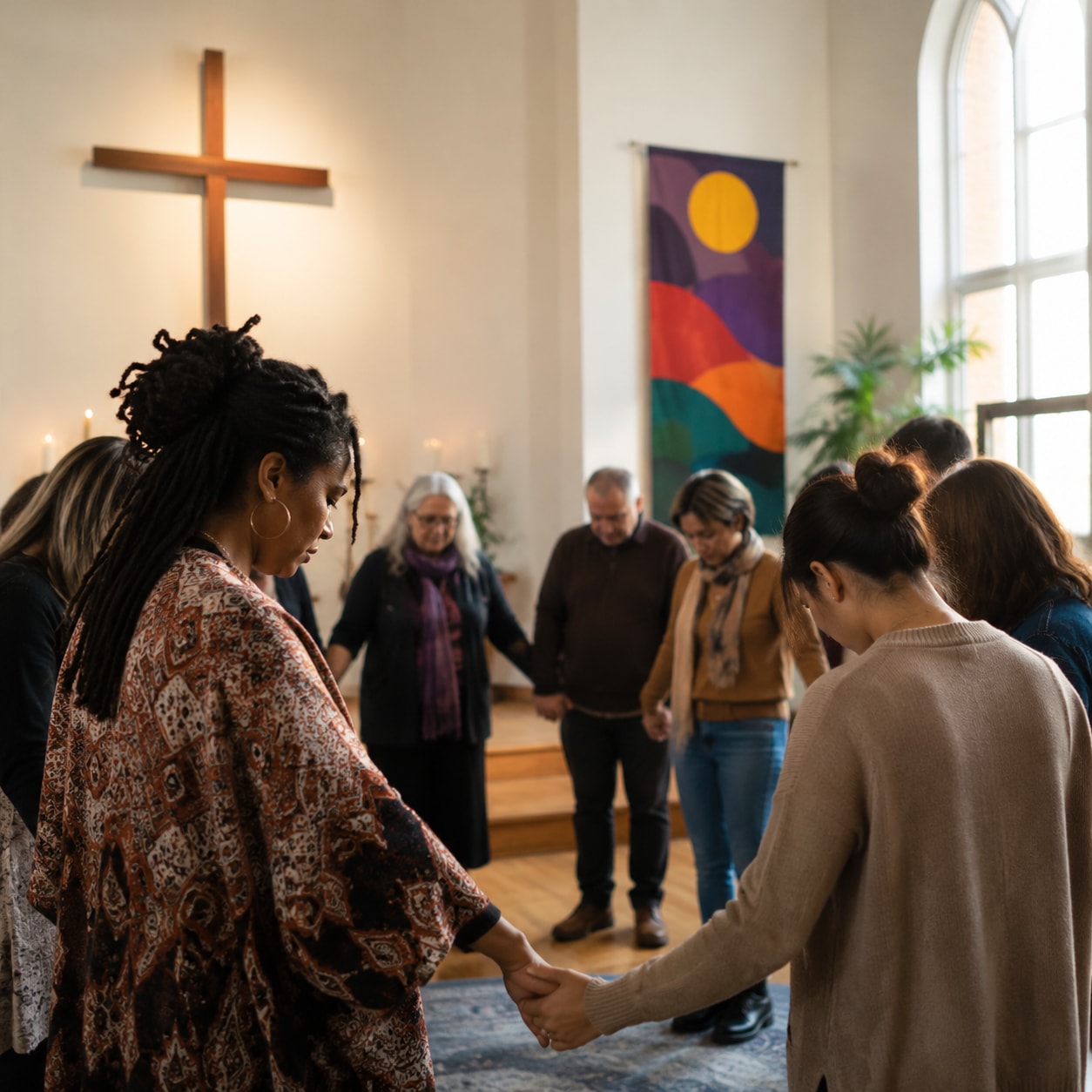
An evidence-backed framework for helping faith communities connect bodily autonomy and human dignity with age-aware worship, education, reflection, partnership, and action.
What reproductive justice means
Reproductive justice is a human-rights framework centered on the conditions people need to make meaningful decisions about their bodies and families. SisterSong defines it through four connected rights: maintaining personal bodily autonomy, having children, not having children, and parenting children in safe and sustainable communities.
This definition gives faith communities a wider starting point than a discussion of any single medical procedure or legal question. It asks planners to consider both personal decisions and the social conditions surrounding those decisions. An all-ages resource can therefore introduce reproductive justice through the shared values of human dignity, bodily autonomy, family well-being, and communities in which people can live safely.
The framework should not be reduced to one prescribed family structure or reproductive outcome. Its central concern is whether people can make decisions without oppression and whether they have the conditions necessary to care for themselves and their families.
Where the reproductive justice framework came from
The term “reproductive justice” emerged in 1994 from a group of Black women gathered in Chicago. This history matters because the framework was developed to address experiences and inequalities that a narrower account of individual rights did not adequately capture.
SisterSong was formed in 1997 to build a national, multiracial reproductive justice movement. Its movement-building role helps explain why reproductive justice joins bodily autonomy to broader questions of race, resources, safety, and community conditions.
A worship or educational resource should preserve this historical context. Naming the framework’s origins recognizes the leadership behind it and helps participants understand that reproductive justice is not simply a new label for reproductive rights.
Why reproductive justice goes beyond legal rights
A rights-based framework commonly asks whether a person is legally permitted to make a reproductive decision. Reproductive justice also asks whether that person can exercise the right in practice. Legal protection alone does not provide transportation, make care affordable, shorten the distance to a provider, or ensure that an appropriate service exists.
The framework therefore examines how power, resources, economics, environment, and culture shape real choices. A nominal right may remain inaccessible when cost, travel, or unavailable services stand between a person and the care they need. These barriers do not affect everyone in the same way because people enter health and social systems with different resources and experiences of inequality.
For worship planners, this distinction changes the guiding question. Instead of discussing “choice” only as an individual decision, participants can be invited to consider what makes a decision genuinely available. That approach connects bodily autonomy with the material and social conditions required to exercise it.
Why this belongs in worship and faith formation
Faith organizations have presented reproductive justice as both a human-rights concern and a subject of religious public witness. The Unitarian Universalist Association places reproductive justice within its broader bodily-autonomy work and provides resources for worship, spiritual nourishment, congregational reflection, and a Reproductive Justice Sunday.
These materials support an approach that does more than announce a position. Worship can name the dignity at stake, faith formation can develop shared understanding, and reflection can help participants consider how their values relate to community conditions and public life.
The topic can also be integrated with ongoing congregational formation instead of confined to a single service. The available resources indicate that worship, education, spiritual reflection, and congregational discernment can function as connected parts of the same ministry.
Center interconnected experiences without reducing the issue to abortion
Abortion is part of reproductive justice, but it is not the whole framework. Source materials also connect reproductive justice with contraception, comprehensive sexuality education, prevention and care for sexually transmitted infections, prenatal and pregnancy care, support related to domestic violence, adequate family income, and safe housing.
This broader scope helps a congregation see how health care and family decisions are shaped by surrounding conditions. It also makes room to examine the intersecting effects of racial and economic inequality, gender, LGBTQIA+ justice, and disability justice. The UUA explicitly places reproductive justice alongside these concerns within bodily-autonomy work.
Planners can reflect this interconnectedness by using examples from more than one area and by avoiding language that treats every participant as having the same body, family, economic resources, or access to care. The purpose is not to cover every issue in a single gathering. It is to make clear that reproductive freedom depends on more than one legal question and that different forms of inequality can shape people’s practical options.
Build an age-aware, all-ages approach
An all-ages approach does not require every participant to receive identical content. The UUA describes Our Whole Lives as a comprehensive, medically accurate, age-appropriate sexuality education program spanning multiple life stages and developed with the United Church of Christ. That model supports a basic planning principle: preserve a common theme while adapting the depth and form of participation to people’s stages of life.
A congregation might organize its planning around shared concepts such as dignity, care, bodily autonomy, and safe communities, then decide locally how those concepts should be communicated to different participants. The available research does not provide a complete all-ages order of service or detailed activities for each age group, so it should not be represented as a ready-made curriculum.
Planners should distinguish clearly between sourced material and their own local adaptations. They should also identify what additional age-specific educational and safeguarding guidance is needed before presenting sensitive content to children or young people.
Combine worship, education, reflection, partnership, and action
The UUA’s collection points to several complementary forms of engagement: a worship resource center, guidance for holding a Reproductive Justice Sunday, life-stage sexuality education, spiritual-nourishment materials, small-group reflection, and congregational guidance. Together, these suggest a planning structure with five connected elements:
– Worship: Establish a shared moral and spiritual frame grounded in bodily autonomy and human dignity. – Education: Explain the reproductive justice framework and distinguish practical access from legal rights alone. – Reflection: Give participants structured opportunities to consider how the topic relates to faith and community life. – Partnership: Discern how relationships can connect the congregation’s learning with wider reproductive justice work. – Action: Conclude with a specific next step rather than only a general statement of support.
These elements do not all need equal time in one gathering. They can form a sequence across worship, classes, and facilitated groups. What matters is that participants can move from shared language to reflection and then toward a defined congregational response.
Plan facilitated reflection for small groups
The UUA lists five reproductive justice reflection activities designed as 45-minute sessions for groups of 8 to 15 people. This provides a documented format for planners who want to extend learning beyond a worship service.
The research package does not include the activities’ detailed contents, so those details should not be reconstructed or presented as though they came from the source. Instead, planners can use the supported format to reserve adequate time, select an appropriate group size, identify a facilitator, and connect the reflection period to the congregation’s wider learning and discernment.
Small-group reflection can serve as a bridge between public worship and a practical next step. Any locally developed questions or facilitation methods should be labeled as local adaptations rather than attributed to the source collection.
Move from reflection to a practical congregational next step
The available congregational resources connect worship and spiritual reflection with education, partnership, and action. A planning process should therefore end with one bounded next step that participants can understand.
Depending on the congregation’s stage of learning, that step could focus on continued age-appropriate education, another facilitated reflection session, relationship-building with a trusted community partner, or a clearly defined form of collective action. The choice should follow from what the congregation has learned rather than functioning as an unrelated addition to the service.
A useful closing invitation can identify who will coordinate the next step, what form it will take, and how participants can remain involved. This keeps bodily autonomy and human dignity from remaining abstract themes while allowing the congregation to proceed at a deliberate and transparent pace.
Scope, care, and source limitations
The cited materials support a planning framework, not a complete ready-to-use all-ages liturgy. They do not supply detailed activities for every age group, a child-safeguarding protocol, or a verified summary of current law and policy. Any resource created from them should state those limits plainly.
Local planners will need to adapt the framework to their setting and obtain appropriate guidance for areas the research does not cover. They should retain visible source notes, distinguish sourced information from locally created material, and avoid presenting legal or policy claims as current without separate verification.
With those boundaries in view, faith communities can use the framework to connect accurate background, spiritual reflection, age-aware education, and a practical next step without claiming that the source package answers every liturgical, educational, safeguarding, or legal question.
Disclosures and limitations
– This article was drafted with AI assistance from the supplied Content Plan and Research Package. It does not claim personal experience, interviews, product use, or independent field testing. – Material claims are limited to the supplied source records from SisterSong, the Unitarian Universalist Association, the United Church of Christ, and corroborating materials represented by the listed source IDs. Publication dates were unavailable in the supplied research, and current legal or policy conditions were not independently verified. – No products are recommended and no affiliate relationship is represented. If product recommendations or affiliate links are added later, their commercial nature and compensation risk should be disclosed clearly.
Sources
– Reproductive Justice — UUA.org – Reproductive justice – Wikipedia — en.wikipedia.org – Reproductive Rights | Reproductive Rights — justice.gov – Reproductive Justice: What Is It? — WebMD – Reproductive Justice – United Church of Christ — United Church of Christ – EUR-Lex – 52026DC0538 – EN – EUR-Lex — eur-lex.europa.eu – Guaranteeing Reproductive Justice for All — RWJF – What is the difference between reproductive health, rights, and justice? – National Latina Institute for Reproductive Justice — National Latina Institute for Reproductive Justice – Reproductive Justice — Sister Song — Sister Song – Reproductive Justice: Part 1 – YouTube — youtube.com