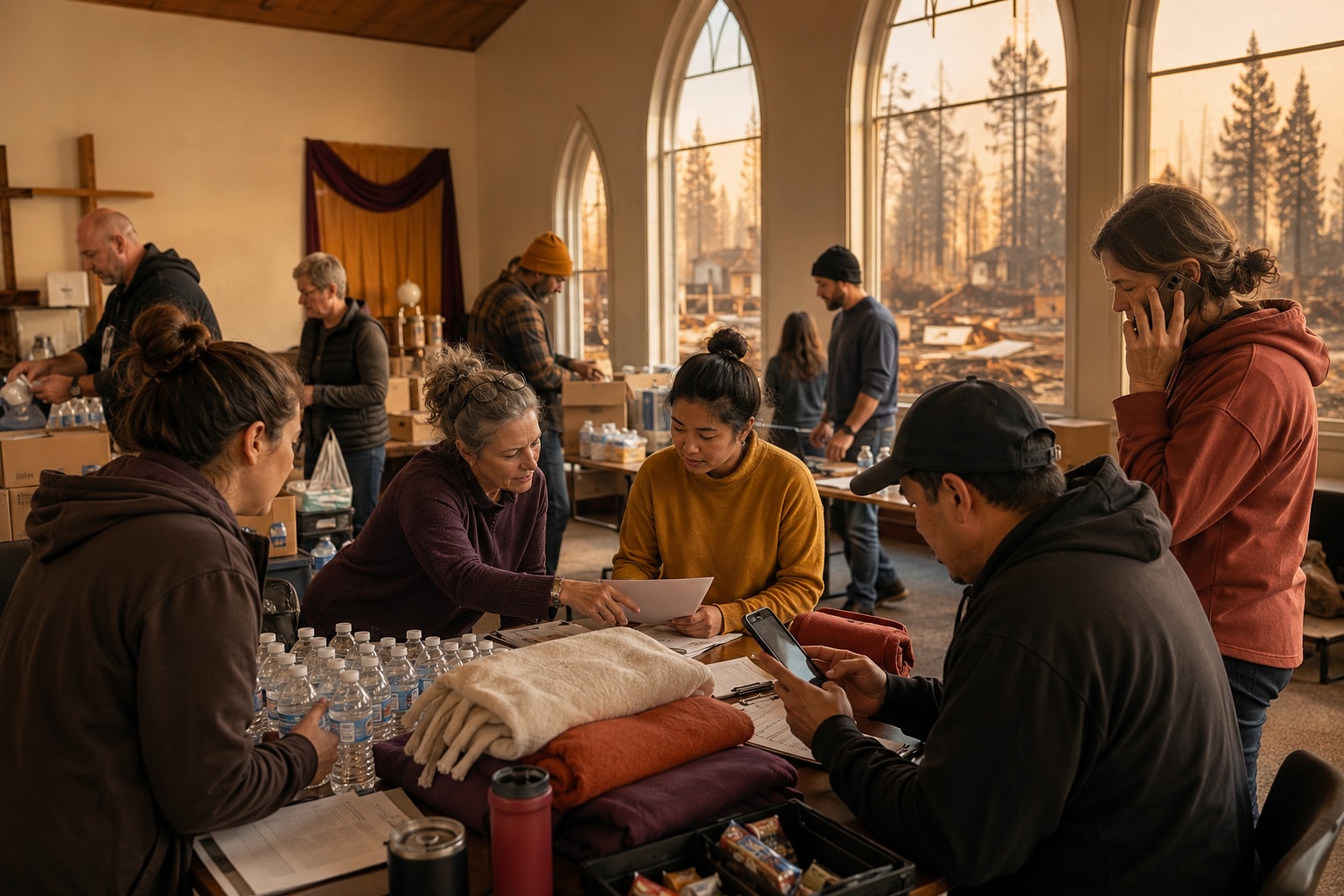
A time-sensitive framework for helping congregations prioritize evacuation safety, coordinate volunteers, address confirmed needs, and prepare for sustained recovery without obstructing emergency operations.
What Is Known About the Spokane Fires—and What May Still Change
The available reports describe a fast-moving emergency affecting Spokane and surrounding communities. By early August 2, 2026, the Old Trails Fire had burned more than 3,500 acres, and parts of Spokane were under Level 3 evacuation orders requiring residents to leave immediately. Strong winds and low humidity affected the Old Trails, Fairview, and Autumn Lane fires. At one point, the Old Trails Fire threatened as many as 5,000 structures.
The effects extended well beyond the fire lines. Spokane opened its convention center to shelter people displaced by the fires. A utility’s real-time map showed nearly 11,000 customers without power across Washington at 6 a.m. local time on August 2, including more than 8,000 in Spokane County. The governor declared a statewide wildfire emergency, and the Washington National Guard was mobilized to assist local responders.
Later reporting contained updated but differently timed damage estimates. The BBC reported that tens of thousands of people had evacuated and cited city officials who said 600 homes had been destroyed as of August 3. RTÉ reported that local officials described hundreds of homes and other structures as damaged or destroyed; at the briefing covered by that report, authorities were still assessing whether anyone had died.
These figures should be treated as dated snapshots, not a final accounting. Fire size, evacuation boundaries, shelter arrangements, outages, damage totals, and casualty information can change quickly. Faith communities should verify the latest official information before making or publicizing response plans.
Put Evacuation Safety and Official Information First
A congregation’s first responsibility is to avoid adding confusion or risk. Level 3 evacuation orders mean residents must leave immediately, while strong winds, low humidity, and rapidly advancing fire can make yesterday’s information—or even information from earlier the same day—unsafe to rely upon.
Designate a response-team member to review current official instructions before every public update, volunteer shift, or assistance effort. When sharing information, preserve its timestamp and clearly distinguish an active instruction from an older situation report. Avoid combining figures from August 2 and August 3 as though they describe the same moment.
Do not send volunteers toward evacuation zones, fire lines, or obstructed roads. One resident’s account described congested roads and escape routes threatened by the advancing fire. At the same time, Washington was dealing with 15 large fires, which state officials said were straining emergency resources. Unrequested traffic, deliveries, or volunteer activity could make an already difficult operating environment worse.
A simple safety rule can guide every decision: if a proposed activity could interfere with evacuation or professional response, pause it until the need, destination, route, and receiving contact have been confirmed. Congregations can reinforce official directions and organize support in safer locations without presenting themselves as emergency authorities.
Organize Around Immediate Displacement and Basic Needs
The documented scale of evacuation, residential destruction, temporary sheltering, and power loss provides a clear starting point for community support. Tens of thousands of people were reported evacuated, hundreds of homes and other structures were reported damaged or destroyed, and Spokane opened the convention center for displaced residents. Power outages affected more than 8,000 Spokane County customers early on August 2.
Begin with confirmed needs rather than assumptions. A small response team can separate inquiries into four categories: safe temporary shelter, essential daily needs, problems caused by outages, and emerging recovery concerns. For each request, record when it was received, whether it remains current, who confirmed it, and whether an official or community operation is already addressing it.
Before collecting goods or directing volunteers, confirm what is needed, in what quantity, where it can be received safely, and whether the receiving location has the capacity to manage it. The provided sources do not identify verified donation channels or establish that particular faith organizations are already conducting relief operations, so congregations should not publicize specific collection points or organizational partnerships without separate confirmation.
The practical goal is not to launch the largest possible response. It is to match available people, space, communication capacity, and other resources to verified gaps while conditions change. Regularly close requests that have been met and reassess requests whose circumstances are unclear.
Coordinate Volunteers Without Burdening Emergency Responders
Volunteer coordination should complement official operations. This is especially important when multiple large fires are drawing on the same emergency resources: state officials reported 15 large fires across Washington and said simultaneous fires in the West were straining capacity.
Create a compact structure with clearly bounded roles. One person can monitor dated official information, another can receive and verify community requests, and another can schedule volunteers only after assignments are confirmed. A separate record keeper can document what was offered, accepted, completed, postponed, or declined. No role should imply authority over evacuations, firefighting, damage assessment, or other professional emergency functions.
Before approving an assignment, ask:
- Is the need current and confirmed?
- Is the location outside hazardous or restricted areas?
- Has a receiving person or operation agreed to the help?
- Could the activity add traffic or distract responders?
- Can volunteers complete it without relying on uncertain power or communications?
- When will the assignment be reviewed again?
Avoid open-ended calls for supplies when quantities, storage, and distribution have not been verified. Likewise, do not dispatch people merely because they are available. The combination of rapid fire movement, evacuation pressure, congested roads, outages, and strained statewide resources makes disciplined coordination part of the aid itself.
Use a Justice-Centered Lens When Assessing Needs
A justice-centered response asks not only how much help is available, but who may be unable to reach it. The reports establish broad pressures: urgent evacuations, major housing loss, temporary displacement, congested escape routes, and widespread power disruption. They do not establish how particular demographic groups have been affected, so organizers should investigate barriers without claiming disparities that the available evidence does not document.
For each confirmed service or offer of support, ask practical access questions. Can displaced people learn about it while power or communications are disrupted? Does reaching it depend on transportation through congested areas? Is the information current, understandable, and explicit about eligibility or capacity? Can people ask for help without repeatedly retelling what happened? Are organizers recording unmet requests rather than treating a referral as proof that the need was resolved?
Use answers from affected people and coordinating operations to adjust the response. Keep observations separate from verified facts: record that someone reported a barrier, when the report was received, and what follow-up is needed. Do not convert an individual report into a claim about an entire population.
This approach keeps equity work grounded in access and accountability. It helps a congregation notice who is being missed while respecting the limits of the current evidence.
Plan for Recovery Beyond the Initial Emergency
Immediate shelter and evacuation support are only the first phase of a disaster response. Reports of hundreds of destroyed or damaged homes—and the BBC’s August 3 figure of 600 homes destroyed—indicate displacement that may continue after the fire’s most urgent phase. However, the available sources do not identify specific long-term service gaps, so congregations should assess future needs rather than presume what survivors will require.
Maintain a dated list of unresolved requests, confirmed assistance, and questions needing follow-up. Review it as evacuation orders, shelter arrangements, power conditions, and damage assessments change. This prevents an early snapshot from becoming a fixed plan after circumstances have moved on.
Congregations can also distinguish between temporary offers and support they can sustain. For every proposed commitment, define its scope, responsible coordinator, review date, and exit or renewal decision. Ask affected people and coordinating operations whether the offer remains useful before extending it.
Continuity matters because attention and volunteer availability may decline while displacement continues. A justice-centered recovery process therefore pairs compassion with reliable follow-through: preserve records, avoid promises beyond the community’s capacity, revisit unmet needs, and adapt only when new information is verified.
A Practical First-Meeting Agenda for Congregational Response Teams
Use the first meeting to establish a safe, reviewable response rather than trying to settle every future decision.
- Date the situation summary. Review the newest official information available about evacuations, sheltering, road safety, outages, and emergency operations. Keep older figures labeled with their reporting times.
- Name the verified pressures. Current reporting documents mass evacuation, extensive housing loss, temporary shelter needs, outages, difficult escape conditions, and strained emergency resources.
- Define safe boundaries. Agree that volunteers will not enter hazardous areas, impede evacuation traffic, or assume professional emergency roles.
- Assign limited roles. Identify who will monitor information, verify requests, coordinate volunteers, and maintain records.
- Confirm gaps before acting. Record the need, time, source of confirmation, receiving contact, safe location, required capacity, and review time.
- List what is not yet known. This may include whether a reported need is still active, whether a receiving site has capacity, or what longer-term support will be requested.
- Schedule reassessment. Set the next review soon enough to account for rapidly changing fire conditions and reported totals.
End with one immediate commitment: verify current evacuation and shelter information through the latest official updates, then identify a safe, coordinated way to support a confirmed need while preparing for sustained recovery.
Disclosures and limitations
- This article was prepared with AI assistance from the supplied research package and approved content plan; no firsthand reporting, interviews, product testing, or personal experience are claimed.
- Factual statements are synthesized from the supplied NPR, BBC, and RTÉ reporting identified by the source IDs. Fire conditions, evacuation boundaries, shelter arrangements, outage figures, damage totals, and casualty information may change rapidly and should be checked against the latest official updates before action is taken.
- The supplied sources do not verify specific donation channels, current faith-community relief programs, or demographic disparities in the fires’ effects. This article does not make product recommendations or include an undisclosed affiliate endorsement.