A sourced guide to the history and purpose of Transgender Day of Remembrance, with considerations for UUA-affiliated congregations planning respectful local observances and sustained support.
What Transgender Day of Remembrance Commemorates
Transgender Day of Remembrance is observed annually on November 20. Established in 1999, it honors transgender people killed in anti-transgender violence. The observance keeps attention on individual lives and names while also increasing public awareness of continuing violence against transgender people.
For congregations and community groups, this dual purpose calls for care. Public education can provide context, but remembrance should remain central. A service can recognize the reality of anti-transgender violence without reducing those who died to statistics or using their deaths merely to illustrate a broader issue.
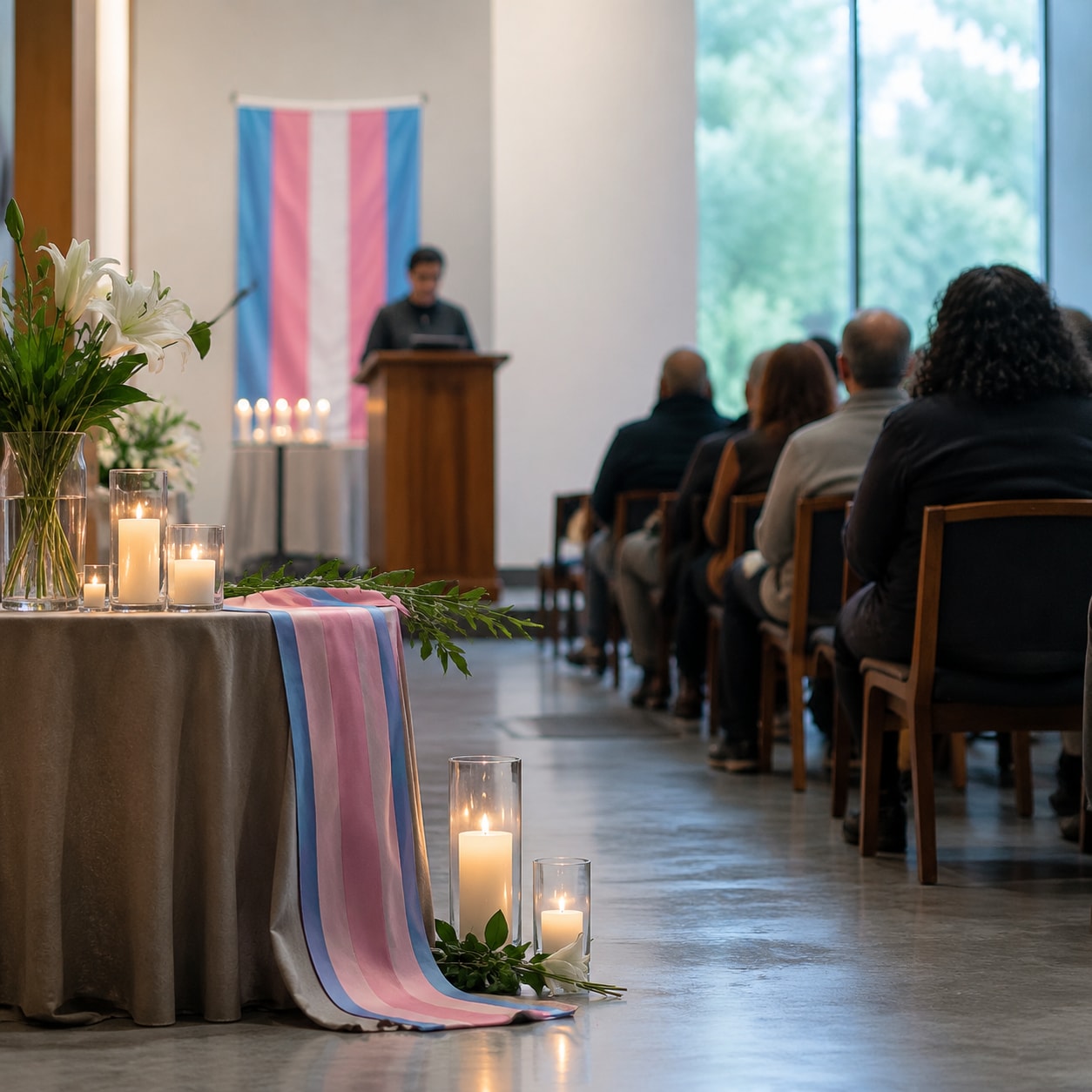
The day is observed in several ways, including readings of names, candlelight vigils, moments of silence, and religious services. Whatever form a local gathering takes, its central work is to remember people whose lives were taken and to acknowledge the loss carried by transgender communities and those who love them.
Origins of the Observance and the Importance of Careful Attribution
The observance grew from mourning after the 1998 killing of Rita Hester, a Black transgender woman. Sources consistently identify Gwendolyn Ann Smith as a principal initiator of the commemoration, which began in 1999. They differ, however, in how they describe its founding: some credit Smith directly, while another describes a group that included her.
That difference is a reason to use precise language. It is well supported to say that Smith played a central documented role and that the observance emerged in response to Hester’s killing. It is less appropriate to make an absolute claim that excludes the possible involvement of others.
Careful attribution also serves the purpose of remembrance. Rita Hester should be named as a person whose death prompted collective mourning, not treated only as a historical marker. A service can briefly explain this origin while keeping its focus on memory, loss, and the human dignity of those being honored.
Why the Observance Aligns With UUA Values
The Unitarian Universalist Association identifies justice, equity, pluralism, interdependence, and love among its shared values. Its stated mission includes helping congregations remain healthy and vital, supporting and training lay and professional leaders, and advancing Unitarian Universalist values in the world. A gathering centered on remembrance, dignity, and concern about anti-transgender violence can therefore be approached in relation to the UUA’s publicly stated commitments.
The UUA is the central organization of the Unitarian Universalist religious movement in the United States and includes more than 1,000 member congregations. Those congregations are autonomous: they determine their own priorities and select their own ministers and staff. Local leaders should consequently shape an observance in accordance with their congregation’s decisions, capacities, and community context.
This guide does not establish that a particular UUA-hosted service has been announced. It offers planning considerations for UUA-affiliated congregations or other readers interested in a service grounded in the association’s stated values.
Elements Congregations May Consider for a Remembrance Service
Documented Transgender Day of Remembrance observances commonly include reading the names of people killed during the preceding year. Other forms include candlelight vigils, religious services, marches, art exhibitions, food drives, and film screenings. Moments of silence are also associated with remembrance gatherings. These are adaptable possibilities, not the program of a specific announced UUA event.
A local congregation might consider a structure such as:
– Opening with a clear statement that the gathering is a memorial for people killed in anti-transgender violence. – Reading names, with pauses that prevent the reading from becoming hurried or merely procedural. – Using candles or silence to provide a shared form of witness and mourning. – Including a religious or reflective element suited to the local congregation. – Adding art or a film only when it supports the memorial purpose. – Pairing the gathering with a food drive, march, or other community activity when local leaders determine that it is appropriate.
Not every element needs to appear in one service. A simple vigil may be more fitting than a crowded program. Organizers can select forms that preserve solemnity, allow time for reflection, and remain understandable to participants who are new to the observance.
Any reading of names deserves particular attention. The practice responds to concern that those who were killed—and their names, lives, and experiences—may quickly be forgotten. The act should therefore be framed as remembrance rather than as the recitation of a list.
Making Space for Grief, Anger, Fear, and Remembrance
People may enter a remembrance gathering carrying grief, anger, fear, helplessness, or a sense of being overwhelmed. These responses can coexist. A respectful service need not force them into a single emotional progression or promise easy resolution.
Organizers can make room for nonjudgmental mourning by explaining the purpose of the gathering, allowing silence, and avoiding pressure to speak. Reading names and holding a public vigil can help preserve memory and express respect for people whose lives and deaths might otherwise be forgotten. These practices can also remind participants that each name represents a life, not simply evidence for an argument.
The tone of a gathering matters. Educational commentary, calls to action, art, and ritual should support the act of remembrance rather than compete with it. Participants should be allowed to remain with grief even when the program also points toward collective action.
No single emotional response should be treated as the correct one. Some people may want communal speech or visible ritual; others may need quiet. Building deliberate pauses into the gathering can acknowledge both needs without judging how any participant mourns.
Balancing Solemn Remembrance With Public Education
Transgender Day of Remembrance has both a memorial purpose and an awareness-raising role. The challenge for organizers is to provide enough context for participants to understand the observance without allowing an educational presentation to displace the people being remembered.
One approach is to establish the memorial purpose at the beginning, offer a concise explanation of the day’s origins and focus, and then devote the central portion of the gathering to names, silence, candles, prayer, or reflection. Additional educational material can be offered before or after the service when local organizers choose to provide it.
This distinction is especially useful for participants unfamiliar with the day. Context can explain why the observance exists, while the structure of the service communicates that remembrance is not simply a lesson. Marches, films, exhibitions, and other public-facing activities are documented forms of observance, but each should be assessed by whether it reinforces rather than overshadows the memorial focus.
Turning Remembrance Into Sustained Support
A November 20 gathering can be one point in a longer commitment. Trans Lifeline recommends several ways to support transgender communities: donating, volunteering, establishing mutual-aid funds, advocating for rights, opposing discrimination, and employing transgender people equitably. These are the organization’s recommended action pathways, not neutral findings that every congregation must adopt in the same way.
Organizers can invite participants to identify one form of continuing support rather than treating attendance at a memorial as the end of their involvement. Possible next steps drawn from Trans Lifeline’s recommendations include:
– Contributing money or volunteer time. – Helping establish or sustain mutual aid. – Advocating for transgender rights. – Challenging discrimination. – Supporting equitable employment of transgender people.
A congregation can consider which pathway fits its local role and capacity. The important shift is from a single commemorative date toward support that continues beyond November 20. Action should not replace mourning within the service, but a clearly identified next step can connect remembrance with an ongoing commitment to transgender communities.
What Readers Should Verify Before Attending or Organizing
The sources used for this guide do not provide the date, location, speakers, registration process, program, or official event page for a particular UUA-hosted service. Readers should not infer that a specific national or local event has been announced.
Before attending, confirm current details through the relevant congregation or UUA channel. Before organizing, verify local leadership decisions, the planned format, and who is responsible for the service. November 20 is the annual date of Transgender Day of Remembrance, but the timing and form of any associated local gathering require separate confirmation.
Because UUA member congregations are autonomous and determine their own priorities, plans may differ among communities. A locally appropriate observance should use confirmed information, preserve remembrance as its center, and identify at least one form of support that can continue after the gathering.
Disclosures and limitations
– This article was prepared with AI assistance and should receive human editorial review before publication. – Factual statements and planning considerations were synthesized exclusively from the source material identified in the supplied Research Package; no independent interviews, attendance, product testing, or firsthand experience are claimed. – The available research does not document a specific UUA-hosted Transgender Day of Remembrance service. Readers should verify current event information through official UUA or local congregation channels. – This article contains no product recommendations or disclosed affiliate links; no commercial relationship should be inferred.
Sources
– Over 1,000 congregations promoting compassion, justice, and spiritual growth. — UUA.org – Transgender Day of Remembrance – Wikipedia — en.wikipedia.org – Transgender Day of Remembrance 2024 – Trans Lifeline — translifeline.org – TDoR – Transgender Day of Remembrance – Transparent — Transparent – Transgender Day of Remembrance: At least 22 trans people killed in 2019 — NBC News – Trans Day of Remembrance: A History | QueerEvents.ca — Queer Events – Protect Religious Liberty — The White House – Transgender Day of Remembrance 2026 | Awareness Days — Awareness Days – Communities of Faith – FIRST UNITED — firstunited.ca – UUA Condemns Deployment of National Guard in Washington, DC – Fourth Universalist Society in the City of New York — Fourth Universalist Society in the City of New York