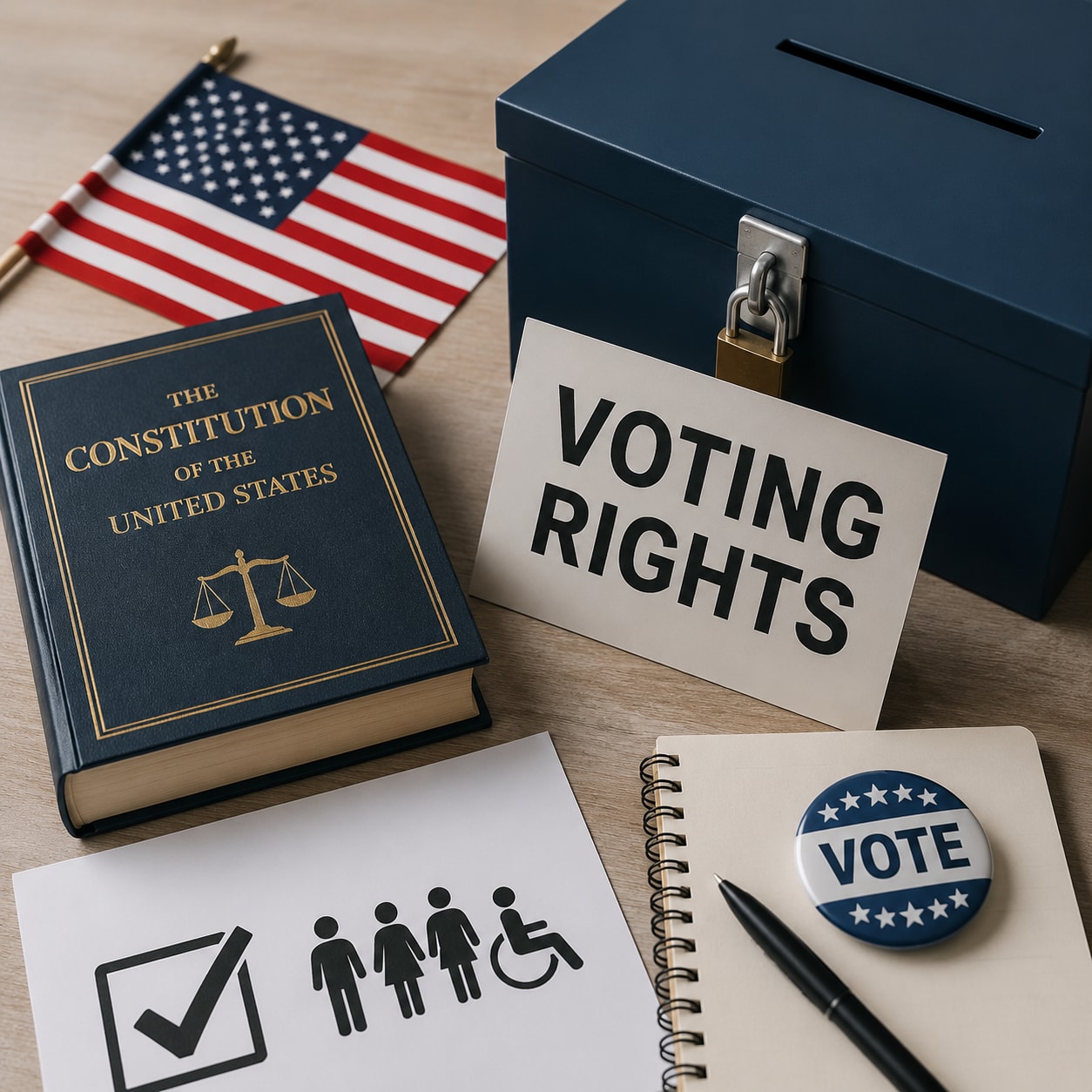
An accessible overview of the federal-state voting framework, constitutional and statutory protections, documented barriers to participation, language access, and practical resources for voters facing problems.
What “Voting Rights Today” Covers
Voting rights in the United States operate through a shared federal-state framework. Article I of the U.S. Constitution assigned states responsibility for overseeing federal elections, while later constitutional amendments and federal laws established protections governing access to the ballot and election administration.
This means that voting rights today cannot be understood through a single law or institution. States administer elections, but their practices are subject to constitutional protections and federal statutes. The U.S. Department of Justice’s Voting Section enforces the civil provisions of several federal voting laws, including the Voting Rights Act, National Voter Registration Act, Help America Vote Act, Uniformed and Overseas Citizens Absentee Voting Act, and Civil Rights Acts.
For voters and community organizations, this overlapping structure makes local verification important. Election procedures can differ by state and locality, while federal protections establish broader legal safeguards. Understanding both dimensions helps communities distinguish between ordinary administrative differences and problems that may interfere with equal participation.
The Constitutional and Federal Protections Behind Voting Rights
Several constitutional amendments prohibit restricting citizens’ voting rights on specified grounds. The Fifteenth Amendment addresses race and color, the Nineteenth Amendment addresses sex, and the Twenty-sixth Amendment protects citizens who are 18 or older from age-based denial or abridgment of voting rights.
Federal statutes add further protections and administrative requirements. The laws enforced by the Justice Department’s Voting Section address different parts of the electoral process. Together, they form a federal enforcement landscape that includes the Voting Rights Act, voter registration requirements, voting-system and election-administration provisions, protections for eligible military and overseas voters, and protections contained in the Civil Rights Acts.
These protections should not be treated as a substitute for current, jurisdiction-specific election instructions. Constitutional principles and federal statutes create important safeguards, but states remain responsible for administering federal elections. A voter’s registration process, polling arrangements, deadlines, and other practical requirements therefore depend in part on rules and decisions within the relevant state or locality.
For congregational leaders, educators, volunteers, and organizers, a useful approach is to separate two questions: what protections exist under federal law, and what procedures apply in a particular election. The Justice Department’s enforcement role helps explain the first. The appropriate state or local election authority should be used to confirm the second. This overview is educational and does not provide individualized legal advice.
How Voting Access Can Be Restricted or Weakened
Barriers to voting do not all take the same form. New York’s voting-rights materials identify suppression, vote dilution, intimidation, deception, and obstruction as distinct ways the right to vote can be harmed.
Voter suppression concerns measures or conditions that impede access to voting. One example identified by the New York Attorney General is providing too few polling sites in communities of color. Practical problems documented in voter resources also include unexpected polling-place changes, voter purges, long waits, and faulty voting machines. These issues may affect whether an eligible voter can participate successfully, even when the obstacle does not look like an explicit prohibition.
Vote dilution concerns the weakening of a group’s voting power. District boundaries or election rules can produce this kind of harm. The issue is not simply whether an individual can cast a ballot, but whether the electoral structure diminishes a protected group’s ability to participate with equal voting strength.
Intimidation, deception, and obstruction focus on conduct directed at voters or the election process. Intimidation can pressure or frighten people in connection with voting. Deception can involve false election information. Obstruction can interfere with voting, ballot counting, access to polling places, or the broader election process.
These categories can overlap in practice. A polling-place change, for example, may create an access problem, while false information about that change may raise a deception concern. Long waits or malfunctioning equipment can also become serious participation barriers when voters cannot complete the voting process.
Community observers should document concerns carefully without assuming that every inconvenience has the same legal meaning. Useful details can include what happened, where and when it occurred, what information voters received, and how access was affected. Available issue-reporting channels can then help route the concern for further review. Because the supplied materials do not establish a complete nationwide reporting procedure, voters should use resources appropriate to their jurisdiction and circumstances.
Language Access and Equal Participation
Equal participation may require more than making a polling place physically available. Some voters with limited English proficiency need translated ballots, voter-registration materials, or other forms of language assistance to take part in elections.
Language access affects multiple stages of participation. If essential registration or voting information is unavailable in a language a voter can understand, that voter may have difficulty completing required steps or accurately using the ballot. Appropriate assistance and translated materials can therefore be important components of meaningful access.
Language needs also belong within the broader voting-rights enforcement landscape. The Justice Department’s Voting Section enforces civil provisions of federal voting laws, while state materials may describe protections or assistance relevant within a particular jurisdiction. The exact resources and requirements available to an individual voter should be verified locally rather than inferred from another state’s guidance.
Community organizations can help by directing voters toward official, current information in accessible languages and by treating reported language barriers as substantive access concerns. This guide does not provide a complete list of language-assistance rules or covered jurisdictions, so voters and those supporting them should confirm available assistance with the appropriate election authority.
What State-Level Protection Can Look Like: New York’s 2022 Law
New York offers one state-specific example of how voting-rights protections can supplement the federal framework. The John R. Lewis Voting Rights Act of New York was enacted in 2022. Among its provisions, the law authorizes advance review—often called preclearance—of certain proposed changes to voting or election procedures.
That review may be conducted by the New York Attorney General or a state court. The process is designed to examine covered changes before they take effect, rather than relying only on challenges after implementation.
New York’s official materials also identify several forms of potential harm to voting rights: suppression, vote dilution, intimidation, deception, and obstruction. They describe examples ranging from too few polling sites in communities of color to interference with voting, vote counting, polling-place access, or other parts of the election process.
This is an example of a state-level protection, not a nationwide rule. The existence, scope, and operation of comparable protections cannot be assumed in another state. Readers outside New York should consult the appropriate authorities and reliable jurisdiction-specific resources to understand what state protections and review procedures apply where they live.
Practical Steps When Preparing to Vote or Facing a Problem
Before voting, confirm current information with the appropriate state or local election authority. The supplied research does not contain a complete state-by-state account of registration deadlines, identification rules, election dates, or polling arrangements, so these details should not be inferred from a general overview.
Be alert to documented access concerns. These can include polling-place changes, voter purges, long waits, faulty machines, too few polling locations, false election information, intimidation, and interference with voting or ballot counting. Voters who need translated materials or language assistance should also verify what support is available in their jurisdiction.
If a problem occurs, preserve the basic facts when it is safe and practical to do so: the location, approximate time, nature of the problem, information provided to voters, and effect on access. This creates a clearer account for an appropriate reporting channel. Do not rely on unverified election information when official confirmation is available.
The Legal Defense Fund provides targeted voter information for Alabama, Florida, Georgia, Louisiana, Mississippi, South Carolina, and Texas. It also provides a channel for reporting voting issues. These resources may be especially relevant to voters and community groups in those seven states, but they do not constitute a complete national directory.
Congregations, educators, volunteers, and community organizations can support access by sharing reliable jurisdiction-specific information, helping people locate appropriate language resources, and directing reported problems to established channels. The practical goal is straightforward: verify before acting, recognize documented forms of interference, and connect voters with resources suited to their location.
Limits of This Guide and What to Verify Locally
This guide explains the broad relationship between state election administration, constitutional protections, and federal voting laws. It is not a complete state-by-state voting guide. It does not supply current registration deadlines, voter-identification requirements, election dates, or comprehensive local procedures.
Because states oversee federal elections within the boundaries established by constitutional and federal protections, actionable details must be checked with the appropriate state or local election authority. Readers should also distinguish New York-specific protections from rules that apply nationally.
Use this overview to recognize the structure of voting protections and common categories of access problems. For an upcoming election, confirm every time-sensitive or location-specific detail through the relevant election authority and use an appropriate reporting resource if a voting problem occurs.
Disclosures and limitations
– This article was prepared with AI assistance and should receive human editorial review before publication. – The article is based only on the supplied research package, which draws on U.S. Department of Justice materials, New York Attorney General materials, Legal Defense Fund resources, and a secondary constitutional-amendment summary. – This is general educational information, not individualized legal advice or a complete state-by-state election guide. Readers should verify current requirements, deadlines, identification rules, election dates, and local procedures with the appropriate election authority. – This article contains no product recommendations or disclosed affiliate links. If commercial links are added later, any affiliate relationship should be clearly disclosed.
Sources
– Voting rights in the United States – Wikipedia — en.wikipedia.org – Voting rights laws and constitutional amendments | USAGov — usa.gov – New York Voting Rights Act — New York State Attorney General – Pro-Trump Republicans try to rewrite state election laws as a voting rights showdown looms in Congress | CNN Politics — CNN – Voting Rights 2026 | Legal Defense Fund — voting.naacpldf.org – Voting Section — justice.gov – Rotation of voting rights in the Governing Council — European Central Bank – Ballot access in the 2024 United States presidential election – Wikipedia — en.wikipedia.org – Postal voting in the United States – Wikipedia — en.wikipedia.org – 2026 United Kingdom local elections – Wikipedia — en.wikipedia.org