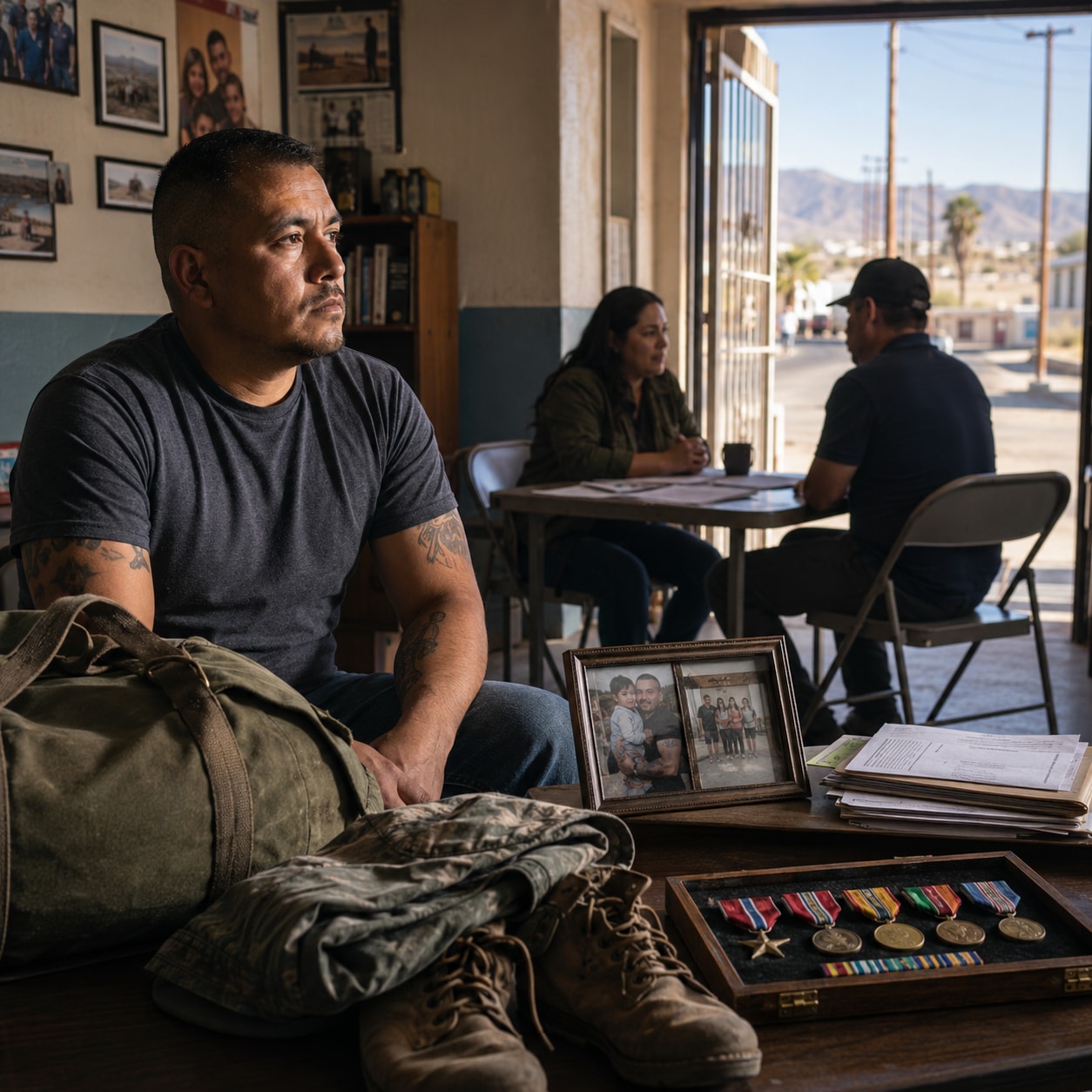
The supplied record does not document Mars’s identity or personal history, but it does illuminate the experiences of deported veterans, the limits of a federal return initiative, and the need for careful, transparent storytelling.
A necessary source note: Mars’s personal story is not documented here
The available research does not identify a person named Mars or establish any facts about Mars’s military service, deportation, advocacy, family, or present circumstances. A responsible account therefore cannot present a personal history under that name. The veteran-specific reporting supplied for this article instead concerns Marcelino Ramos and federal policies affecting noncitizen and deported veterans. His documented experience provides human context, but it must not be attributed to Mars. What follows is an explanation of that record, with its dates and limitations preserved. A reliable first-person or primary source would be necessary before any claims about Mars could responsibly be published or shared.
Marcelino Ramos’s account of service, deportation, and family separation
Marcelino Ramos told the Center for Public Integrity that he joined the U.S. Marine Corps at 17 and served in the Gulf War. He was later deported because he had not obtained U.S. citizenship. His account illustrates how military service did not, by itself, resolve his immigration status or protect him from removal.
Ramos described consequences extending beyond the legal process. Deportation separated him from his wife, father, and daughter. While outside the United States, he also reported limited access to care for post-traumatic stress disorder. After receiving permission to return temporarily, uncertainty continued: he feared he could be required to leave again.
His experience shows why “return” must be described precisely. Temporary entry can reunite a veteran with family and improve access to support without providing lasting security. Ramos’s documented story stands on its own; it supplies no evidence about Mars and should not be retold as though it does.
How the federal initiative addressed deported veterans
In February 2021, President Biden issued an executive order directing the government to review policies affecting noncitizen service members, veterans, and their immediate families. That review led to the Immigrant Military Members and Veterans Initiative, which created a pathway for the government to consider cases involving veterans outside the United States because of removal or other obstacles to returning.
The reported returns occurred through humanitarian parole. That distinction matters: parole is temporary permission to enter or remain in the country for a defined purpose, not citizenship or a guarantee of permanent residence. A veteran allowed back through the initiative could therefore remain uncertain about what would happen when that temporary authorization ended.
The initiative represented a federal response to the circumstances of deported veterans, but the supplied reporting does not establish that it resolved their long-term status. Describing parole as permanent repatriation would go beyond the available evidence.
What the reported numbers show—and what they do not
Congressional testimony cited by the Center for Public Integrity said that, as of June 21, 2022, the initiative had received 143 inquiries involving veterans outside the United States because they had been removed or faced other barriers to returning. In reporting published in February 2023, the Center said roughly 50 deported veterans had returned through humanitarian parole. An advocate from Repatriate Our Patriots said only about a dozen of those veterans had subsequently obtained citizenship.
These figures describe reported outcomes at particular moments; they are not current totals. They also should not be treated as a complete count of deported veterans or as proof that every inquiry produced a decision. The gap between temporary returns and reported citizenship outcomes underscores the difference between permission to come back and durable legal status. Any later discussion should retain the dates rather than presenting these numbers as conditions today.
Why the full scale of veteran deportation remains unclear
The available record does not provide a reliable total for veterans placed in removal proceedings or deported. A 2019 Government Accountability Office report, cited by the Center for Public Integrity, found that ICE had not consistently followed its veteran-identification policies between 2013 and 2018. As a result, the agency did not know how many veterans had entered removal proceedings or been removed.
That recordkeeping failure limits what can responsibly be claimed about the scale of the problem. It also complicates efforts described by advocates to locate deported veterans and protect noncitizen veterans in the United States from removal. Counts of inquiries or humanitarian-parole returns cannot fill the gap because they measure participation in a later initiative, not every veteran affected by enforcement. The most accurate conclusion from the supplied evidence is therefore that documented cases exist while the total remains uncertain.
The broader immigration-enforcement context
More recent ICE custody reporting offers context but does not provide a veteran-specific count. CNN reported that internal records covering more than 185,000 custody bookings from October 2024 through May 2025 showed that more than 75% involved no conviction beyond an immigration- or traffic-related offense. Fewer than 10% involved convictions for serious crimes such as murder, assault, robbery, or rape.
DHS disputed CNN’s framing using a different timeframe and a measure that combined convictions with pending charges. Those descriptions are not directly comparable: a pending charge is not the same as a conviction, and changing the period under review can change the resulting proportions. The disagreement demonstrates why readers should examine definitions, dates, and denominators when assessing enforcement claims. These custody figures illuminate a broader debate about immigration enforcement, but they neither identify deported veterans nor establish anything about Mars.
What standing with deported veterans requires from storytellers
Responsible solidarity begins with accuracy. Storytellers can center Ramos’s documented account while making clear that it is his—not Mars’s—and can discuss the federal initiative without equating humanitarian parole with citizenship or permanent permission to remain. Program figures should retain their 2022 and early-2023 dates, while broader custody statistics should preserve the distinction between convictions and pending charges.
The evidence also supports candor about what remains unknown. Inconsistent veteran identification prevents a complete count, and the supplied sources contain no verified account of Mars. Justice-seekers, congregational leaders, educators, and organizers can use the documented context to support informed discussion, but they should obtain a reliable first-person or primary source before circulating biographical claims about Mars. Protecting the integrity of someone’s story is part of standing with the community whose experience it is meant to represent.
Disclosures and limitations
– This article was drafted with AI assistance from the supplied research package and approved content plan; its factual claims are attributed through the listed source IDs. – The veteran-specific account and policy information come from Center for Public Integrity reporting represented by source-9cbcd4a3f519f2c9e5ed7f6f. Broader ICE custody context comes from CNN reporting represented by source-3aaa21f673d193917379ce1e. – The supplied evidence does not document Mars’s identity or personal history. Figures from 2022 and early 2023 may not represent current program outcomes, and the broader 2024–2025 custody data are not veteran-specific. – This article contains no product recommendations or affiliate links; no affiliate relationship is represented.
Sources
– Deported Veterans Advocacy Project – YouTube — youtube.com – White House initiative leaves deported veterans in limbo – Center for Public Integrity — Center for Public Integrity – Wikipedia:Artificial intelligence resources – Wikipedia — en.wikipedia.org – Hyperscience | LinkedIn — linkedin.com – Veterans – National Library Service for the Blind and Print Disabled (NLS) | Library of Congress — National Library Service for the Blind and Print Disabled (NLS) | Library of Congress – Less than 10% of immigrants taken into ICE custody in recent months had serious criminal convictions, internal data shows | CNN — CNN – Checking your browser – reCAPTCHA — pmc.ncbi.nlm.nih.gov – Out of the Rain: A Novel od autorů J. Malcolm Garcia – Knihy na Google Play — play.google.com – Care of war graves | Válečné hroby — valecnehroby.mo.gov.cz – Veterans – Oregon Department of Justice — Oregon Department of Justice