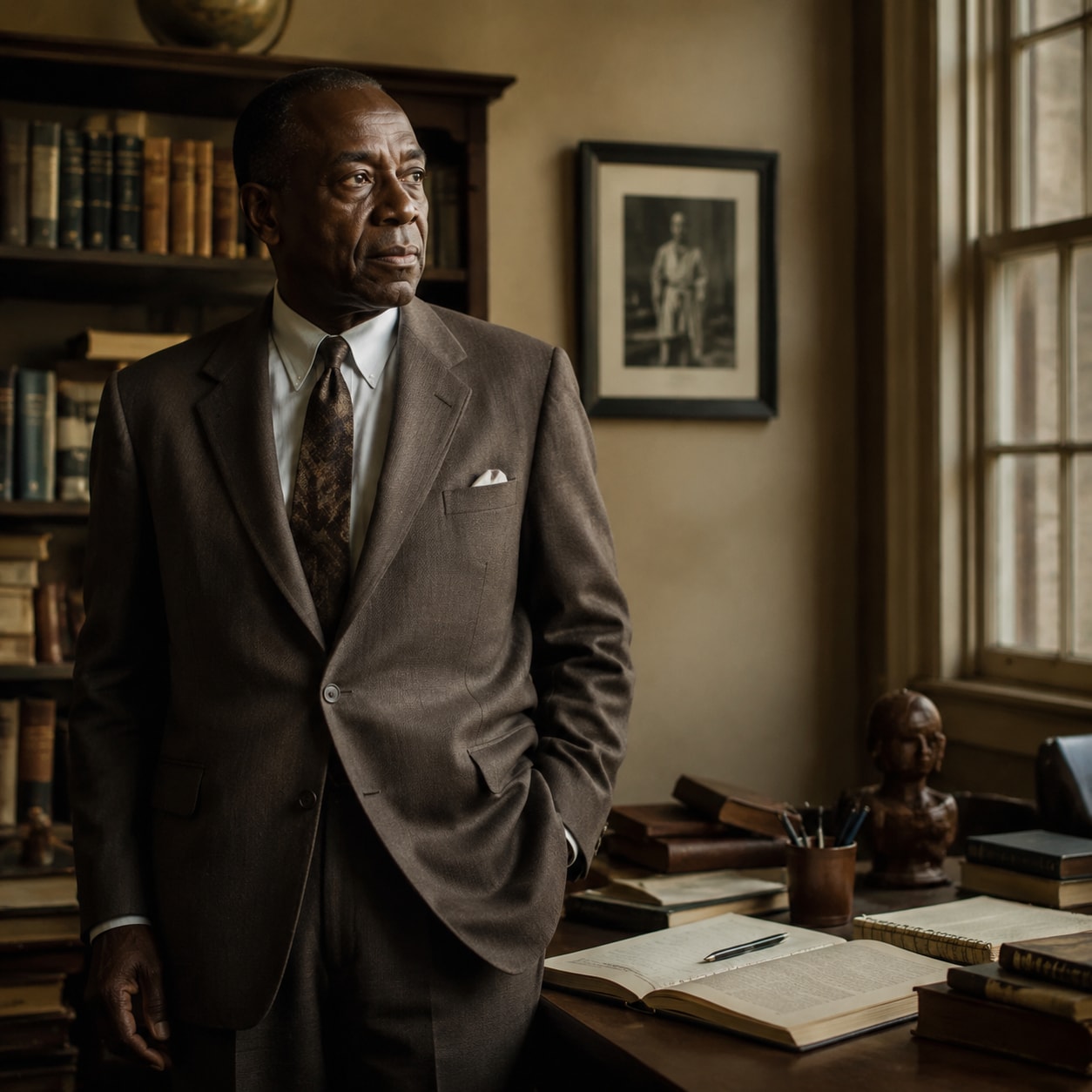
A concise biographical portrait of Howard Thurman’s ministry, educational leadership, commitment to radical nonviolence, writing, and work to build inclusive community.
Who Howard Thurman Was
Howard Washington Thurman (November 18, 1899–April 10, 1981) brought several forms of intellectual, spiritual, and public leadership together. He was an American author, philosopher, minister, theologian, Christian mystic, educator, and civil rights leader. Those roles form the basis of this biographical portrait: they present a figure whose religious thought was connected to education, community building, and the pursuit of justice.
Here, “portrait” means an evidence-based account of Thurman’s life and work. The supplied research does not identify or describe a particular painting, photograph, artist, medium, or location. It therefore supports an introduction to Thurman rather than an interpretation of a specific artwork.
Spiritual and Educational Leadership
Thurman exercised spiritual leadership within two university communities over substantial periods. From 1932 to 1944, he served as dean of Rankin Chapel at Howard University. He later served as dean of Marsh Chapel at Boston University from 1953 to 1965.
These appointments document the institutional dimension of his ministry. His leadership was situated not only in religious life but also in educational settings, where questions of faith, learning, and community could meet. The record provided here does not detail particular sermons, programs, or administrative decisions from either tenure, so broader conclusions about those years would require additional evidence. What can be established is that chapel leadership at Howard University and Boston University was a significant, sustained part of Thurman’s public work.
The India Delegation and an Encounter With Gandhi
During a 1935–1936 delegation to India, Thurman met Mahatma Gandhi. Their discussion addressed nonviolence and the struggles of Black Americans. This encounter belongs within Thurman’s documented development as a religious thinker and advocate of radical nonviolence.
The supplied evidence establishes the meeting and its subjects but does not provide a full transcript or enough detail to reconstruct the conversation. It is therefore important not to assign either participant arguments or conclusions that the research does not record. Even within those limits, the meeting shows that Thurman engaged questions of racial injustice and nonviolent action in an international setting, connecting the circumstances of Black Americans with a wider conversation about principled resistance.
Building an Interracial and Interdenominational Community
In 1944, Thurman and Alfred Fisk co-founded the Church for the Fellowship of All Peoples in San Francisco. The supplied source describes it as the first major interracial, interdenominational church in the United States. Because this historical characterization comes from a single secondary source, it should be attributed rather than treated as independently verified here.
The founding nevertheless provides a clear example of institution building within Thurman’s work. Interracial and interdenominational commitments were incorporated into the identity of a religious community rather than left solely as abstract principles. The available research does not describe the church’s membership, programs, governance, or later history, but it does establish Thurman’s role in creating a community organized across racial and denominational lines.
Radical Nonviolence and Civil Rights Leadership
Thurman’s theology of radical nonviolence influenced civil rights activists. He also served as a mentor and spiritual adviser to civil rights movement leaders, including Martin Luther King Jr. These documented relationships place spiritual counsel and theological reflection alongside his work as an educator, minister, and institution builder.
The research supports a meaningful connection between Thurman’s religious thought and civil rights leadership, but it does not specify every channel through which that influence operated. It would therefore be unwarranted to attribute particular strategies, speeches, or decisions by other leaders directly to Thurman without further sources. The supported portrait is more precise: his theology contributed to the moral and spiritual context of civil rights activism, while his mentorship provided a personal form of guidance to important movement figures.
For present-day communities, this history offers a basis for discussion rather than a ready-made formula. Thurman’s documented example brings together spiritual grounding, a commitment to nonviolence, relationships with movement leaders, and the creation of inclusive institutions.
Writing and Jesus and the Disinherited
Thurman wrote twenty books addressing theology, religion, and philosophy. The supplied source identifies *Jesus and the Disinherited*, published in 1949, as his best-known work. That distinction gives the book a prominent place in a concise account of his writing, while the larger total shows that it formed part of an extensive body of work.
The available research does not provide the book’s arguments, publication history, critical reception, sales, or detailed influence. Those subjects should not be inferred from its status as Thurman’s best-known title. Readers can instead use this biographical introduction as a starting point for approaching the book itself and considering Thurman’s writing alongside his ministry, educational leadership, advocacy of radical nonviolence, and community building.
What This Portrait Can and Cannot Establish
The supplied evidence supports a portrait of Howard Thurman as a multifaceted spiritual and intellectual leader: a minister and theologian, an educator and chapel dean, a co-founder of an interracial and interdenominational church, an advocate of radical nonviolence, a civil rights mentor, and the author of twenty books.
This account has clear limits. It relies on one relevant secondary source and should be independently verified before publication, especially where historical significance is claimed. It also contains no evidence about a particular painted or photographic portrait of Thurman. Within those boundaries, the introduction can serve as a starting point for reading Thurman’s work and discussing how spiritual grounding, nonviolence, and inclusive community building might inform collective action today.
Disclosures and limitations
– This article was prepared with AI assistance from the supplied Research Package and approved Content Plan. – All biographical claims in this article rely on one supplied secondary source identified as source-7fae9a52c1f448973122d91d. Important claims should be independently verified before publication. – No products are recommended in this article, and no affiliate relationship is represented.
Sources
– James D. Thurman – Wikipedia — en.wikipedia.org – Judith Thurman (Books) | bookbot.com — bookbot.com – Shop – The Carroll County Heritage Museum — ccheritagemuseum.com – Homepage | Chadwick A. Boseman College of Fine Arts — finearts.howard.edu – Howard Sounes (Knihy) | knihobot.cz — knihobot.cz – Richard Avedon: Photographs 1946-2004 by Judith Thurman (2007, Hardcover) for sale online | eBay — eBay – Publications – Komeniologie – Filosofický ústav AV ČR — komeniologie.flu.cas.cz – File:Blank.png – Wikipedia — en.wikipedia.org – Howard Thurman – Wikipedia — en.wikipedia.org – Uma Thurman – Wikipedia — en.wikipedia.org
