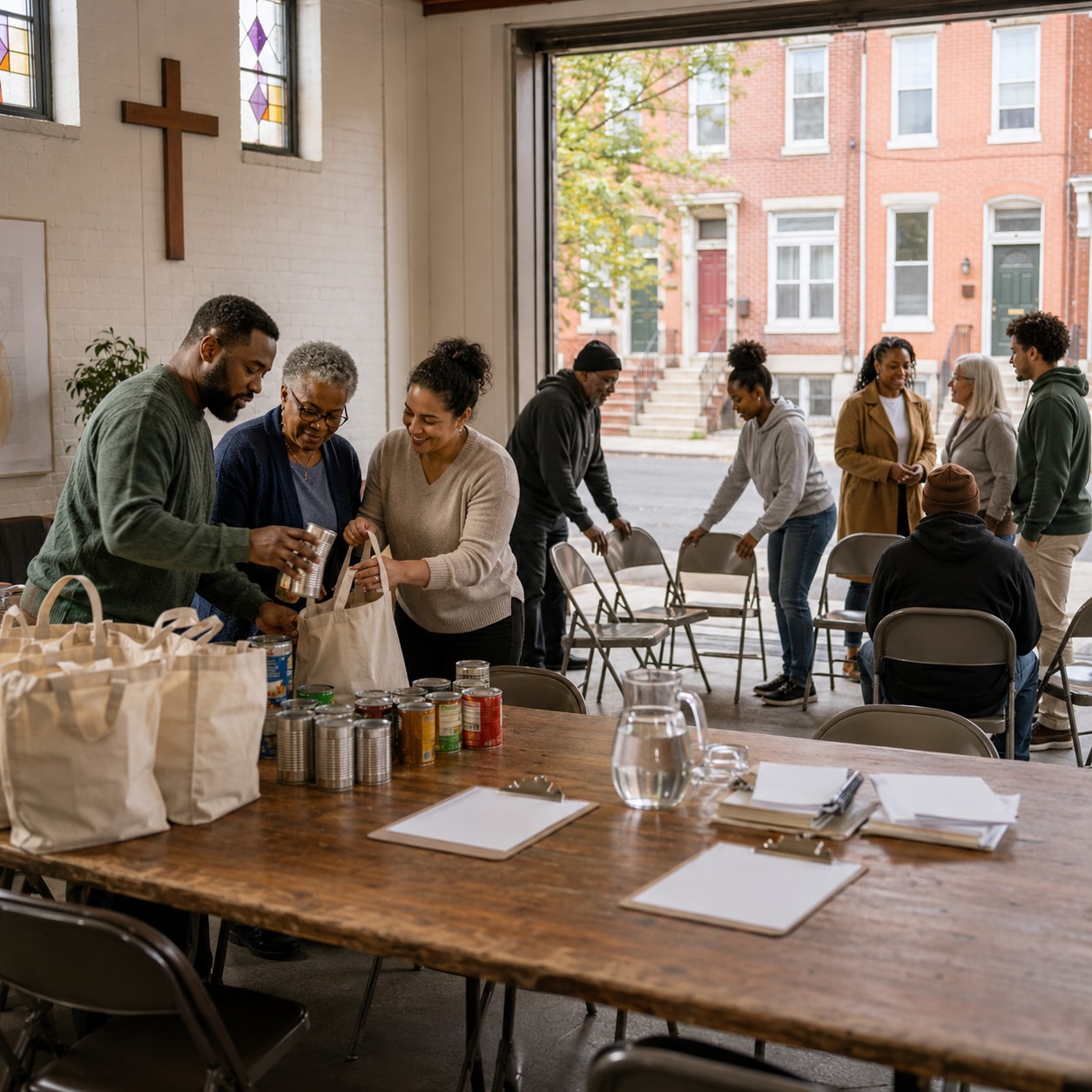
Baltimore-area resources show how congregations can connect inclusive welcome, sustained interfaith learning, anti-racism formation, public witness, and support for immigrants. The available evidence supports an action framework—not a first-person account—and points toward concrete, accountable next steps.
What “My Liberation Is Bound Up with Yours” Means in This Baltimore Context
Here, “my liberation is bound up with yours” serves as a framework for shared responsibility rather than the title of a documented personal story. The available sources describe institutional commitments and regional resources; they do not record a particular person’s experience under this title.
Those sources nevertheless show how interdependence can shape congregational practice. First & Franklin Presbyterian Church publicly connects its welcome with service, fellowship, and social engagement in Baltimore. The Baltimore–Washington Conference of The United Methodist Church lists resources that join spiritual reflection to confronting racial injustice and building a “beloved community.” Together, these examples suggest a practical question: How can a faith community make another person’s dignity, safety, and participation part of its own public commitments?
This interpretation does not establish that any program has achieved liberation or produced a particular outcome. It identifies documented pathways through which Baltimore-area communities can move from stated values toward shared learning and action.
Inclusion Begins with Who Is Welcomed and How a Congregation Serves
First & Franklin Presbyterian Church states that its mission includes improving the Baltimore community through social engagement, service, and fellowship. It also says that people of different colors, backgrounds, gender expressions, gender identities, and sexual orientations are welcome to worship.
These commitments place two dimensions of inclusion side by side. The first concerns participation: who is explicitly told that they belong in worship. The second concerns responsibility beyond worship: how a congregation relates to its surrounding community through service and social engagement. Within an interdependent-liberation framework, welcome is therefore more than a general expression of goodwill. It can be examined through both stated inclusion and the congregation’s orientation toward community life.
The source documents First & Franklin’s public position, not the experiences of individual worshippers or the results of its work. Congregations using it as a point of reflection should distinguish between publishing an inclusive commitment and learning whether their practices consistently support that commitment.
Interfaith Understanding Requires Sustained Participation
The ICJS description of its 2026 Christian congregational fellowship presents interfaith formation as an extended practice. The program is described as lasting ten weeks, with each congregation sending two to four representatives. Its components include continuing dialogue, visits to other faith communities, reflective writing, and an applied learning project that participants can bring back to their home congregation.
That structure matters because it treats interfaith understanding as more than attendance at a single gathering. Participants are expected to learn over time, encounter other communities, reflect on what they observe, and translate the experience into a congregational project. It creates a path from individual participation to institutional learning while also connecting representatives across congregations.
For a congregation considering a similar approach, the documented model raises useful planning questions: Who will participate consistently? How will visits be approached respectfully? How will reflection be shared with the wider congregation? What project will convert learning into an accountable practice?
The underlying page carries a 2021 publication date while describing a 2026 fellowship. Its current schedule, availability, and enrollment status should therefore be verified before publication or participation. The evidence supports discussion of the program’s described design, but not assumptions about its present status or effectiveness.
Connecting Spiritual Formation with Racial-Justice Action
Resources listed by the Baltimore–Washington Conference of The United Methodist Church connect inward reflection with collective action. One listed resource, *Jericho Road*, draws on work associated with Martin Luther King Jr. and brings reflection and action together in confronting racial injustice and pursuing a “beloved community.” The conference also lists a Lenten study that combines the United Methodist Social Principles with anti-racism action.
This pairing offers a useful pattern for congregational formation. Spiritual reflection can help a community examine its values and assumptions. Shared study can establish language for discussing injustice. Action can then give those commitments a public or institutional form. None of those elements needs to stand alone: reflection can inform action, while the demands of action can identify subjects requiring deeper learning.
The listed materials should not be treated as evidence that a particular congregation has changed or that participants have had a specific experience. The sources establish that these resources are offered and describe how their themes are connected. Congregations can use that documented connection to ask whether their own racial-justice work includes ongoing reflection, collective learning, and a defined form of anti-racist action rather than relying on a single observance or statement.
A Practical Solidarity Path: Prayer, Learning, Witness, and Support
National faith-based resources concerning immigration provide a progression that local congregations can adapt: prayer, learning, public witness, and direct support.
1. Prayer: Pax Christi USA organizes its immigration-enforcement resources around prayer, study, and action. Prayer can establish the moral and spiritual context for a congregation’s response. 2. Learning: Congregations can study the documented concerns facing immigrants and families before deciding how to act. This helps connect public activity to the needs identified in the available resources. 3. Public witness: Pax Christi USA lists public vigils, prayer outside ICE headquarters, and appeals directed to political and immigration officials. These examples show that prayer can also take a visible public form. 4. Direct support: The USCCB’s 2026 Religious Freedom Week material recommends accompaniment, support for families, public prayer witness, and contact with legal-service organizations.
This framework does not require every congregation to take every action immediately. It does show that solidarity can operate at several levels: spiritual formation, education, public expression, and practical care. A responsible local plan should define which pathway the congregation can sustain, identify appropriate partners, and verify current local circumstances before acting.
The framework also helps prevent public witness from becoming disconnected from affected people’s practical concerns. Advocacy and prayer can be considered alongside accompaniment, family support, pastoral care, and referral to qualified legal-service organizations.
Responding When Fear Limits Access to Worship and Pastoral Care
USCCB’s 2026 Religious Freedom Week materials state that risks associated with immigration enforcement may affect whether some people attend worship. They also identify concerns about detained people’s access to sacraments and pastoral care. For congregations, this means that an open invitation to worship may not, by itself, remove the barriers experienced by immigrants or their families.
The same materials identify several possible responses: accompaniment, emergency support for families, pastoral care, public prayer witness, and connections with legal-service organizations. These actions address different dimensions of the reported problem. Accompaniment responds to isolation; family assistance addresses urgent practical needs; pastoral care supports religious life; public prayer makes concern visible; and a legal-service referral connects people with an appropriate source of legal help.
Congregations should keep the limits of each role clear. The source supports referral to legal-service organizations, not the substitution of unqualified congregational volunteers for legal professionals. Similarly, support should be organized around the safety and needs of affected people rather than assumptions about what they require. The documented options provide a starting point for planning, while local details and referral relationships should be checked before the congregation makes promises or directs anyone to a service.
Questions for Congregations Moving from Values to Collective Action
A congregation can use the documented pathways as a reflection checklist:
– Welcome: Does the congregation explicitly identify who is welcome, including people across differences in background, gender expression, gender identity, and sexual orientation? – Service: How are fellowship and worship connected to social engagement and service in the surrounding community? – Interfaith relationships: Is the congregation prepared for sustained dialogue, visits, reflection, and an applied project rather than a one-time event? – Racial-justice formation: Does its approach join spiritual reflection and shared learning with a defined anti-racism action? – Prayer and witness: Could prayer, vigils, or appeals to public officials form part of a responsible response to immigration concerns? – Accompaniment: Is there a realistic plan for supporting families or providing pastoral care when fear or detention disrupts community participation? – Referral: Has the congregation identified a current legal-service organization to which people can be referred, without presenting volunteers as legal professionals? – Accountability: Who will verify program dates, local conditions, partner capacity, and the congregation’s ability to sustain what it begins?
These questions cover distinct but connected forms of solidarity. A congregation does not need to claim success in all of them before beginning. It does need to distinguish intention from documented practice and choose actions it can pursue responsibly.
From Shared Liberation to One Accountable Next Step
The most useful next step is specific enough to carry responsibility. A congregation might commit to sustained interfaith learning, begin an anti-racism formation process, organize public prayer and witness, establish a family-accompaniment pathway, or verify a referral relationship with a legal-service organization.
Before proceeding, leaders should confirm current program information, consult appropriate local partners, and consider the needs and safety of the people most affected. Then they can name who is responsible, what support is available, and how the commitment will be sustained.
Shared liberation becomes practical when a community connects reflection to a concrete obligation. Choose one documented pathway and ask: What would it take for our congregation to pursue this responsibly, consistently, and in relationship with others?
Disclosures and limitations
– This article was prepared with AI assistance and is based solely on the institutional and faith-organization materials identified in the supplied Research Package. – The sources document public commitments, listed resources, and proposed actions; they do not establish program effectiveness, participant experiences, or a first-person account under this article’s theme. – No products are recommended, and no affiliate relationship or affiliate compensation is represented in this article. Any future addition of commercial recommendations should clearly disclose potential affiliate relationships. – Program dates, enrollment status, local conditions, and referral information should be verified before publication or action.
Sources
– Talk:Battle of the Atlantic/Archive 2 – Wikipedia — en.wikipedia.org – Solidarity to advocate for neighbors’ dignity (STAND) — Pax Christi USA – Home – First & Franklin — First & Franklin – Witness for Peace Solidarity Collective | LinkedIn — linkedin.com – Fellowship for Congregations — ICJS – Institute for Islamic, Christian, Jewish Studies – Přehlídka veteránů – zasloužilí mistři sportu v 80. a 90. letech (1. část) — Články — Hard rock & Heavy metal — 80. léta — Svět — Bigbít — Česká televize — ceskatelevize.cz – Standing firm — Global Witness – Devotionals and Studies | Baltimore-Washington Conference UMC — bwcumc.org – Full text of “Selected Writings (1920-1969)” — archive.org – Religious Freedom Week — USCCB