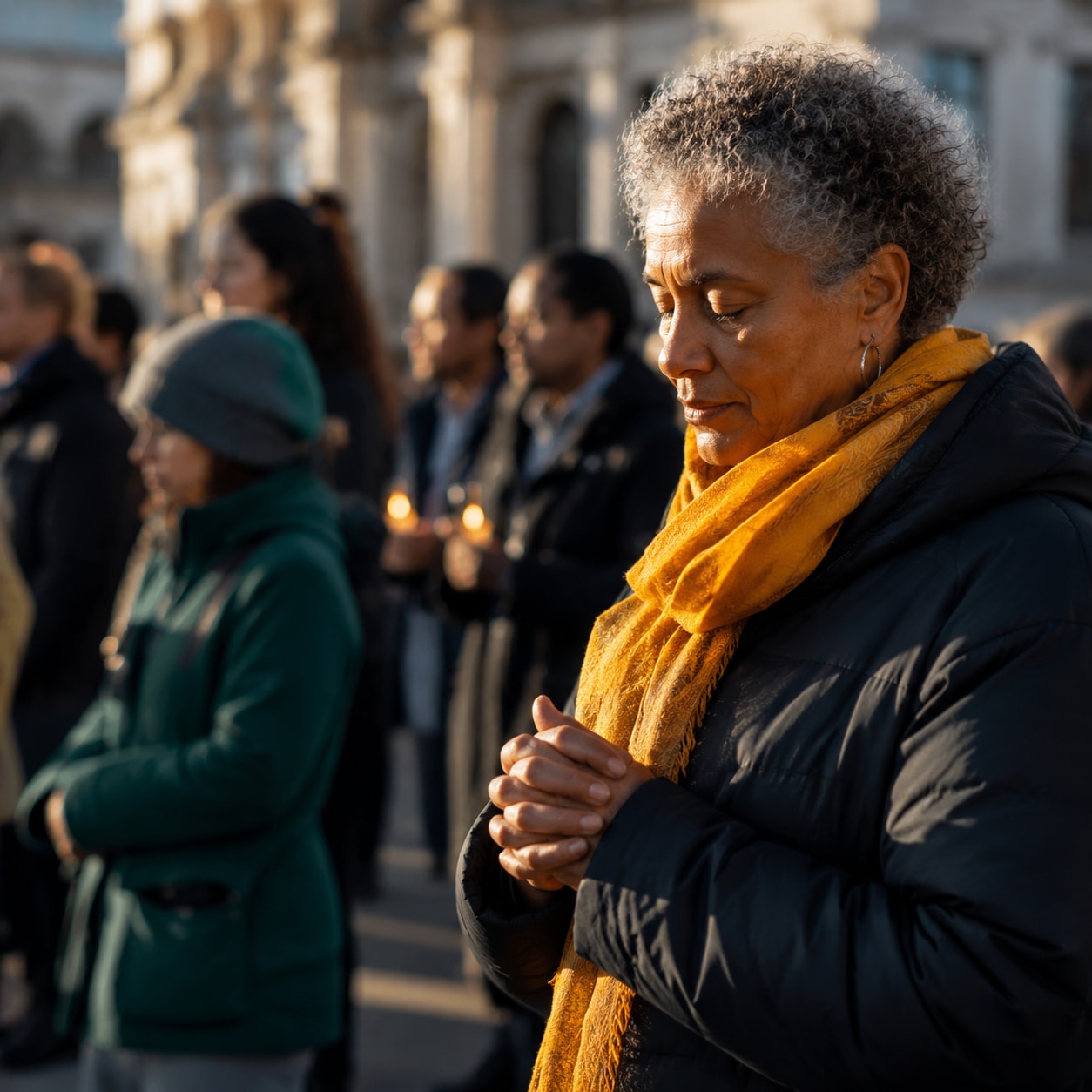
An evidence-conscious explanation of how shared faith values can connect with public witness, documented justice issues, and practical routes into local, nonpartisan participation.
What “A Week of Righteous Resistance” Means in This Article
“A Week of Righteous Resistance” is an editorial frame for considering how faith, solidarity, and public witness can lead toward organized community action. It is not a verified account of seven consecutive days, and the supplied research does not establish a dated sequence of events or a breaking-news trend.
Within that limit, the phrase offers a useful lens for examining values-driven resistance: communities identifying an issue, expressing their commitments publicly, and seeking an organized path for participation. Faith in Action provides one example of this connection through its presentation of faith-based grassroots organizing around love, dignity, and liberation. The focus here is therefore not a chronology but a progression—from shared values to collective witness and then to possible local action.
How Faith-Based Organizing Connects Values and Public Witness
Faith-based organizing can give communities a structure for connecting moral commitments with collective action. Faith in Action presents its work in terms of love, dignity, and liberation, placing those values within a grassroots organizing network rather than treating them only as private convictions.
The organization describes itself as a nonpartisan, global faith-based network working with 1,000 congregations in more than 200 cities and towns through 46 local and state federations. It also reports activity in Haiti, Central America, Africa, and Eastern Europe. These figures and descriptions come from Faith in Action itself and are not independently corroborated by another source in the supplied research.
Public witness in this context can be understood as the visible expression of shared values through organized community participation. The research supports the existence and stated reach of the network, but it does not document a specific action, outcome, or seven-day campaign. The grounded takeaway is narrower: Faith in Action offers an organizational example of how congregations and people of faith may connect their stated values with issue-based grassroots work.
The Justice Issues That Bring Communities Together
Faith in Action lists immigrant justice, faith-based organizing, education, mass incarceration, affordable housing, and environmental justice among its issue areas. Together, these categories show the range of concerns through which communities may seek to express solidarity.
Each issue also offers a different starting point for reflection. A congregation might begin by asking whether immigration concerns are especially visible in its community, whether education is a shared priority, or whether housing conditions are creating local pressure. Other communities may be focused on incarceration or environmental justice. The supplied research establishes these as issue areas named by Faith in Action; it does not provide local conditions, campaign details, or evidence that every federation works on every issue.
That distinction matters. Values-driven solidarity becomes more concrete when a community identifies the concern it is actually prepared to address and then looks for an appropriate organizational setting. The documented issue list can help readers name a possible area of focus, but it should not substitute for learning about local circumstances or available opportunities. The practical first step is to connect a broad commitment to justice with a specific issue relevant to the community.
Why Collective Resistance Requires Local Relationships
Moving from general solidarity to sustained participation can be difficult. Concern about immigration, education, incarceration, housing, or environmental justice does not by itself reveal where to participate or which local relationships already support the work.
Faith in Action’s stated structure—congregations connected through local and state federations—provides one possible organizational context. Its network description suggests a way for people to begin with existing local bodies rather than approaching a justice issue only as an individual concern. The supplied source does not establish what activities are available in a particular place, so readers should not assume that every issue or form of participation will be represented nearby.
Local relationships matter because they help turn a broad value into a defined point of connection. For a congregation or individual, that may begin with identifying an issue, locating a relevant federation, and learning what participation options are actually presented. This is a pathway for exploration, not a promise of access or results.
How to Find a Local Path to Participation
Faith in Action provides two tools for exploring local connections: a federation directory and a ZIP-code search. Readers interested in participation can use either tool to investigate whether the network identifies a nearby federation or other local point of contact.
A careful process is straightforward:
1. Identify which documented issue—immigrant justice, education, mass incarceration, affordable housing, environmental justice, or faith-based organizing—is most relevant to your community. 2. Browse the federation directory or enter a ZIP code in the search tool. 3. Review the information returned and determine whether it describes a relevant local connection. 4. Confirm the local group’s current priorities and available forms of participation before making assumptions about its work.
The source confirms that the directory and ZIP-code search exist, but it does not guarantee coverage, a nearby organization, a particular program, or any outcome. These tools are best treated as starting points for inquiry. The central call to action is to choose a locally relevant justice issue and then use the available search options to explore nonpartisan participation opportunities.
Understanding the Network’s Nonpartisan Position
Faith in Action states that it and its affiliates are nonpartisan and do not endorse or support political candidates. That position is important when interpreting its presentation of public witness and community organizing.
Issue-based participation and candidate advocacy are not presented as the same activity. The organization identifies justice concerns around immigration, education, incarceration, housing, and the environment while separately stating that it does not endorse or support candidates. Readers considering local involvement should keep that distinction in view and review the information supplied by the relevant federation before participating.
This description reflects Faith in Action’s own statement. The supplied research does not independently evaluate the practices of the network or its individual affiliates.
Questions for Reflection Before Taking Action
Before seeking a local path into faith-based organizing, individuals and congregations can consider a few grounding questions:
– Which of the documented justice issues is most relevant to our community? – What relationships with congregations, organizers, or affected community members already exist? – Are we looking for education, public witness, ongoing organizing, or another form of participation? – Does the federation directory or ZIP-code search identify a possible local connection? – What does the relevant local organization say about its current priorities and participation options? – How will we respect Faith in Action’s stated nonpartisan position while engaging an issue?
These questions do not prescribe a campaign or promise a particular opportunity. They help connect reflection with a practical next step: identifying an issue, locating an organizational contact, and verifying what responsible local participation could involve.
Source Limits and Editorial Context
This article relies on one supplied source: Faith in Action’s own website, observed on July 30, 2026. Its statements about organizational identity, network size, geographic reach, affiliations, issue areas, search tools, and nonpartisan status are self-descriptions and are not independently corroborated here.
The research does not establish a dated seven-day sequence, so “A Week” is an editorial framing rather than a verified chronology. It also supplies no trend anchor and supports no claim about search growth, search volume, Google Trends activity, or breaking-news status. Relative website language such as “this week” has not been converted into a precise event date.
These limits narrow the article’s purpose: it explains the organization’s stated model and points readers toward its local-search tools without claiming specific events, outcomes, or universal availability.
Disclosures and limitations
– This article was prepared with AI assistance from the approved Content Plan and Research Package. – All material factual claims rely on a single supplied source: Faith in Action’s website, observed on July 30, 2026. The organization’s descriptions of its identity, scale, reach, affiliations, issue areas, tools, and nonpartisan status were not independently corroborated here. – “A Week” is an editorial framing, not a verified seven-day chronology. The supplied research establishes no trend signal or breaking-news status. – This article contains no product recommendations or disclosed affiliate links. If affiliate links are added later, their commercial relationship and potential influence must be clearly disclosed.
Sources
– Danish resistance movement – Wikipedia — en.wikipedia.org – Faithwire – Christian Leaders Leaving Faith – YouTube — youtube.com – Ki yeu Trung hoc — FlipHTML5 – The ‘Leading Against White Supremacy Act of 2023’ — The Unz Review – Angela Rayner offers support to Andy Burnham’s devolution ‘vision’ — bbc.com – Faith in Action | Faith in Action — faithinaction.org – Will China Send Weapons to Russia? — sonar21.com – Border Collies | Wag! — WagWalking – U.S. thwarts an Iranian missile attack and launches strikes with Saudi Arabia against militias in Iraq — CTVNews – TikTok Bans AI-Generated Voices from Livestreams | Trevor O'Hare posted on the topic | LinkedIn — LinkedIn