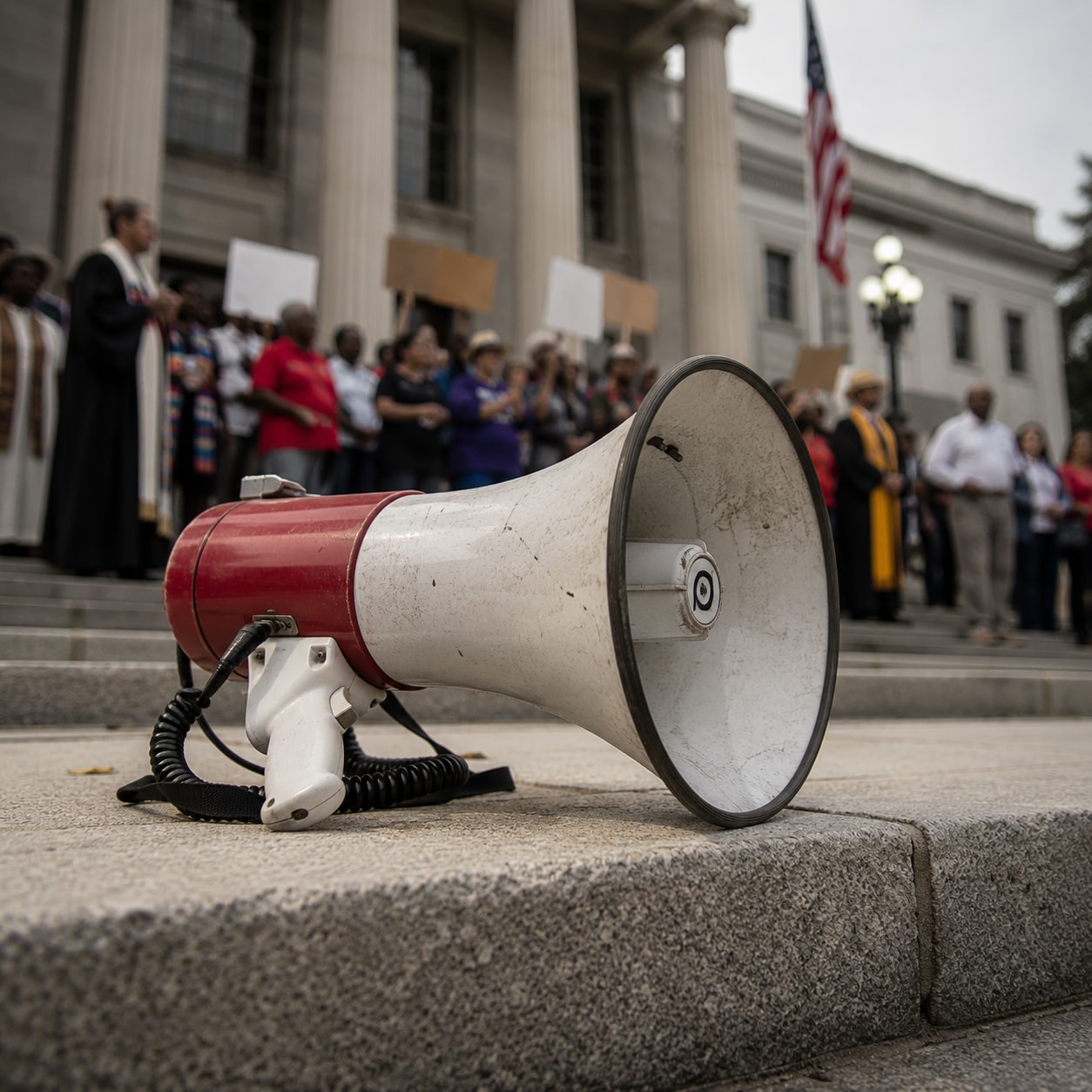
A sourced introduction to the February 8 march, its relationship to Moral Monday, the Forward Together coalition, and the limits surrounding its reported attendance and historical scale.
What happened in Raleigh on February 8, 2014?
The Mass Moral March on Raleigh took place on February 8, 2014. The available source presents it as part of the continuing organizing associated with the Forward Together Moral Movement, commonly linked with Moral Monday.
According to that source, approximately 80,000 people participated. This figure requires careful attribution: the source is relaying an estimate from USA Today, while the original USA Today report is not included in the research package. The number should therefore be understood as a secondhand reported estimate, not an independently verified count established by the available evidence.
Even with that limitation, the account places the march within a broad public mobilization that brought several justice concerns into a shared movement. Understanding the event consequently requires looking beyond a single day and considering the organizing that began during the previous year.
How the march grew from the Moral Monday protests
The available source traces the march’s immediate context to the Moral Monday protests, which began in 2013. It reports that tens of thousands of people participated in those protests and that more than 1,000 people were arrested during acts of civil disobedience.
In this account, the 2014 Raleigh march was not an isolated gathering. It represented a continuation of sustained organizing under the broader Forward Together Moral Movement. The connection helps explain why the march encompassed numerous public issues instead of advancing only one demand.
For congregations and community groups studying the event, this relationship offers a useful discussion framework: a large public march can be viewed as one moment within a longer sequence of participation, civil disobedience, coalition building, and public action. The supplied evidence establishes this general relationship, although it does not provide a detailed timeline of individual Moral Monday events or explain every step leading to the February 2014 mobilization.
The Forward Together coalition behind the mobilization
The source describes the Forward Together Moral Movement as a coalition of more than 200 progressive organizations led by William J. Barber II. It also identifies this broader alliance with the organizing commonly called Moral Monday.
That coalition structure is central to the source’s account of the mobilization. Rather than describing the march as the project of a single organization or constituency, it places the event within an alliance spanning many groups and public concerns. The reported number of participating organizations indicates the breadth claimed for the coalition, but the research package does not include a membership list or further details about the roles of particular organizations.
The evidence therefore supports a limited conclusion: the source attributes the march to a large, multi-organization movement under Barber’s leadership. It does not establish how decisions were made inside the coalition, how responsibilities were distributed, or how every member participated.
How one movement connected multiple justice issues
The available account links the movement to voting rights, public education, Medicaid, environmental concerns, and the rights of women, workers, immigrants, and LGBTQ communities. These concerns appear together in the source’s description of a cross-issue movement rather than as unrelated campaigns.
This framing can help community groups examine how public policies may affect overlapping constituencies. Voting rights concern participation in government; public education and Medicaid concern access to major public systems; environmental questions concern shared conditions; and the listed rights issues concern the treatment and standing of several communities. The source supports identifying these concerns as parts of the same movement, but it does not provide enough detail to specify the coalition’s policy proposals or describe how it prioritized each issue.
A congregation, classroom, or community group could use this cross-issue framework as a discussion prompt: Which concerns were joined in the movement’s public identity, and what does their inclusion reveal about the breadth of the coalition? Any deeper conclusions should be tested against additional records, since the available research contains only one qualifying source.
Interpreting the march’s reported historical scale
The source characterizes the Raleigh event as the largest march in the American South since the 1965 Selma campaign. That description should be treated as an attributed claim, not as an independently verified historical ranking.
The same caution applies to the reported attendance of approximately 80,000. The source attributes that estimate to USA Today, but the original report is not part of the supplied evidence. No additional source is available here to confirm the counting method, compare alternative estimates, or define the geographic and event categories used in the historical comparison.
The claim remains relevant because it shows how the source presents the march’s significance. Responsible interpretation, however, requires preserving its attribution and limitations. The evidence supports saying that the event was described in these terms; it does not support presenting the ranking or attendance estimate as conclusively established facts.
What the available evidence can—and cannot—establish
The research package supports a concise account: a Mass Moral March took place in Raleigh on February 8, 2014; the source connects it to Moral Monday and the Forward Together Moral Movement; it describes a coalition of more than 200 progressive organizations led by William J. Barber II; and it associates the movement with multiple justice issues.
Important limits remain. Only one source passed the source gate, so none of these statements can be checked against a second qualifying source within the supplied material. The page has no publication date, making its timeliness difficult to assess. The approximately 80,000-person estimate is a secondhand reference to USA Today, whose original reporting is absent. The historical comparison with the 1965 Selma campaign also lacks independent corroboration here.
Readers can use the movement’s cross-issue framework to guide reflection or community discussion, while retaining these source notes and avoiding stronger conclusions than the evidence permits.
Disclosures and limitations
– This article was prepared with AI assistance from the supplied Content Plan and Research Package. – All material claims rely on one qualifying source, source-5ee8b594005cda029bb21118; cross-source verification was not possible, and the source page’s publication date was unavailable. – The attendance estimate is a secondhand reference to USA Today, whose original report was not provided. The claim comparing the march’s scale with the 1965 Selma campaign was also not independently verified. – This article contains no product recommendations or affiliate links.
Sources
– Institute for New Economic Thinking — Institute for New Economic Thinking