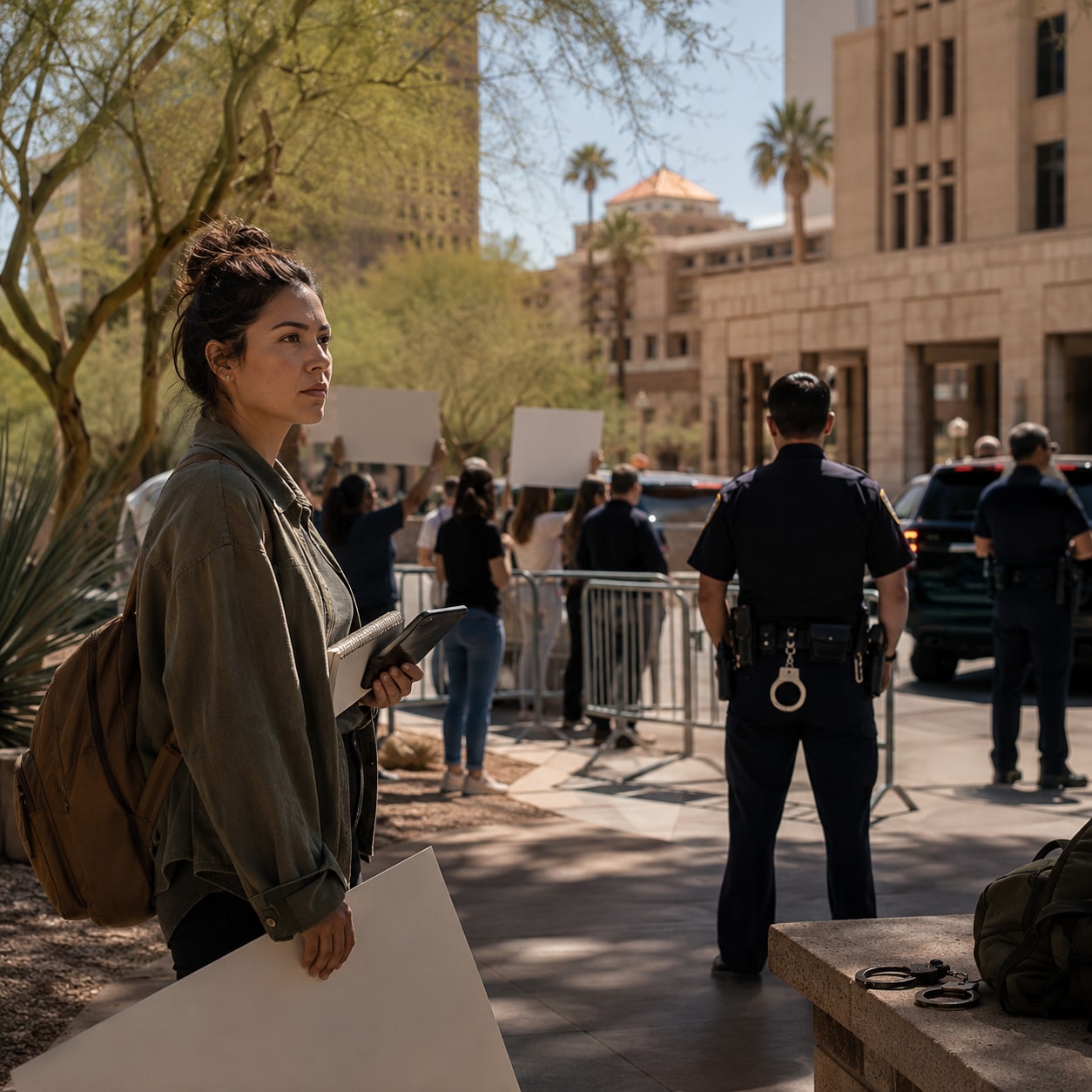
The available sources offer only a partial picture. A careful reading separates documented events from legal allegations, competing accounts, interim rulings, and questions the record cannot answer.
Why protest and arrest in Arizona require careful reflection
Protest brings questions of public expression, government power, community safety, and human dignity into the same space. Yet reflection must begin with the limits of the evidence. The supplied material does not document a current Arizona trend or provide a complete record of a recent Arizona protest-arrest case.
Instead, it offers two narrow forms of Arizona-specific information: a historical timeline stating that protesters were taken from a 2015 political event in Phoenix, and a criminal-defense law firm’s general account of conduct that it says may lead to resisting-arrest allegations. Neither source establishes what happened in a current case, and neither supplies the primary legal authorities or full case records needed to evaluate an individual’s rights, liability, or outcome.
The responsible approach is therefore to ask what each source establishes, what it merely asserts, and what remains unknown.
What is documented about the 2015 Phoenix protest
A historical protest timeline records a limited event on July 12, 2015. According to that secondary compilation, protesters displayed a large banner during a Trump speech in Phoenix, Arizona, and were subsequently taken from the venue.
That is the extent of the supplied record. It does not say whether the protesters were formally arrested. It does not identify an arresting agency, legal basis, criminal charge, court proceeding, or final case outcome. Being taken from a venue may be significant, but the source does not support treating removal and arrest as interchangeable.
This gap matters because a brief timeline entry can preserve the visible moment of a protest while leaving the legal process undocumented. Any account that described these protesters as charged, convicted, or otherwise subject to a particular legal disposition would go beyond the available evidence. The event can be cited as part of Phoenix protest history, but not as a complete Arizona protest-arrest case study.
What one Arizona law firm says about resisting-arrest allegations
An Arizona criminal-defense law firm describes resisting arrest as intentionally preventing or attempting to prevent an arrest while knowing that the person making it is a police officer performing official duties. The firm says that circumstances may be treated as either a misdemeanor or a felony.
The firm also presents the potential scope of an allegation as broader than overt violence. Its account includes threats or physical force, but it also says that walking away or interfering with the placement of handcuffs may be characterized as resistance. This helps explain why people seeking protest-related information may worry that nonviolent conduct could still be interpreted by law enforcement as resisting arrest.
These statements require careful attribution. The source is legal-services marketing from a defense firm, not a statute, government guide, or judicial opinion supplied for independent verification. The package also gives no publication date for the page. Its descriptions should therefore be understood as that firm’s general account of Arizona law and enforcement practice, not as a definitive statement about how a court would evaluate any particular incident.
A protester’s conduct, an officer’s interpretation, the allegations eventually filed, and a court’s conclusions are separate matters. This source alone cannot resolve those distinctions or provide situation-specific legal advice.
Why removal, arrest, charges, and case outcomes must be separated
Reports about protest encounters often compress several stages into one word or headline. A more accurate reading separates at least four questions: Was someone removed from a place? Were they formally arrested or detained? Were allegations or charges brought? What did a court or other responsible authority ultimately decide?
The Phoenix timeline illustrates why this separation is necessary. It records that protesters were taken from a political speech, but supplies no basis for concluding that they were arrested, charged, or convicted. Those missing details cannot be filled in through inference.
The law firm’s page occupies a different evidentiary category. It describes conduct that the firm says may generate a resisting-arrest allegation, including physical behavior and certain nonviolent actions. But a general description of possible allegations is not proof that a specific person committed an offense, that prosecutors filed a charge, or that a judge or jury reached a final finding.
Careful language preserves both accuracy and dignity. “Removed,” “arrested,” “accused,” “charged,” and “found liable or guilty” describe different events. Using the terms precisely avoids converting an incomplete account or an official allegation into an unsupported conclusion.
A national comparison: competing accounts in the Mahmoud Khalil case
A separate case offers national context, but it did not occur in Arizona. The Verge reported that Immigration and Customs Enforcement arrested Mahmoud Khalil, a permanent resident who had participated in pro-Palestinian protests at Columbia University, on March 8, 2025.
The report presented competing accounts. The Department of Homeland Security offered a national-security rationale, while Khalil’s attorneys objected that the government’s action involved retaliation for speech and raised due-process concerns. These are attributed positions, not a single agreed account of the legal and factual issues.
The report also described a distinct judicial development: a federal judge temporarily prohibited the Department of Homeland Security from deporting Khalil while the matter underwent judicial review. An interim restriction preserves a position while a court considers a dispute; it should not be described as a final resolution of every underlying claim.
This case should not be used to infer Arizona law or the circumstances of the 2015 Phoenix event. Its narrower comparative value is methodological: a documented arrest, a government explanation, attorneys’ objections, and an interim court order are different kinds of information. A responsible account identifies the source and status of each rather than merging them into one conclusion.
A source-checking framework for protest-arrest reports
Readers can evaluate protest-arrest reporting by sorting information into clear categories.
1. Confirmed event: Identify the narrow event the source actually records, including the date and place. The Phoenix timeline supports saying that protesters displayed a large banner and were taken from a 2015 speech. It does not provide a complete legal history.
2. Official claim: Attribute a government agency’s explanation to that agency. In the Khalil report, the national-security rationale belongs to the Department of Homeland Security’s account; attribution does not establish that all parties or a court accepted it.
3. Attorney or advocate claim: Treat a lawyer’s argument as a position advanced for a client or audience. Khalil’s attorneys raised speech-retaliation and due-process objections. The Arizona defense firm also gives its own general description of resisting-arrest allegations.
4. Judicial action: Determine whether an order is interim or final. The reported temporary prohibition on Khalil’s deportation during judicial review was a procedural development, not evidence of a final determination on every disputed issue.
5. Unresolved question: List what the source does not supply. For the Phoenix event, those gaps include whether a formal arrest occurred, what legal authority was invoked, whether charges followed, and how any case ended.
6. Source incentive and authority: A secondary historical compilation, a news report, and a law firm’s marketing page serve different purposes. None should be silently elevated into a primary statute, complete court record, or official Arizona legal guide.
This framework helps communities resist two errors at once: dismissing documented state action and overstating what incomplete evidence proves.
Questions for communities reflecting on protest and state power
Communities preparing for or reflecting on protest can begin with questions that preserve dignity without pretending the evidence is complete:
– Which parts of an account are directly documented, and which are claims made by officials, attorneys, or other interested parties? – Are we describing removal, arrest, charges, and a final outcome as separate events? – What information is missing about the authority used, the process followed, and the result? – How can a community support affected people without presenting an allegation as an established finding? – What plans can organizers make for communication, accompaniment, and nonviolent community support when events are uncertain? – Where should participants obtain current, situation-specific legal guidance before acting?
The Phoenix record demonstrates how little a historical summary may reveal beyond a visible confrontation. The Khalil report demonstrates how quickly an arrest can generate opposing explanations and interim judicial action. Together, they invite disciplined attention to both power and uncertainty.
Before participating in or supporting a protest, communities should distinguish verified facts from allegations, consult current official Arizona legal materials or a qualified attorney for situation-specific guidance, and prepare a support plan grounded in dignity and nonviolence.
Limits of this research and where readers should seek further guidance
This research package is not legal advice. It does not include the text of Arizona statutes, court precedents, an official government guide, or a complete record of a specific Arizona case. The Arizona law firm’s undated material has a marketing purpose and was not cross-checked here against primary legal authority. The Phoenix timeline is a brief secondary compilation that does not establish whether a formal arrest or later legal proceeding occurred.
The Khalil case concerns New York-based events and federal immigration enforcement, so it cannot establish Arizona law. It is included only to illustrate how government explanations, attorneys’ objections, and interim court actions should be distinguished.
Readers seeking actionable guidance should consult current official Arizona legal materials or a qualified attorney who can consider the specific facts. The supplied sources cannot determine any particular person’s rights, responsibilities, exposure to liability, or case outcome.
Disclosures and limitations
– This article was prepared with AI assistance and is based only on the supplied research package and its three identified sources. – The source set includes a secondary protest timeline, an Arizona criminal-defense law firm’s marketing-oriented page, and reporting by The Verge. Their claims and limitations are attributed in the article. – This article is general educational and reflective material, not legal advice. Readers should consult current official Arizona legal materials or a qualified attorney for situation-specific guidance. – No products are recommended, and no affiliate relationship is represented in this article.
Sources
– NY circus performer airlifted to hospital after female colleague’s arrow misses target and hits his neck — New York Post – Timeline of protests against Donald Trump – Wikipedia — en.wikipedia.org – I tried 16 posh supermarket crisps – I’m stocking up on M&S’s delicious £1.80 bag — The i Paper – The Zionists are Failing to Cover Up Their Lies, And a New Ukrainian War Crime — sonar21.com – Mexico to file criminal complaints over deaths in US custody — bbc.com – RethinkEd | LinkedIn — linkedin.com – 2019 Hong Kong Protests & Unrest | Hong Kong Free Press HKFP — Hong Kong Free Press HKFP – Resisting Arrest Defense | Phoenix AZ | Gaxiola & Litwak Law Group — Gaxiola & Litwak Law Group – The disappeared Columbia student is the start of a surveillance nightmare — The Verge – General Information — culteducation.com