A retrospective on the Boston Marathon bombing response highlights the value of advance planning, repeated training, cross-sector relationships, coordinated medical information, and sustained recovery support. It also offers a cautious framework for communities considering emerging responder technologies whose benefits remain unproven.
Why “the next responders” begins before an emergency
The idea that “we are the next responders” begins with preparation, not with predicting who will be closest when disaster strikes. In Atyia Martin’s first-person retrospective on the Boston Marathon bombing response, a central lesson is that a planned public event can rapidly become a disaster operation. Without established transition protocols, that shift can produce uncertainty about roles, authority, and the availability of personnel.
The account emphasizes defining responsibilities in advance, practicing them through recurring exercises, and building working relationships before an emergency. These measures give organizations a shared foundation when ordinary plans no longer fit the situation.
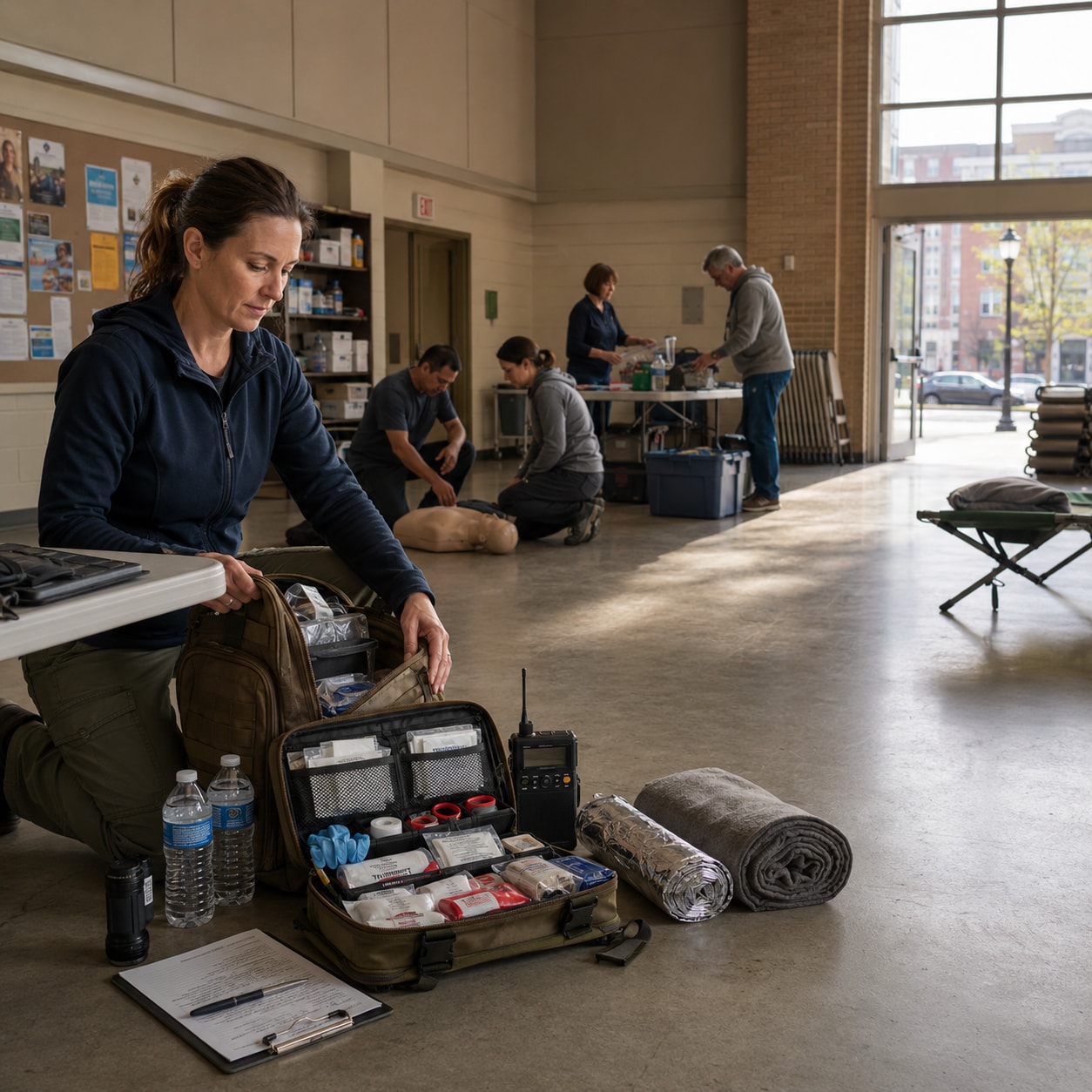
For community and faith organizations, the lesson is not to assume the duties of professional responders. It is to understand where community groups fit within local systems, how volunteers should be coordinated, and whom leaders should contact when conditions change. This is a retrospective explanation of one response account, not breaking news or evidence of a current trend.
How cross-sector coordination supported the response
Martin’s retrospective describes emergency preparedness as a networked responsibility. The relationships involved extended across public health agencies, emergency medical services, hospitals, police, transit agencies, emergency planners, and volunteer networks. Each part of that network brought different authority, information, personnel, and operational capabilities.
According to the account, recurring multi-agency exercises helped establish a foundation for the response. Repetition matters in this context because organizations need opportunities to clarify responsibilities and learn how their procedures connect. Exercises can expose uncertainty about who has authority, how information should move, and how a planned event will transition into disaster operations.
Established relationships were another part of that foundation. During an emergency, agencies may need to coordinate quickly across institutional boundaries. Familiarity developed beforehand can give participants a clearer understanding of their counterparts and the structures through which decisions and information move.
Volunteer networks are part of this coordination picture, but public willingness to help does not eliminate the need for structure. Martin’s account supports advance consideration of how volunteers connect with professional agencies and existing response plans. Community organizations can contribute most responsibly when their roles and points of contact are understood before a crisis.
The broader lesson is that preparedness is relational as well as procedural. Plans identify duties, exercises test how those duties interact, and established relationships help separate organizations work within a coordinated response.
What coordinated medical information can accomplish
Martin’s retrospective identifies Boston’s Medical Intelligence Center as part of the preparedness structure. The account says the center connected public health, EMS, hospital incident command, and emergency planners. It helped those participants coordinate information about patients, medical supplies, available hospital beds, and the broader situation.
These information categories address different operational questions. Patient information can support awareness of where injured people have been taken. Bed-availability information can help participants understand hospital capacity. Supply information can reveal needs or constraints, while situational reports can provide a shared view of changing conditions.
The significance is not merely that information exists. Relevant organizations must have established ways to exchange and interpret it under pressure. A coordinating structure can bring together information that would otherwise remain distributed across ambulance services, hospitals, public health agencies, and emergency planners.
This description should be read with appropriate limits. It comes from a first-person retrospective, not from an official incident report included in the supplied research. It therefore provides a perspective on how coordinated medical information supported the response, rather than an independently corroborated account of every system or outcome.
Patient tracking and family reunification under pressure
Mass-casualty care can separate patients from the information and possessions normally used to identify them. Martin’s account notes that patients may reach hospitals without identification or personal belongings. That makes patient tracking and family reunification more difficult and can add to the distress experienced by families seeking information.
Preparedness planning should therefore consider what happens after a patient leaves the immediate scene. Organizations need established processes for recording available information, coordinating across receiving facilities, and supporting reunification efforts when ordinary identification methods are unavailable.
Community and faith organizations should approach this need through coordination with qualified local agencies. The retrospective supports asking in advance which authorities manage patient and family information, where families should be directed, and how community volunteers can assist without disrupting formal tracking processes. The objective is not to create a separate system, but to understand and reinforce the authorized local process.
Recovery continues after the immediate emergency
Preparedness does not end when immediate medical operations conclude. Martin argues that planning must extend beyond initial clinical outcomes to the longer work of recovery. The needs identified in the retrospective include sustained survivor support, mental health care for responders, equitable access to assistance, and funding capable of supporting recovery over time.
This longer horizon changes how preparedness is understood. A response plan focused only on the first hours may leave organizations without a clear approach when survivors, families, and responders continue to need support. Recovery responsibilities and resources should be considered before attention and emergency capacity begin to recede.
Responder mental health belongs within that planning. People participating in an emergency response may need support after the immediate operation, so responder care should not be treated as separate from preparedness. Survivor support likewise may continue beyond urgent treatment.
Equitable access is another explicit concern in the retrospective. Recovery planning should examine whether assistance can be reached by everyone who needs it, rather than assuming that the existence of a resource guarantees access. Sustainable funding matters because extended support cannot depend solely on the intense attention that accompanies the initial emergency.
For community and faith organizations, this perspective points toward continuity: knowing how to connect people with assistance, considering how responder support will be sustained, and keeping equity visible as recovery unfolds. These activities should remain coordinated with qualified agencies and established community systems.
What current research may—and may not—add to responder support
A separate Boston University article addresses a different preparedness challenge: EMS clinicians may have difficulty retaining specialized procedures for emergencies they rarely encounter. The article describes pediatric calls as uncommon and highly stressful for EMS clinicians.
Researchers planned more than 500 simulated pediatric-emergency observations across Massachusetts and eight other states. The study examines whether physician support delivered by video call could help ambulance crews in these situations. It also considers the possible future use of artificial intelligence in prehospital care.
The limits are essential. The researchers explicitly say they do not yet know whether videoconferencing or AI assistance will benefit responders; establishing whether those approaches help is the research question. The simulations should not be presented as proof of effectiveness, and possible future AI assistance should not be described as an established emergency-care tool.
This research also does not concern the Boston Marathon bombings. It belongs in this discussion only as a contemporary example of how researchers are investigating support for uncommon, high-stress emergencies. The retrospective emphasizes planning, practice, relationships, and coordination, while the Boston University source examines whether particular remote-support approaches might add value. Emerging technology does not erase the need for the organizational foundations described in the retrospective, and the supplied evidence does not establish that the studied technology improves outcomes.
A preparedness checklist for community and faith organizations
Community and faith organizations can use the retrospective’s lessons to guide conversations with qualified local emergency authorities. The following are planning questions, not a substitute for agency protocols or professional emergency guidance:
– Roles and authority: If a public gathering becomes an emergency operation, who has decision-making authority? Which organizational roles continue, change, or stop? – Transition protocols: How will leaders recognize and communicate the shift from routine event management to emergency operations? – Agency relationships: Which public health, EMS, hospital, police, transit, and emergency-planning contacts should the organization know before an incident? – Exercises: Does the organization participate in recurring exercises with relevant agencies? What uncertainties about responsibilities or coordination have those exercises revealed? – Volunteer coordination: How will willing volunteers receive authorized assignments? Who determines where help is needed and how volunteers connect with professional responders? – Information pathways: How should the organization share situational information with local authorities? What information should remain within official medical or emergency systems? – Patient and family needs: Which local authorities oversee patient tracking and family reunification? Where should concerned families be directed when patients lack identification or possessions? – Responder well-being: What support pathways exist for the mental health needs of responders and volunteers after the immediate emergency? – Survivor support: How will the organization remain connected to longer-term survivor needs rather than focusing only on the initial response? – Equitable assistance: What barriers could prevent some people from reaching recovery assistance, and which qualified partners can address those barriers? – Sustained recovery: What relationships and funding structures could support recovery after the initial surge of attention ends?
The checklist’s central purpose is to make coordination concrete before a crisis. Organizations can review these questions with local emergency agencies, clarify where community capacity fits, and revise internal plans around the authorized local response structure.
Evidence limits and responsible interpretation
The evidence base supplied for this article is narrow. The principal source about the bombing response is a first-person retrospective rather than an official incident report or an independently corroborating account. Its descriptions support lessons about planning, exercises, relationships, medical-information coordination, patient tracking, and long-term recovery, but they should remain attributed to that perspective.
The Boston University source covers planned simulated research into remote physician video support and possible future AI assistance for pediatric emergencies. It does not address the Boston Marathon bombings, and the researchers have not established that either approach benefits responders.
Neither retained source supplied a publication date; both were observed on July 30, 2026. Readers should interpret the article as a sourced reflection on preparedness and unresolved research questions, not as a comprehensive reconstruction of the bombing response or a finding that emerging technologies are effective.
Disclosures and limitations
– This article was prepared with AI assistance from the supplied Content Plan and Research Package. – Material claims are limited to two supplied sources: Atyia Martin’s first-person retrospective on the Boston Marathon bombing response and a Boston University account of planned simulated pediatric-emergency research. The source identifiers attached to each section and FAQ show which material supports it. – The bombing-response source is not an official incident report or an independently corroborating source. The Boston University research does not concern the bombings, and benefits from videoconferencing or AI assistance have not been established. – Neither retained source supplied a publication date; both were observed on July 30, 2026. No product data or product recommendations were included, and no affiliate relationship was disclosed in the supplied materials.
Sources
– Talk:Boston Massacre/Archive 1 – Wikipedia — en.wikipedia.org – Bernard Fontaine, Jr., D.B.A., CIH, CSP, FAIHA – The Windsor Consulting Group, Inc. | LinkedIn — linkedin.com – Client Challenge — scribd.com – Friday Video Tsunami… It’s All About Israel, Iran and Trump — sonar21.com – Can Artificial Intelligence Help Emergency Responders Save Children? — Boston University – Leading Public Health Preparedness After the Boston Marathon Bombings – DrMartin.io — DrMartin.io – ‘Patriots Day’ Official Trailer (2016) | Mark Wahlberg – YouTube — youtube.com – Elevate Senior Living Marketing with Elderbloom Strategies — Elderbloom Strategies – Powertodecide.org Sitemap | Power to Decide — Power to Decide – Webinars – VA Homeless Programs — VA Homeless Programs