
Community vigil planning should begin with an organized list of questions, not assumptions about what a particular event requires. Broad planning resources can help structure research, but the available sources are not vigil-specific guidance. Organizers must adapt their questions to the local setting and verify applicable requirements with the venue and relevant US authorities.
Start with a structured set of planning questions
A useful starting point is to divide the planning conversation into clear topics. GOV.UK’s planning practice guidance includes categories concerning consultation and pre-decision matters, healthy and safe communities, noise, open space, and travel planning. These categories can serve as prompts for organizing research: Who should be consulted? What questions arise from the proposed setting? Which issues remain unresolved?
Treat this only as a way to structure inquiry. The cited guidance concerns planning policy in England; it is not a US community-vigil rulebook and does not establish requirements for any local event. Record questions and assign responsibility for finding authoritative answers rather than turning broad categories into unsupported instructions.

Adapt the process to local conditions and uncertainty
NOAA’s sea-level-rise application guide illustrates a general planning approach built around getting started, incorporating scenarios into community planning, considering regional and local circumstances, working with uncertainty, and finding resources for subsequent steps. That approach suggests a useful discipline for vigil planning: document what is known, identify what depends on the particular location, and keep uncertain matters visible until they can be checked.
The subject boundary matters. NOAA addresses coastal planning and the use of projection data, not community vigils. It also describes its material as broad guidance rather than regulatory or engineering direction. Its value here is therefore limited to the planning process: adapt questions to context, acknowledge uncertainty, and seek appropriate follow-up resources.
Separate useful planning prompts from requirements that need verification
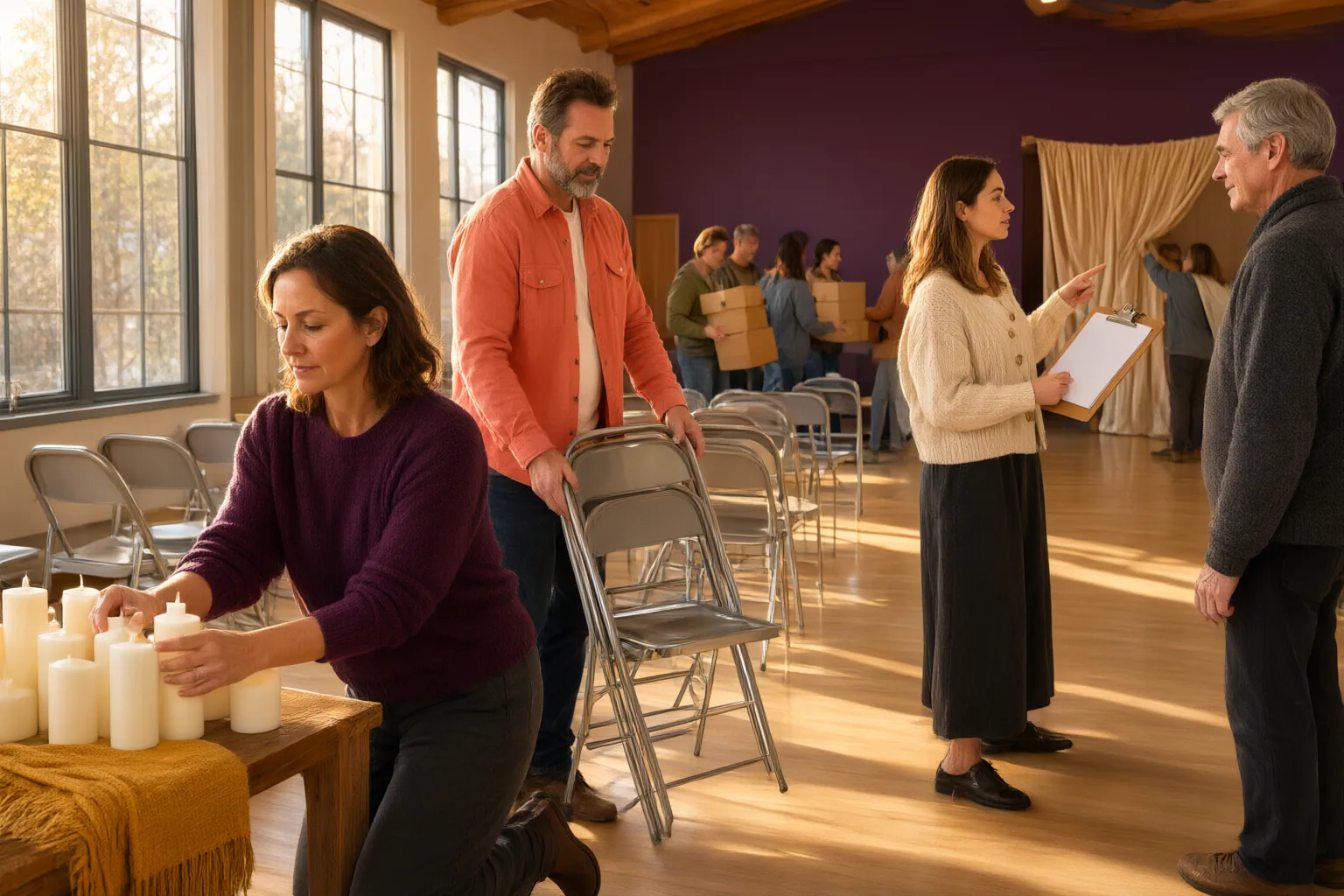
General sources can help organizers create prompts, but they cannot answer vigil-specific questions. A working document might group open questions under consultation, location, community well-being, noise, open space, travel, and local conditions. For each question, note the current information, the uncertainty, the person responsible for verification, and the authoritative source that will be consulted. This is an organizational framework, not a statement that every category creates a legal obligation.
The available evidence does not establish rules for permits, event safety, accessibility, religious observance, crisis response, or onsite operations. It also does not show that requirements are uniform across the United States. Organizers should therefore avoid presenting an inference from these broad resources as official direction. Questions in those areas need answers from the relevant locality, venue, and other appropriate authorities before plans are finalized or communicated publicly.
Conclusion
An evidence-bounded community vigil planning framework has four parts: organize questions by topic, adapt them to the proposed local setting, record uncertainty instead of concealing it, and identify authoritative resources for follow-up. Broad planning materials can support that process, but they cannot determine what a specific US vigil must do.
Create a written verification checklist now. Mark each unresolved question, identify who can answer it, and contact the venue and relevant local authorities before announcing or holding the vigil.
Disclosures and limitations
- This article was prepared with AI assistance from the two identified planning sources. Those sources provide general process context, not vigil-specific legal, safety, accessibility, religious-practice, crisis-response, or operational advice. No products are recommended or affiliate relationships asserted.
Related reading
- Spiritual Care for Courageous, Sustained Action
- Mass Moral March in Raleigh, 2014: What Happened and the Movement Behind It
Sources
- Planning practice guidance — GOV.UK
- Application Guide for the 2022 Sea Level Rise Technical Report Now Available — oceanservice.noaa.gov
- Building Community Support for Religious Projects — linkedin.com